A promise to make your business visible across AI platforms is too vague to buy responsibly. A proposal can contain a score, a busy content schedule and a projected commercial benefit while leaving you unable to tell what will actually be checked or who will fix inaccurate product information.
You don't need to dictate every technical or editorial move. You need to know what the provider controls, what evidence it can obtain and where its conclusions stop. That's how a promising proposal becomes work you can hold someone accountable for completing.
Tell the agency which decision matters
Start with the product range or customer decision you want the programme to address. Perhaps an important comparison route needs improving, a package description needs correcting or identifiable referral activity needs investigating. Each gives the work a concrete commercial purpose.
Explain your current information and operating constraints. A public website review won't reveal every stock exception, contribution assumption or approval responsibility. Contribution here means the money left after the costs included in your calculation; the agency needs the relevant basis rather than a guess.
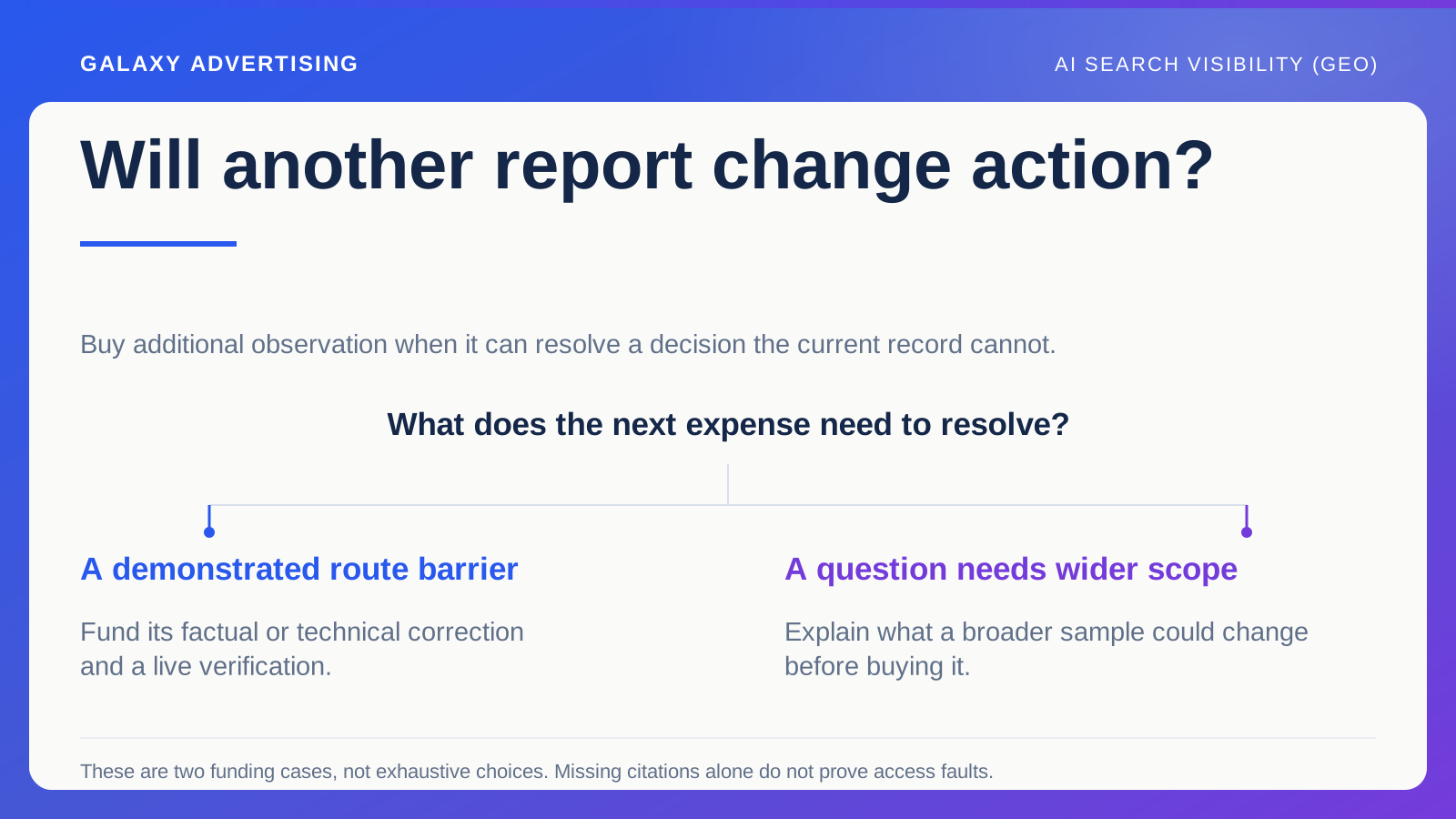
Simply requesting a bigger visibility score risks encouraging work on a measure whose relationship to your business is unclear. Ask how the proposed evidence could change a decision about information, implementation or investment. The answer should make the purpose easier to understand.
Get plain definitions before accepting the result
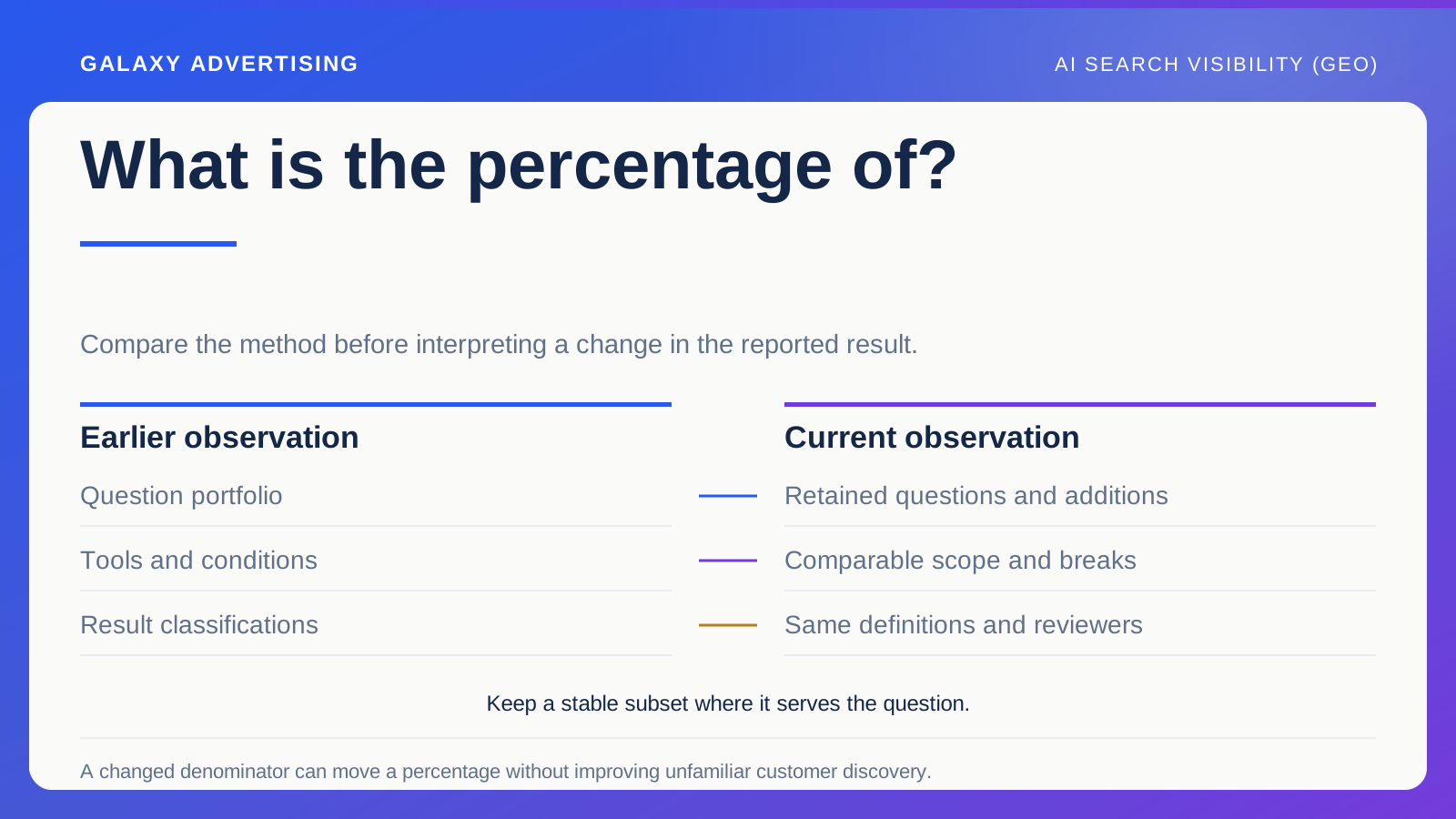
What counts as a mention, citation, recommendation or referral in this provider's method? Ask them to define each. These describe different things and shouldn't be treated interchangeably or folded into a percentage nobody can explain.
Which tools and experiences does the method cover? Observing a defined set of questions in selected systems doesn't establish your presence across every possible AI interaction. The scope of the observation needs to travel with the result.
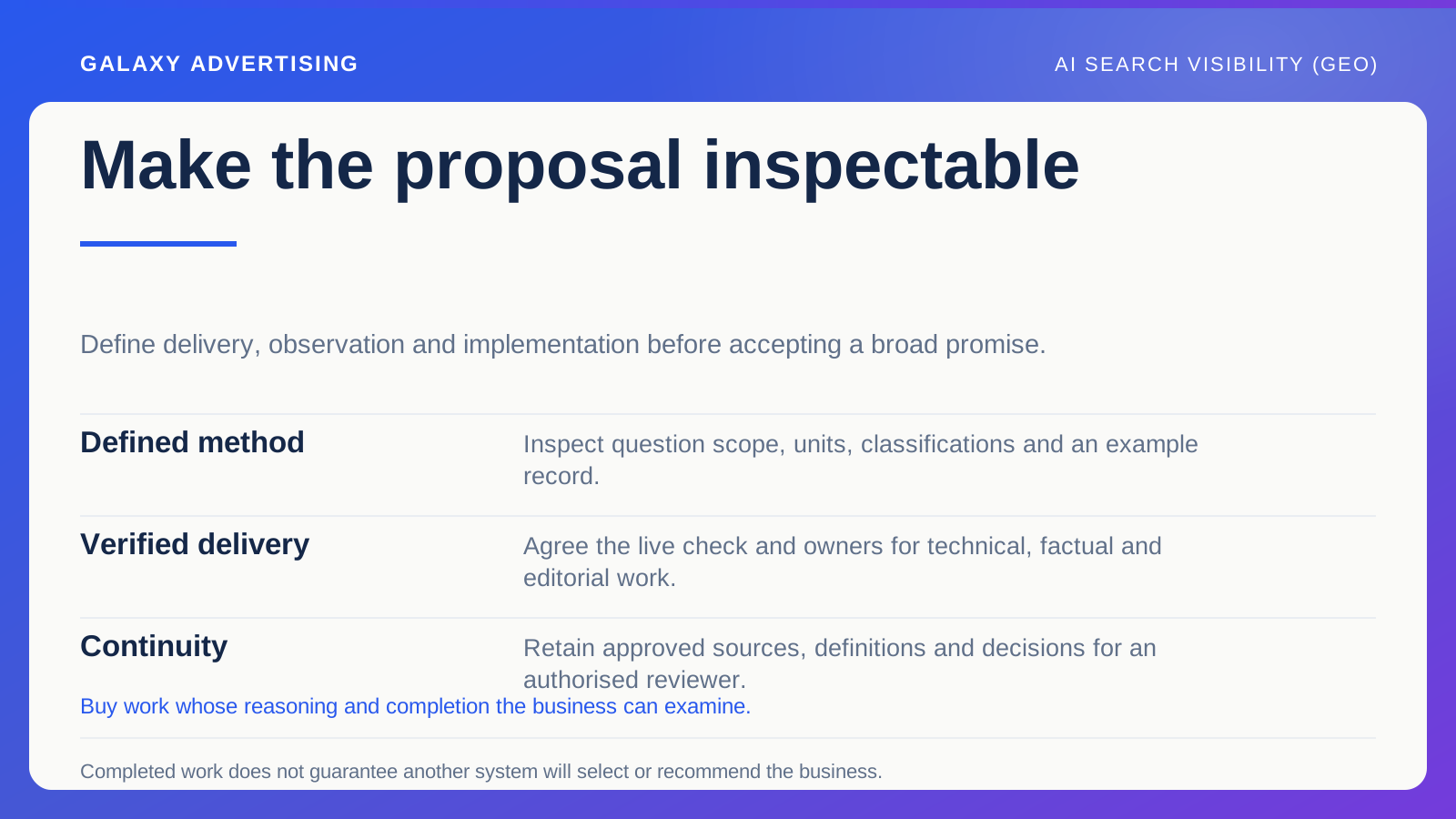
Request an example record that lets you inspect the classification. You don't need unrelated client information. You do need to understand the reasoning behind the provider's own report. Calling a score proprietary doesn't explain what the underlying observation means.
Separate the promised work from the hoped for outcome
An agency can commit to a technical review, verified content revisions, a maintained observation process or a clear report. Completing those tasks doesn't guarantee selection in another system's generated answer. Keep that boundary explicit in what you buy.
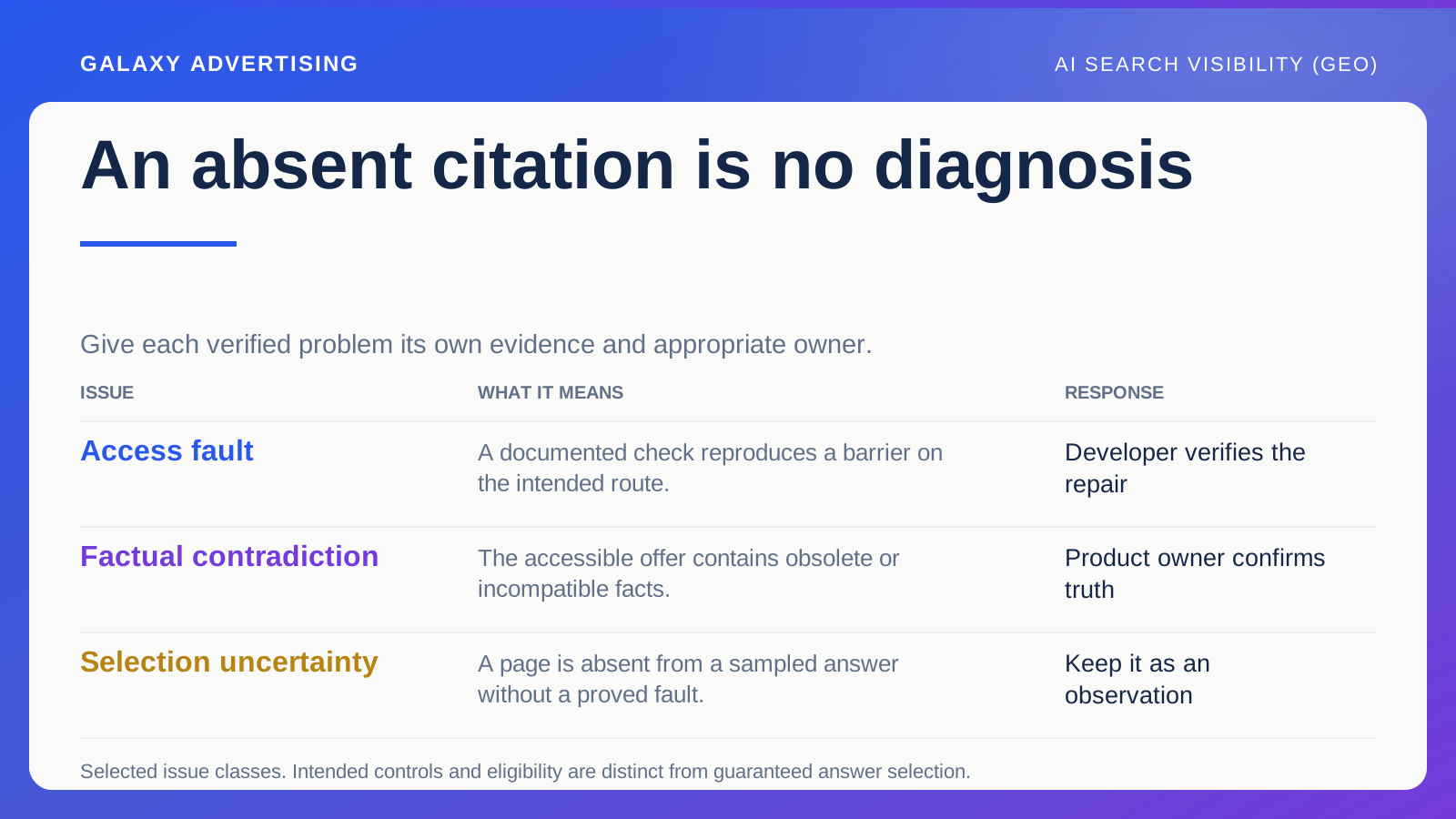
Ask how delivery will be checked. Recommendations aren't implemented changes. A published page isn't necessarily a page whose facts and customer route have been reviewed. Those distinctions affect whether the work has reached the useful stage you expected.
Reflect them in scope and price. If development, product verification or imagery needs separate work, establish the dependency before starting. Otherwise a sensible recommendation can sit unfinished while everyone assumes the missing stage belongs to someone else.
Name the person behind the product claim
Identify who in your business can verify dimensions, package contents and service arrangements. Give the agency reliable records and a way to resolve uncertainty. A product claim needs an accountable factual source, rather than the confidence of whoever writes it.
Don't commission expertise your business doesn't possess and expect polished prose to fill the gap. An article assembled from public summaries can still lack the product knowledge needed to answer a particular buying question responsibly.
Agree how material changes reach the content owner after publication. You don't want a second catalogue slowly disagreeing with your store. Accuracy needs a continuing operating process, beyond the final approval checkbox on the original draft.
Make system access serve a defined task
Ask which systems need to be inspected or changed, and why. Use supported permission processes and proportionate access. Informal credential sharing isn't a substitute for agreeing what the provider actually needs to do.
Be clear about your intended discovery policy. The agency should distinguish deliberate restrictions from accidental barriers and consult current official guidance before proposing changes to crawler controls, which govern automated access, or related settings.
Don't approve a sweeping instruction to remove every AI block without understanding its scope and consequences. Technical changes should reflect your explicit intention for public content, with the relevant controls and responsibilities understood by the appropriate owner.
Ask what you'll decide after reading the report
Require separate accounts of completed work, observed visibility, identifiable website response and remaining uncertainty. Combining them into one success story can hide the missing connections. You should be able to inspect how the recommendation follows from the evidence.
Include unchanged and unfavourable observations. Attractive examples can demonstrate individual answers; selecting only those examples doesn't establish a credible monitoring process. The method needs to survive less flattering findings too.
Ask for the next recommendation, its owner and its review condition. Repeatedly paying for an increasingly elegant description of the same unresolved information gap doesn't complete the useful work. A good relationship should make the next practical step clearer.
Arrange the handover while everything is calm
Agree where approved content, factual references, observation definitions and significant decisions will be retained. Useful work should remain maintainable when people or agency responsibilities change. Planning continuity isn't a prediction that the relationship will fail.
Clarify what the handover includes and which systems remain your property or account responsibility. Test one important conclusion with a new authorised reviewer: can they identify the question checked, captured observation, classification and resulting recommendation?
If everything depends on a score inside an interface with no retained explanation, continuity is weak. Apply the same test to content. Your business should know the factual source and approval owner behind a significant claim.
You don't need an elaborate archive of every interaction. You need enough commercial memory to maintain the work and challenge its reasoning when methods or people change. Put that practical standard into the handover scope instead of relying on a general promise to provide all relevant material.
The proposal worth buying is one you can question intelligently. Its method, limits and implementation ownership give you a basis for purchasing useful expertise without mistaking ambition for control over what every AI system will recommend.