 Google Ads
If you put the advertising report down now, could you explain what the business should do next?
You might know that click costs moved, revenue changed and the team completed several optimisations. The charts could be accurate. You're still left trying to work out whether the acquisition programme became more commercially useful.
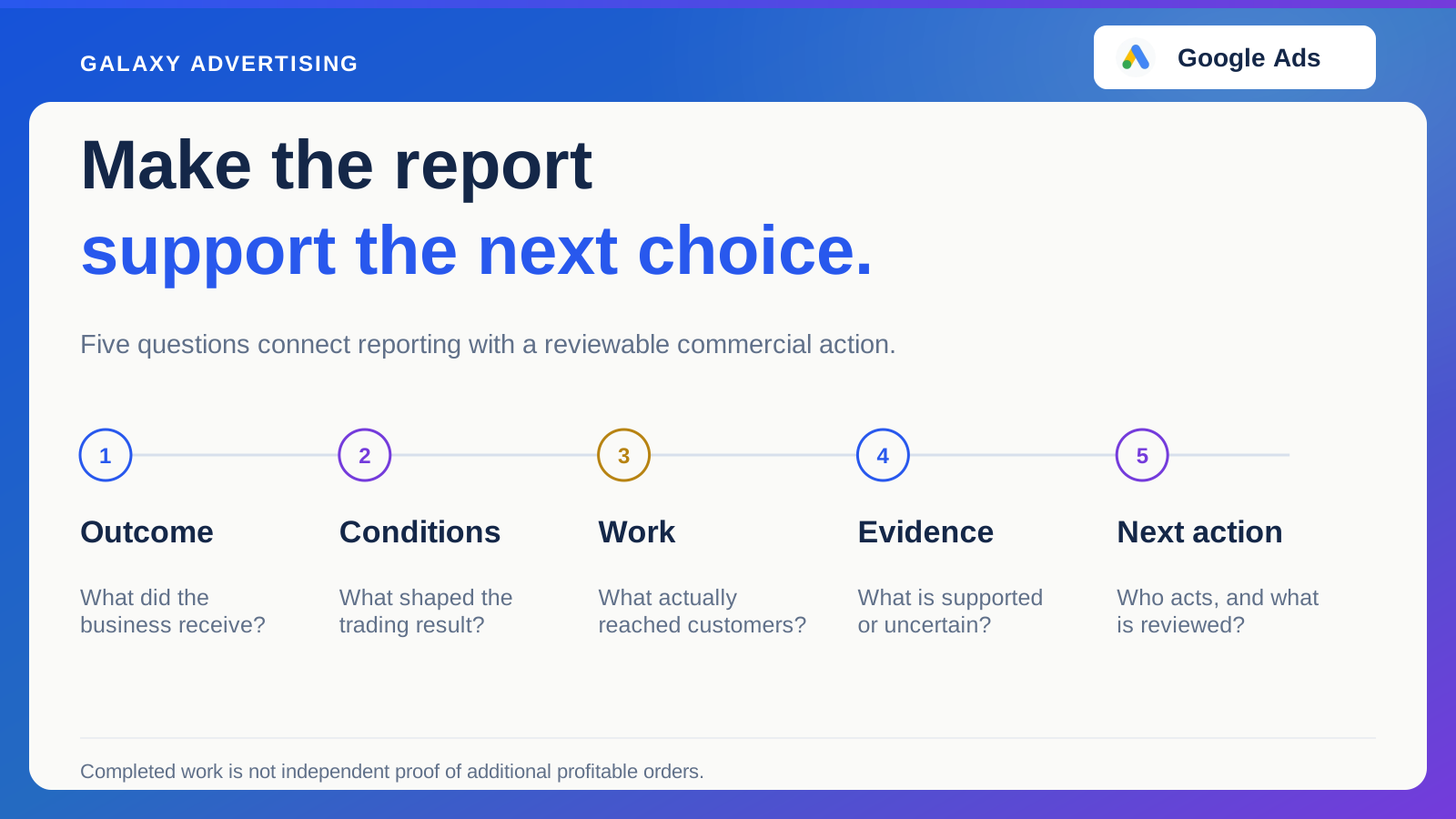
A management report needs questions in an order that supports judgement, with enough detail to justify the explanation and enough restraint to avoid making every metric a headline.
What did the business actually receive?
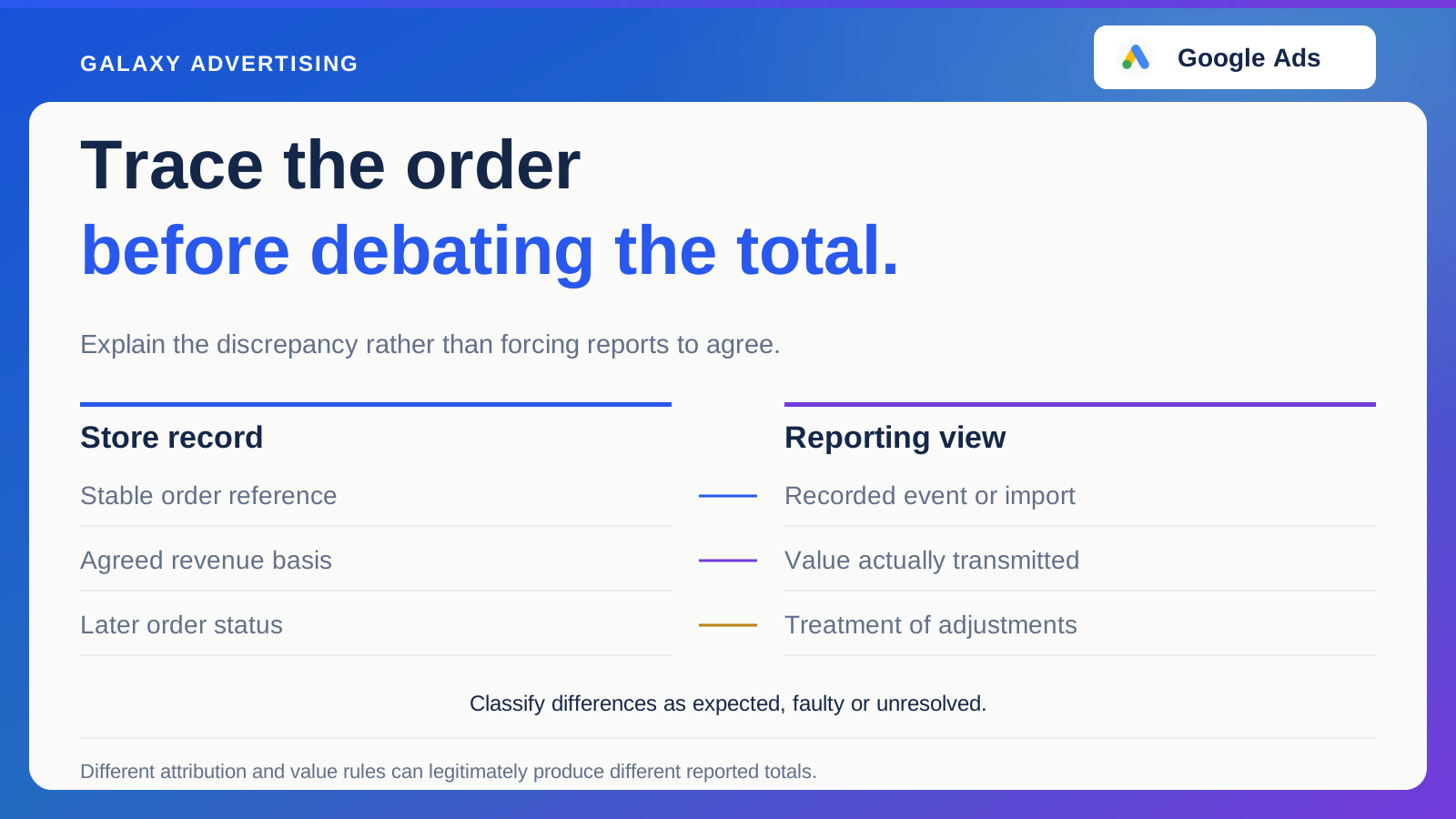
Start with consistently defined completed orders and the revenue basis used for review. Explain how advertising attribution, the rules assigning credit to interactions, relates to actual store records. A platform total shouldn't be presented as an unrestricted description of all sales.
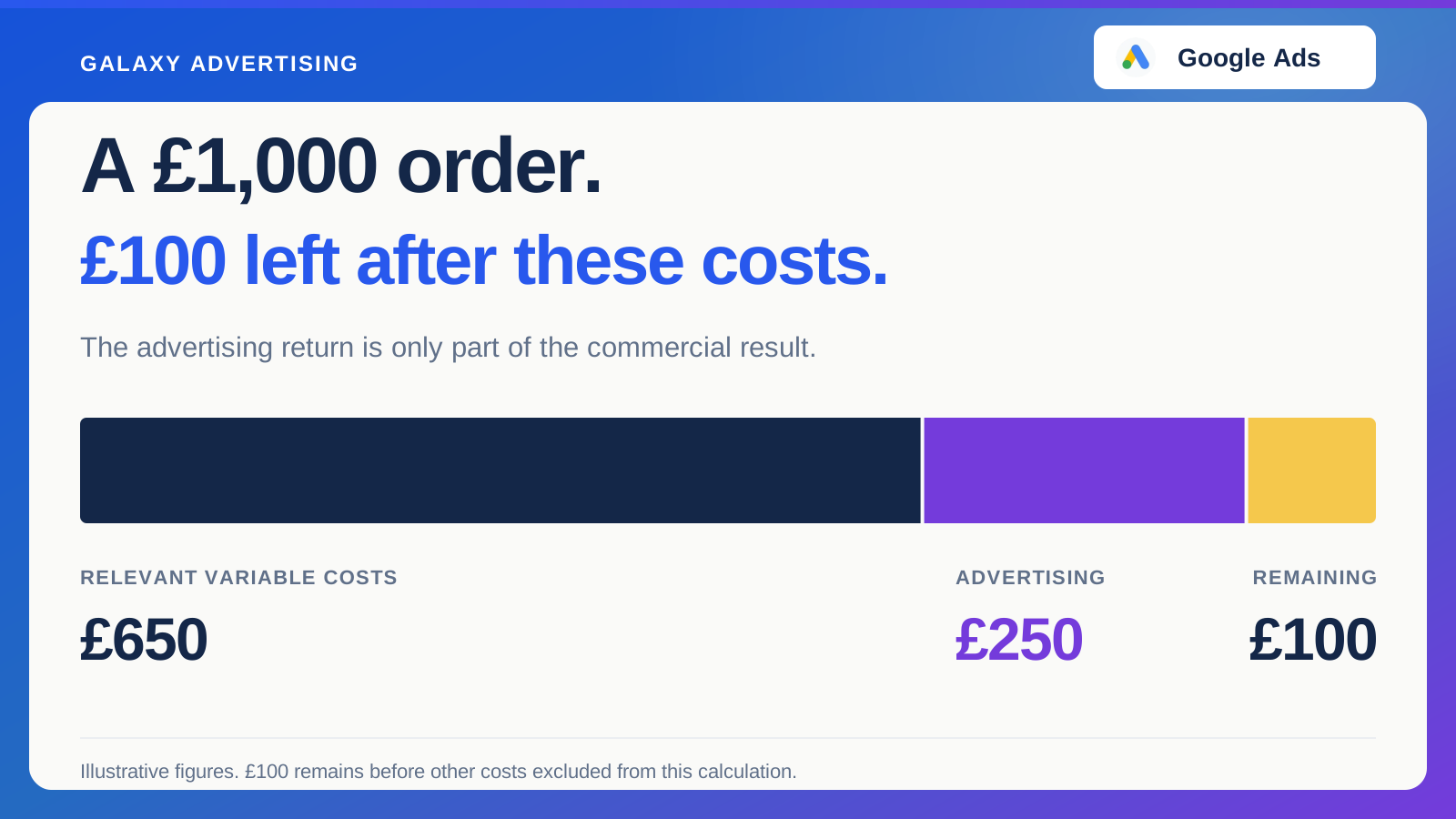
If you've agreed a relevant contribution calculation, show it beside revenue. Contribution is the money remaining after the costs included in that calculation. Higher turnover can come with a weaker product mix or more expensive fulfilment. The additional context helps you judge what the business can use, rather than just what passed through it.
Don't fill gaps with false precision. State when a cost is estimated or order data incomplete. A clear estimate can responsibly support a decision. A precise looking figure built on an unacknowledged assumption asks the reader to trust more than the evidence warrants.
What conditions shaped that result?
Describe material changes in investment, availability, pricing, promotions and fulfilment. Those can influence results independently of campaign management. Omitting them leaves you trying to explain the business through the account alone.
A strong furniture period with reliable stock shouldn't be casually compared with one missing useful configurations. An incentive can change both purchasing response and contribution. Include the conditions needed to make sense of the comparison.
Be selective. The report doesn't need every business event. It needs facts that could materially change the explanation. A favourable chart with its most important condition left out isn't a balanced account, however accurate the plotted figures are.
What work actually reached the customer?
Explain completed work through its purpose. Repaired product information, a revised goal configuration and a new creative argument are different interventions with different intended consequences. They shouldn't blur into a general claim that optimisation happened.
Separate delivery from observed business impact. Publishing an asset establishes that production happened. It doesn't independently establish additional profitable orders. You can recognise completed work without making it prove an effect the evidence hasn't shown.
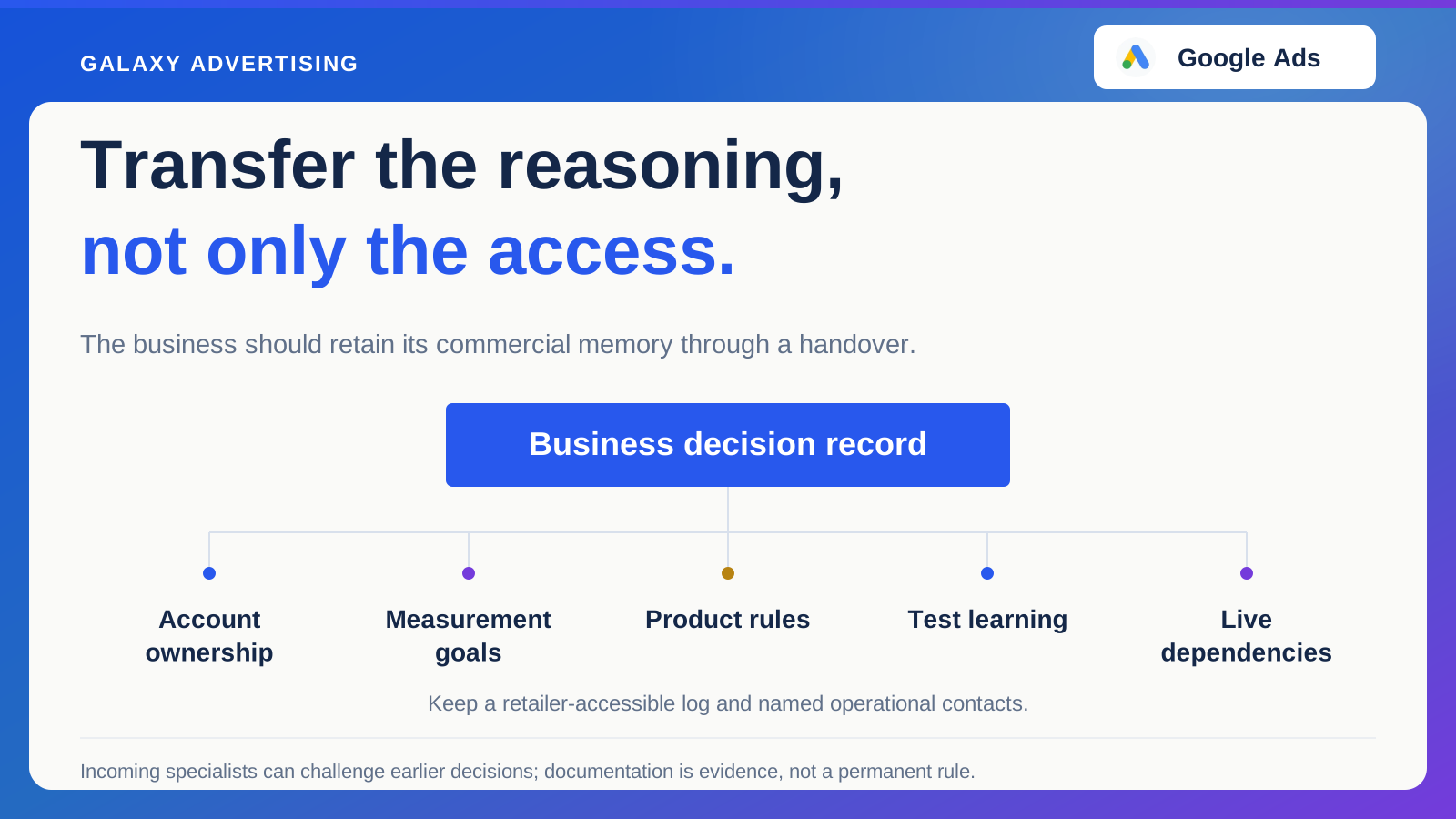
Include dependencies and verification. A recommendation isn't a completed optimisation if the product or website team hasn't implemented it. Report the live customer experience, rather than the agency's intention. This makes it clearer which work is finished and which still needs someone else to act.
How far does the evidence take us?
Give the main interpretation and reasonable alternatives. Could a small number of unusual orders be influencing the result? Does attribution prevent precise allocation of influence? Say so before the language becomes more certain than the records.
Use supporting metrics to investigate a question. A click cost change could help explain demand or delivery without delivering a verdict on the commercial programme. Every available number doesn't need a role in the main conclusion.
Some variation is normal. Some evidence is too limited to justify a conclusion. A senior review can distinguish those situations and still exercise judgement. Being careful isn't the same as refusing to recommend anything until every uncertainty disappears.
What decision follows from that evidence?
Give a specific recommendation, owner and review condition. You could correct a destination, change product emphasis, continue a bounded test or investigate a discrepancy. The business needs to know which of those you're proposing.
Explain why it follows. A generic task list doesn't become strategic because it's placed at the end of the report. Connect the action to what you've observed and what remains uncertain, so the reader can assess the reasoning.
Name decisions required from the retailer. Pricing, stock and service promises can sit outside advertising's control. Show the consequence of unresolved dependencies rather than repeatedly asking for more time while the same operating question remains unanswered.
Keep the detail available without making everyone read it
Use a concise management view with supporting records available for inspection. The summary should explain the decision. The detail should let somebody challenge the explanation. Neither is doing the other's job.
Keep definitions stable and identify changes. A new conversion basis or revised cost calculation can make earlier comparisons less straightforward. Make that visible rather than leaving the reader to interpret the movement as a trading change.
Length isn't a measure of quality. A short, defensible explanation can help more than a dashboard containing every dimension and no clear account of what changed or why it matters. The owner needs the decision before the accompanying data becomes a second job.
Turn one headline into something the reader can use
Take “conversion value increased”. Which definition of value? Which products drove it? Did offer, investment or availability change? What action follows if the interpretation is right?
You don't need every answer in one sentence. Put material context nearby, then rewrite the headline to connect the observed outcome with its practical consequence without overstating the evidence. Check that the detail supports it.
You could discover no immediate change is justified. Continuing a stable, suitable programme is a legitimate decision with an explicit rationale. A useful report doesn't need a dramatic intervention every time. It needs to explain why this next step makes sense and what observation would change that choice.
See whether the report supports a real choice
Before sending, ask whether the reader can identify the main commercial outcome, relevant conditions and next action. If not, revise the order and explanation.
Could an independent reviewer distinguish observed facts, estimates and proposed explanations? A favourable result shouldn't quietly raise the certainty of the language used to describe it.
Your report is a decision document with evidence behind it. Its value becomes visible in the conversation that follows: a better informed choice, a named person to act and work whose completion can be checked. The charts have done their job when they make that possible.