Your guide appears in several sampled AI answers, and sales rise during the same period. Then the report credits AI visibility with a team chosen percentage of the increase. The figure looks reassuringly precise, but nobody can show the connection underneath it.
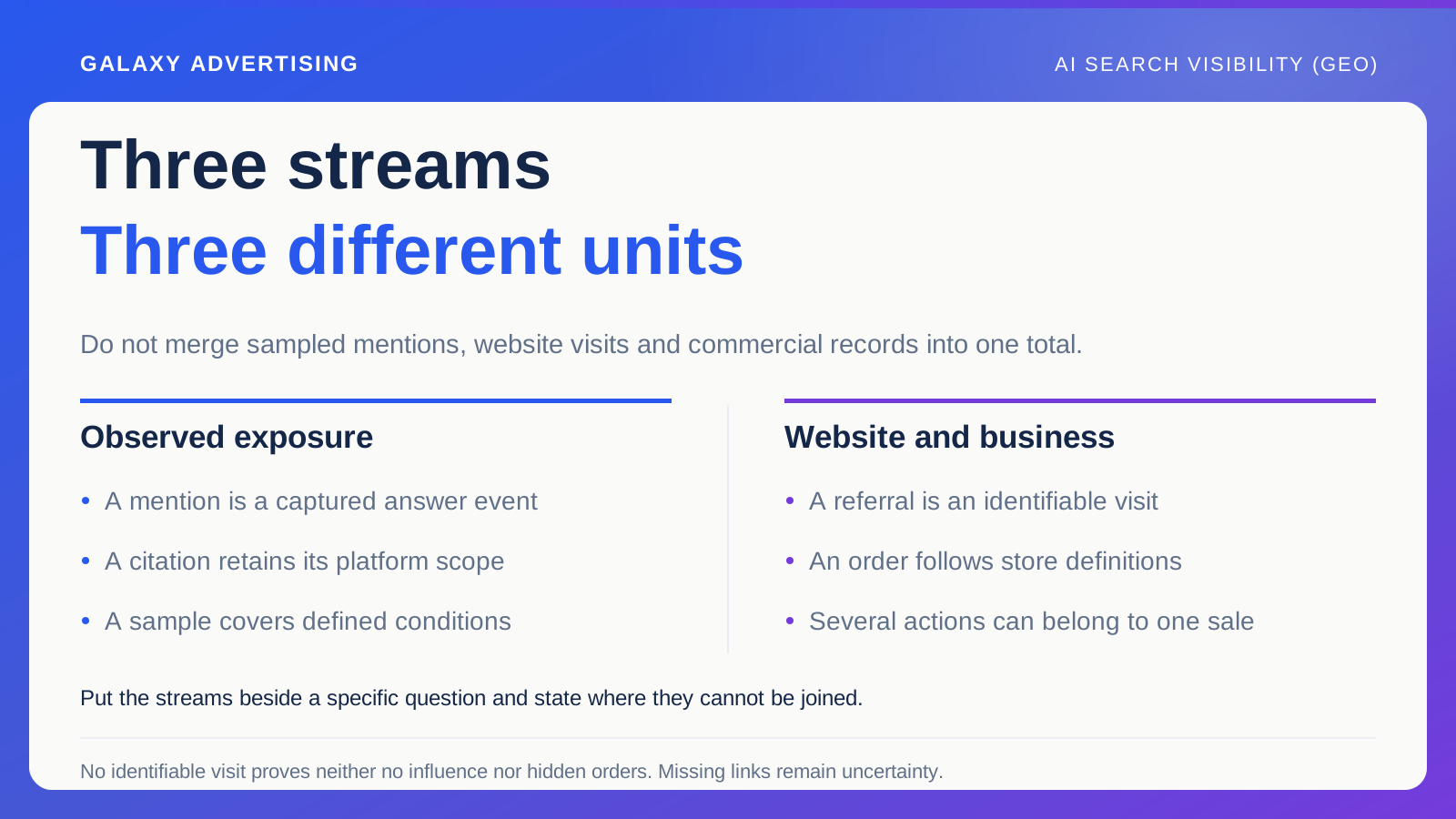
You don't need perfect measurement to make a sensible business decision. You do need to keep recorded referrals, observed transactions and possible influence apart. Uncertainty gives you a reason to qualify the claim, rather than a licence to put a value on an outcome you haven't connected.
Begin with the orders your shop actually recorded
Use your agreed definition of an order and your agreed revenue basis. Count each transaction once, treating cancellations, refunds and material changes consistently. This is the commercial record against which the other evidence needs to make sense.
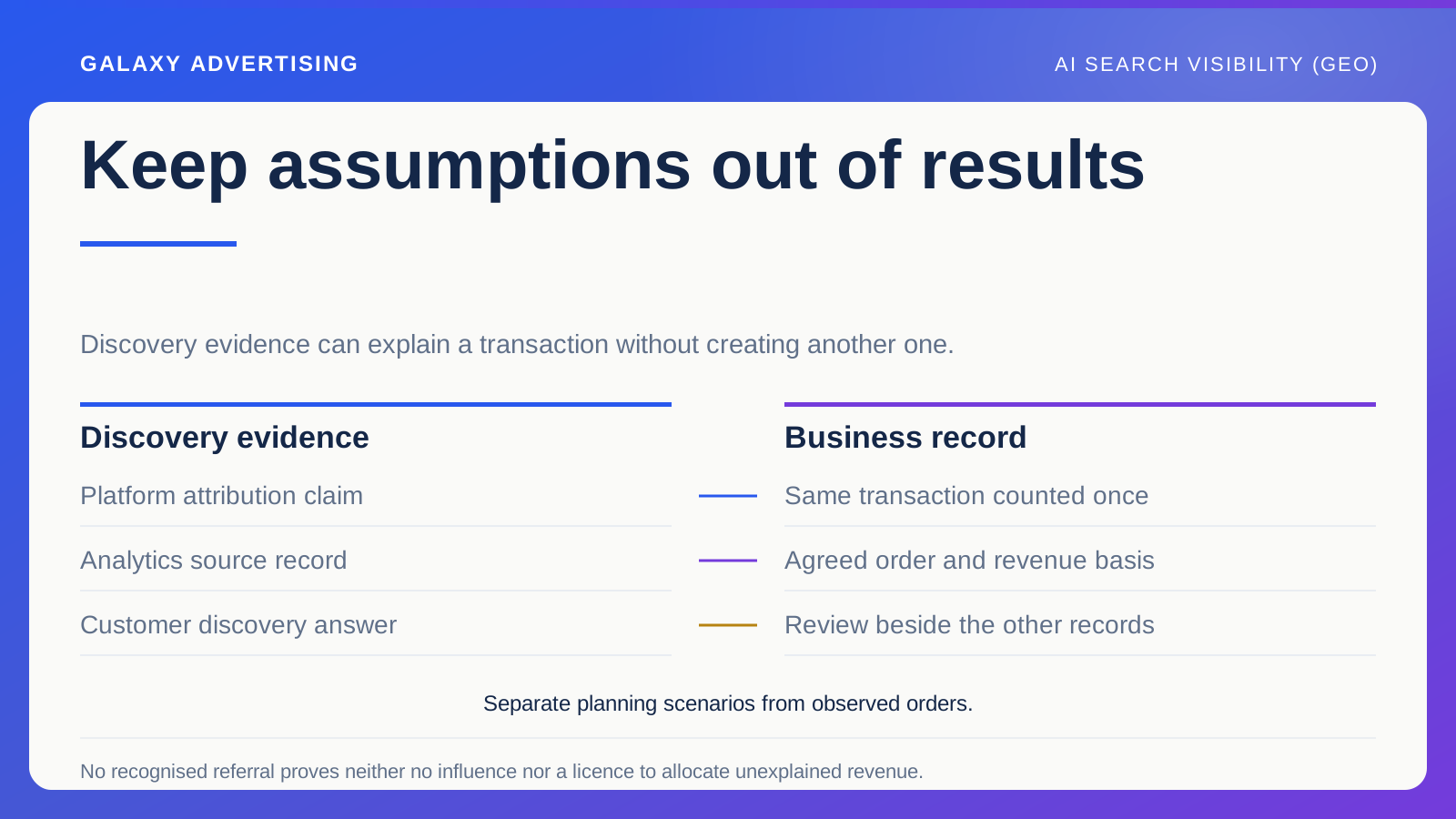
Keep it separate from the systems that associate themselves with the purchase. A platform claim, an analytics source and a customer's answer about discovery can describe different parts of the same order. They aren't automatically three different sales.
Reconciliation means making those relationships understandable, rather than adding every attribution claim into a bigger total. Your store's actual trade comes first. Discovery evidence helps explain it, but extra reports mentioning an order don't create extra transactions.
Ask what the referral record really shows
Sit down with whoever owns your analytics and inspect the source classification and destination. What does the record establish? What known limits affect how it was collected or how you can interpret it? Start there before attaching a commercial conclusion.
A recognised referral can show that an observed visit reached your website through a particular route. It doesn't show all the research before that visit, or prove that this source was the customer's only reason for ordering.
Keep your claim at the same level as the evidence. You can report attributed orders on a defined basis without declaring every one an additional sale that would otherwise never have happened. Attribution and additional demand are separate questions, however neatly a report places them together.
Leave the unknown part unknown
Someone could encounter your brand in an answer, then return another way. That is a reasonable explanation for why recognised referrals might miss some influence on a considered purchase. It is still a possibility rather than a measured outcome.
It doesn't justify allocating a convenient portion of direct or unattributed revenue to AI visibility. Without an appropriate method, that number is a management assumption. Label it as one instead of letting the calculation make it look observed.
Be equally careful in the other direction. No recognised referral doesn't prove no influence. Sometimes the honest conclusion is simply that your records cannot establish the connection. You don't have to choose between declaring zero value and imagining a large hidden return.
Ask customers without steering their answer
If you ask customers how they found you, agree how answers will be collected and classified. Keep the question neutral. Allow more than one route when that reflects what the person remembers, rather than squeezing a complicated journey into one convenient box.
Memory isn't a perfect transaction log. People can recall the latest interaction, confuse a tool with a search engine or give a broad description of their route. Useful evidence still needs to be read with those limits in mind.
Review answers alongside your other records. Don't force them to fill every empty analytics field. They can reveal patterns worth investigating, but their limitations should stay visible whenever a commercial conclusion rests on them.
Keep citations out of the revenue formula
A citation records the use of a page in an observed answer or within a defined platform reporting scope. Its relationship to visits and orders depends on the question and the role your content played. The same label doesn't guarantee the same buying significance.
A factual reference might answer a question without encouraging a shopping visit. A product comparison could support a different response. Giving each citation an identical assumed financial value makes a return calculation possible, but doesn't make that calculation defensible.
You can use scenarios for planning. Show the assumptions and keep them distinct from measured performance. A scenario helps you consider investment risk; it isn't proof that the revenue has already arrived.
Use the right method for the harder question
If your decision needs stronger evidence of additional demand, discuss a suitable analytical or experimental approach with qualified support. The design needs to fit your business's scale, systems and practical constraints. The question is worth asking properly.
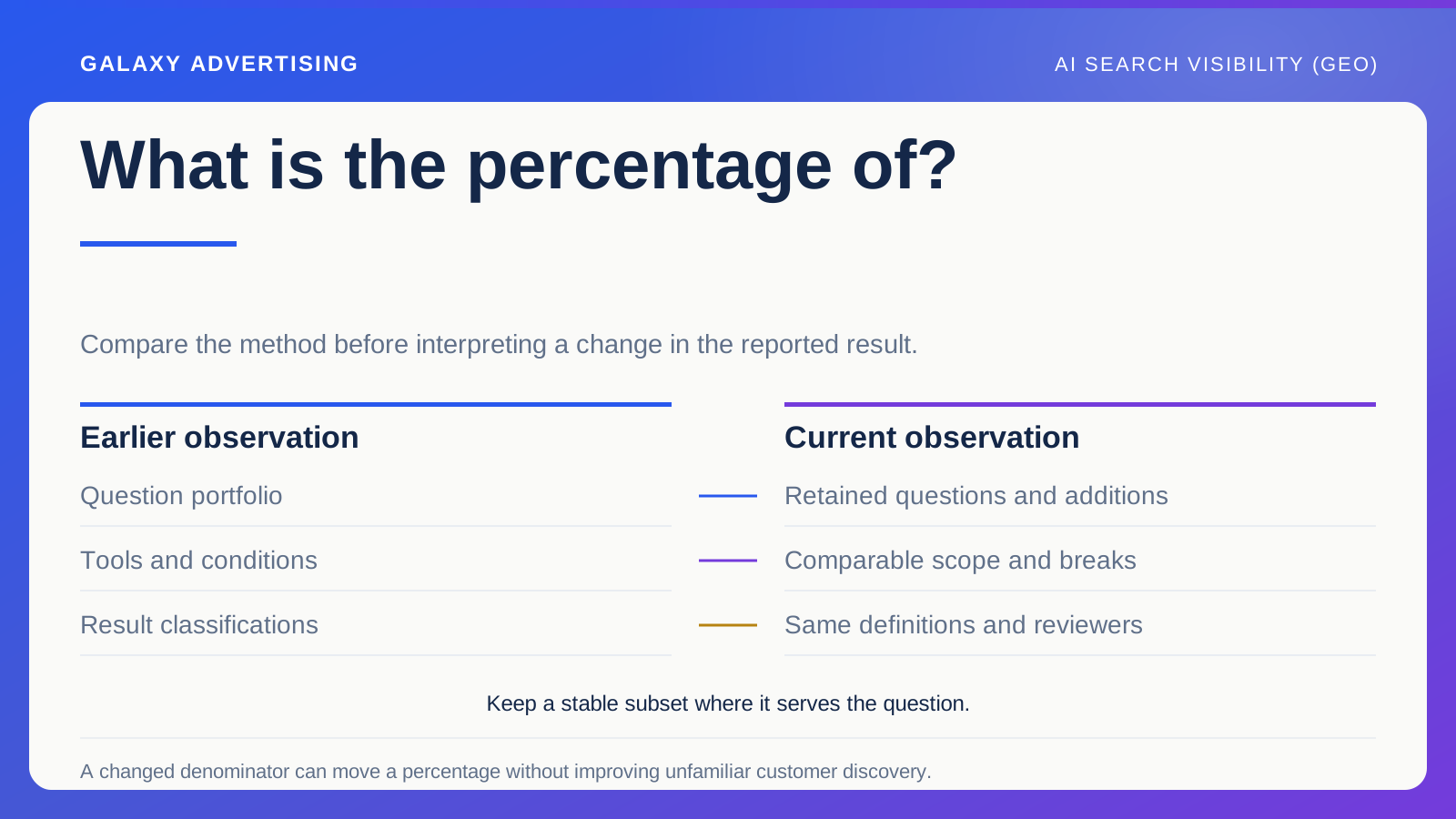
A simple before and after comparison can be affected by seasonality, stock, price and other promotion. Making the chart more attractive doesn't remove those explanations. They still matter when deciding what the observed change means.
Keep the conclusion within the design's reach. Evidence for one product group or period may inform that decision without establishing a lasting effect across your entire catalogue. Your confidence should follow the method, rather than the size of the proposal attached to it.
Match the commitment to the evidence
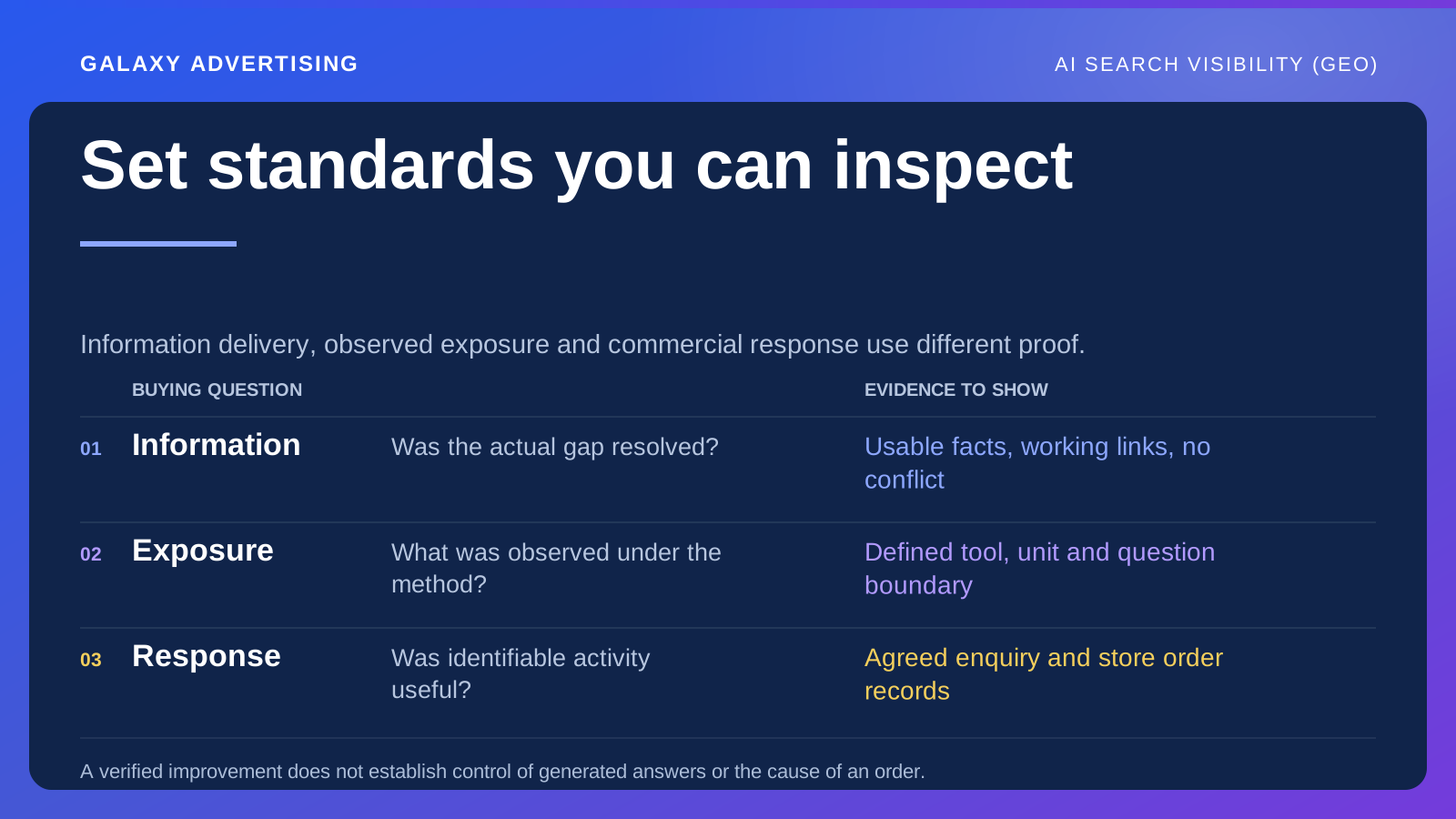
Use the quality of the observed route, actual orders and information improvements to decide whether a bounded continuation is worthwhile. You don't need perfect attribution for every sensible action. Uncertainty should still affect how much you commit and what that commitment is for.
Write down what further evidence would strengthen or weaken the recommendation. That gives the next review something useful to test, instead of another argument about whether the invisible influence must be larger than the records suggest.
Keep planning assumptions in a different field from observed results. A manager may model several possible levels of unrecorded influence to consider risk, provided the scenarios are clearly labelled and their purpose is understood. Don't let them drift into a performance report as measured orders.
That separation also leaves room to learn. Better records should be able to challenge an earlier assumption, rather than being made to agree with a figure already presented as fact.
Your programme can show useful work, identifiable response and honest limits without claiming unexplained sales. A retailer can make a firmer investment decision from that evidence than from a precise revenue number built mainly to make every citation look decisive.