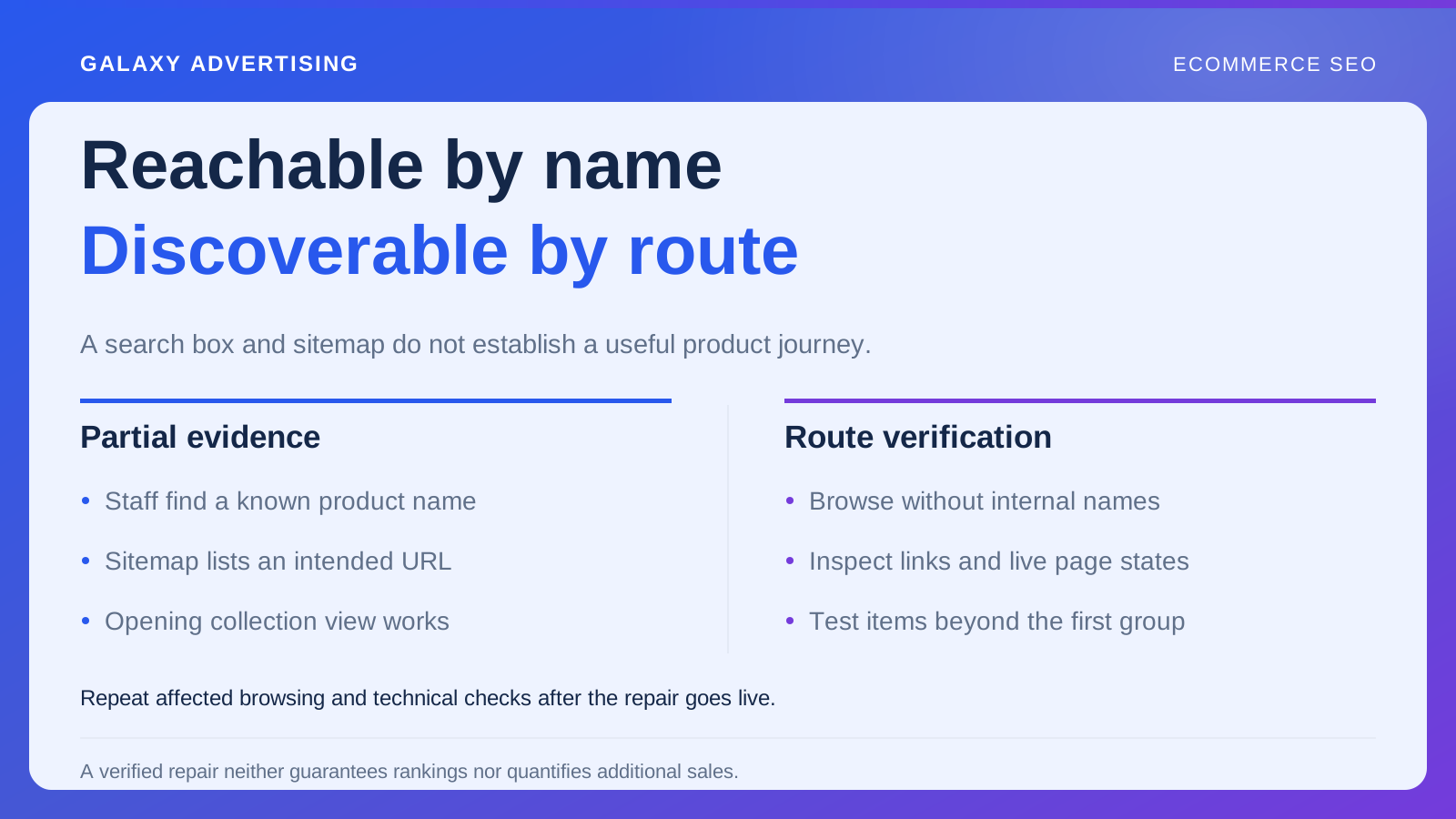
A search box doesn't mean your new range is properly connected to the site. Your team can find every product by name, yet an unfamiliar customer may have no useful route from the main navigation or relevant collections.
That's a discovery problem worth investigating, rather than an automatic request for more indexing. You need to understand how important pages can be reached, what their links communicate and what gets in the way. The audit should give people findings they can reproduce, across both the customer journey and the technical implementation.
Pick the destinations that matter to the business
Choose representative products and collections tied to your objective. Include different templates and relevant exceptions, rather than giving the homepage and best known product another inspection.
Record what each destination is for and whom it serves. An obscure discontinued item and a current range you want to promote call for different conversations.
Consider a hypothetical home office retailer with a new compact desk collection. The range might matter commercially while being poorly connected with the wider site. Establish that relationship first. Then you can judge whether another guide, a menu change or a technical correction addresses the actual problem.
Browse as if you don't know the product names
Start where an unfamiliar customer reasonably could and try to reach your chosen products. Record the links, their labels and any point where you have to know an internal name to continue.
Look at confusing category relationships as well as missing links. A product can be technically reachable while its placement gives no useful clue that it belongs there. Navigation should explain the range, rather than simply expose URLs.
Google's official eCommerce guidance notes that Googlebot generally doesn't submit searches through a search box as part of crawling. Internal search can help your customers, but don't assume it provides the same discovery route as useful linked navigation. Being findable by your team isn't the whole test.
Give the technical specialist something specific to inspect
Ask the specialist to verify how relevant links and content are supplied, and whether the intended pages can be accessed appropriately. The right investigation depends on your architecture and current official guidance.
One page missing from an observed search result doesn't identify a technical cause. Discovery, crawling, indexing and ranking are connected questions, but they aren't interchangeable. Preserve those distinctions when commissioning the work.
Record examples, the observed fault and the expected behaviour. A developer can act on a particular route far more easily than “Google can't see the site”. That precision also gives you a way to check the correction later, rather than trading one broad assurance for another.
Go beyond the first screen of the range
Where collections use pagination, incremental loading or filters, check how customers and discovery systems reach the relevant items. An attractive opening view tells you little about the route to the rest of the range.
Have the implementer compare the behaviour with appropriate primary documentation. Understand the system and the requirement before prescribing the technical answer.
Include a product beyond the first visible group in your sample. It can expose an assumption a review of the opening screen would miss. Keep the conclusion proportionate, though. This is a targeted challenge to the implementation; one example doesn't establish the condition of the entire catalogue.
Treat the sitemap as evidence, rather than a conclusion
Review whether the declared important URLs reflect the destinations you currently intend. A sitemap helps communicate relevant URLs. It doesn't replace a useful site structure or prove every listed page has been indexed.
Look for disagreements between that output, internal links and live page states. A removed destination remaining prominent in one place creates confusion for the people maintaining the site as well as discovery systems.
Trace the problem to the process producing the output. A manual repair to a generated file may disappear at the next release. Give someone responsibility for the underlying rule, then verify the resulting state after it's corrected. Otherwise you may be paying to fix the same symptom again.
Prioritise what the fault prevents people doing
Separate verified broken routes from improvement hypotheses. A missing link to an important current collection may need correcting. A proposed link wording change may need another kind of review.
Connect the priority to commercial purpose and effort. Raw tool warnings cannot make that judgement: a shared template fault can generate many rows, while one important route may matter more than numerous minor exceptions.
Avoid assigning invented revenue gains to repairs. Explain what the correction enables and what remains uncertain. That's a responsible basis for allocating development time, without making the audit sound like a promise of guaranteed sales.
Agree what the finished repair should do
Define the expected route before development starts. Your selected collection should be reachable from a sensible parent, with labels describing its real contents. Representative products should stay accessible through the intended browsing states.
That acceptance check creates an observable outcome and helps keep the job from growing into a general navigation redesign without reason. If wider work becomes necessary, explain which new finding justifies it. The original audit shouldn't become blanket permission to change every part of the site.
Repeat the route after the change goes live
Use the same sample and affected browsing steps that exposed the issue. Repeat the relevant technical checks too. Confirm that the live destination and its important relationships now work as intended.
Keep that result separate from subsequent performance observations. A successful repair establishes that the obstacle changed. It neither guarantees a particular ranking nor quantifies the additional commercial effect.
The useful outcome is a more dependable commercial structure: customers can understand how to reach relevant products, specialists can reproduce faults and you can distinguish a necessary correction from an idea worth testing. A search box and sitemap are helpful parts of that picture. They aren't reasons to stop looking at the route.