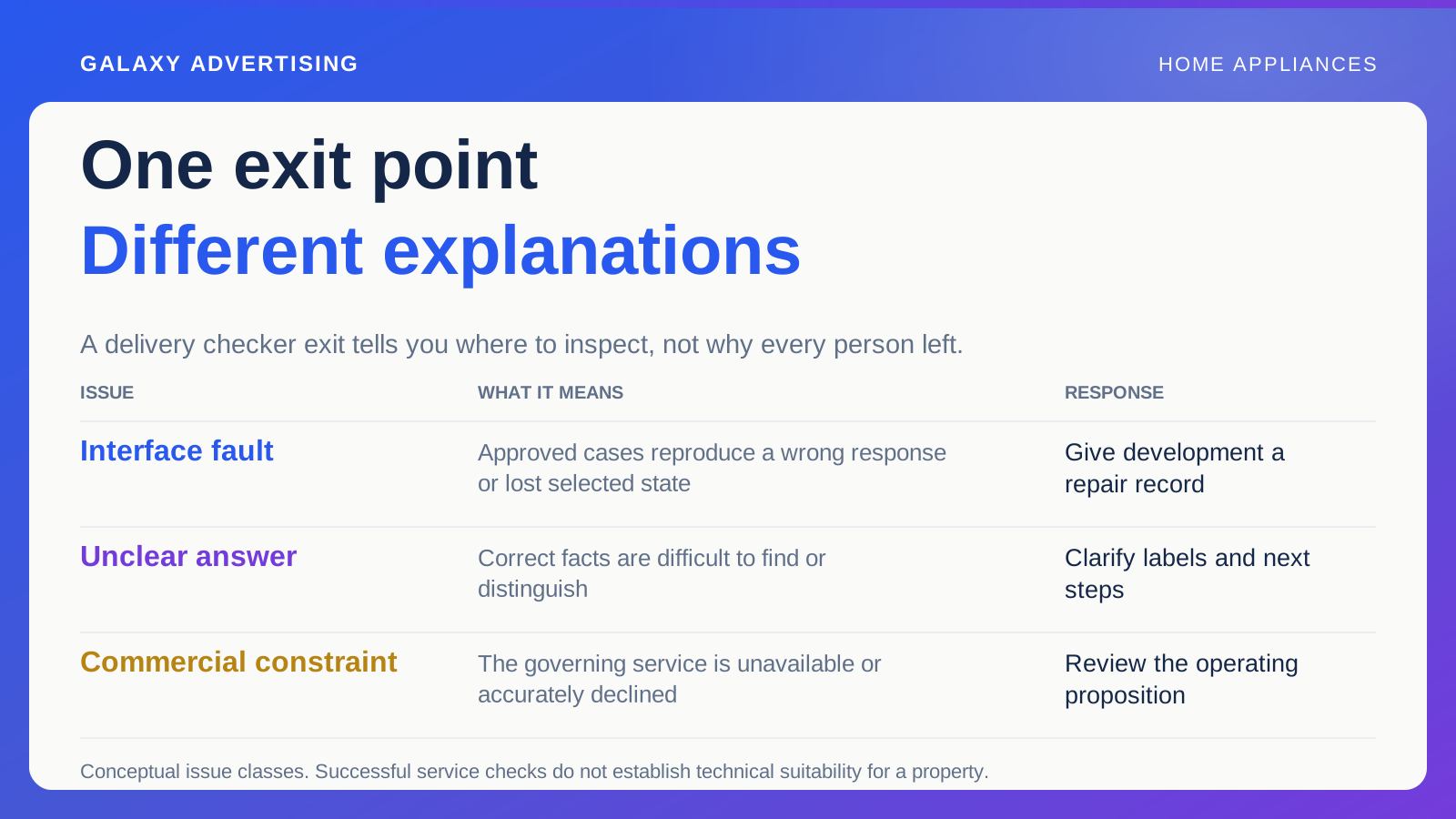
Customers leaving your delivery checker do not automatically need a shorter form. Some may have received an ambiguous message. Others may be outside the relevant service area. Those are different outcomes, even if the reporting places them at the same exit point.
Follow the customer's task before commissioning the redesign. Establish what they entered, what the interface told them and which offer was genuinely available. The exit gives you a useful place to inspect. It cannot explain why every visitor decided to leave.
Describe the route you observed
Identify the model, entry point and device context. Check how the relevant interaction and subsequent purchase are recorded before treating a reporting change as a behavioural problem. Otherwise you might investigate a change in measurement as if customers had changed their minds.
Consider whether someone was discovering the total offer rather than expressing firm purchase intent. The checker may be their first practical way to learn the service scope or cost. Reaching it does not establish readiness to buy.
Keep that limitation explicit. The observation can justify a focused review without proving the form is defective. Enquiries add context, but a handful of conversations cannot become a universal explanation for everybody who did not purchase. The evidence should determine the size of the claim.
Reproduce the answers with approved cases
Ask the responsible owner for representative supported and unsupported service cases. Use your business's approved testing approach without putting unnecessary customer information into the review. You need reproducible evidence, rather than more personal detail than the investigation requires.
Record each input category, displayed response and relevant next step. Unavailable is not always a useful answer. It can hide whether the problem concerns the model, delivery area, selected service or a technical failure.
Check on a phone too. A correct response may be hard to find, poorly labelled or detached from its option. Your audit needs to inspect communication as well as whether the system returns a value. The customer has to understand the answer before it can help them decide.
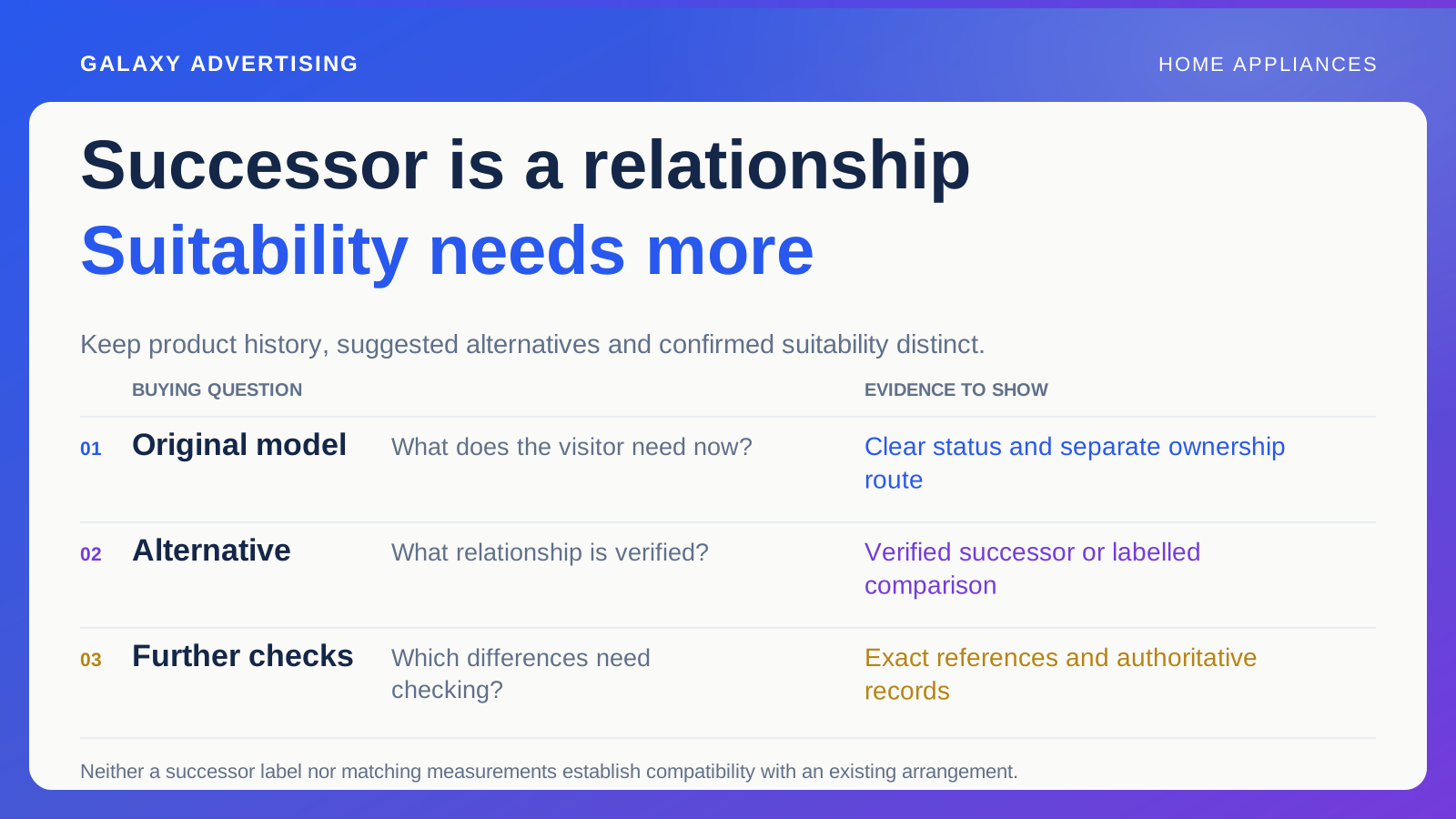
Separate the model from its service availability
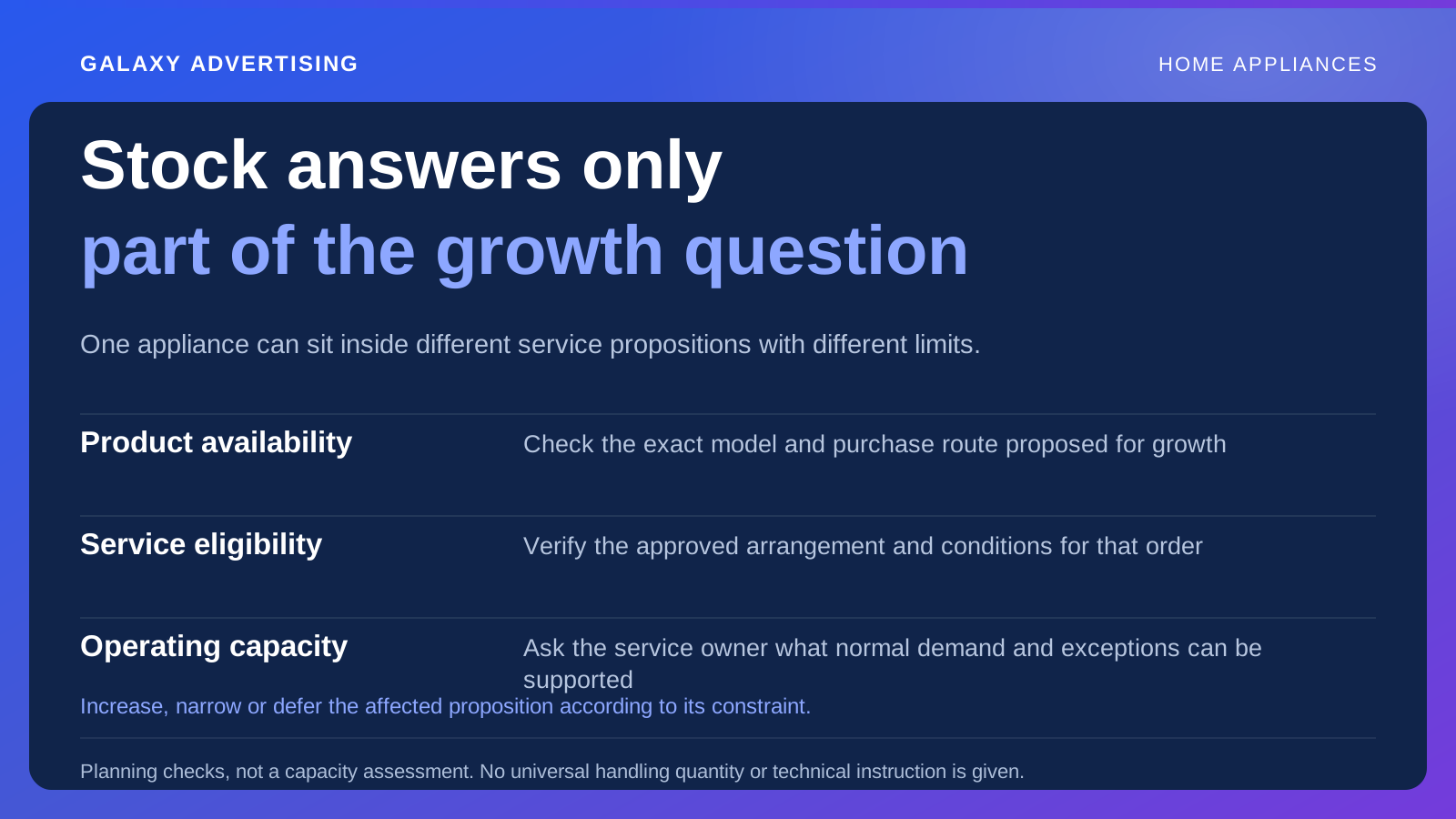
An appliance may be in stock while delivery or an optional service is unavailable for a particular order. Those states should not be interchangeable in the interface, nor should customers have to infer which one applies.
Confirm the facts with the operational owner. A broad map, old campaign message or similar previous order does not establish eligibility for the route you are reviewing. Use the actual governing offer.
If the service is unavailable, consider whether a credible alternative exists. Explain its scope and conditions accurately. Another arrangement can be useful without being equivalent, and without suggesting that an unresolved household requirement has somehow been assessed. The distinction belongs in the answer the customer sees.
Look at what people knew before the form
Can customers understand what they are checking and why you need the information? A clear label is more useful than a request for details that appears without explaining which part of the purchase it will establish.
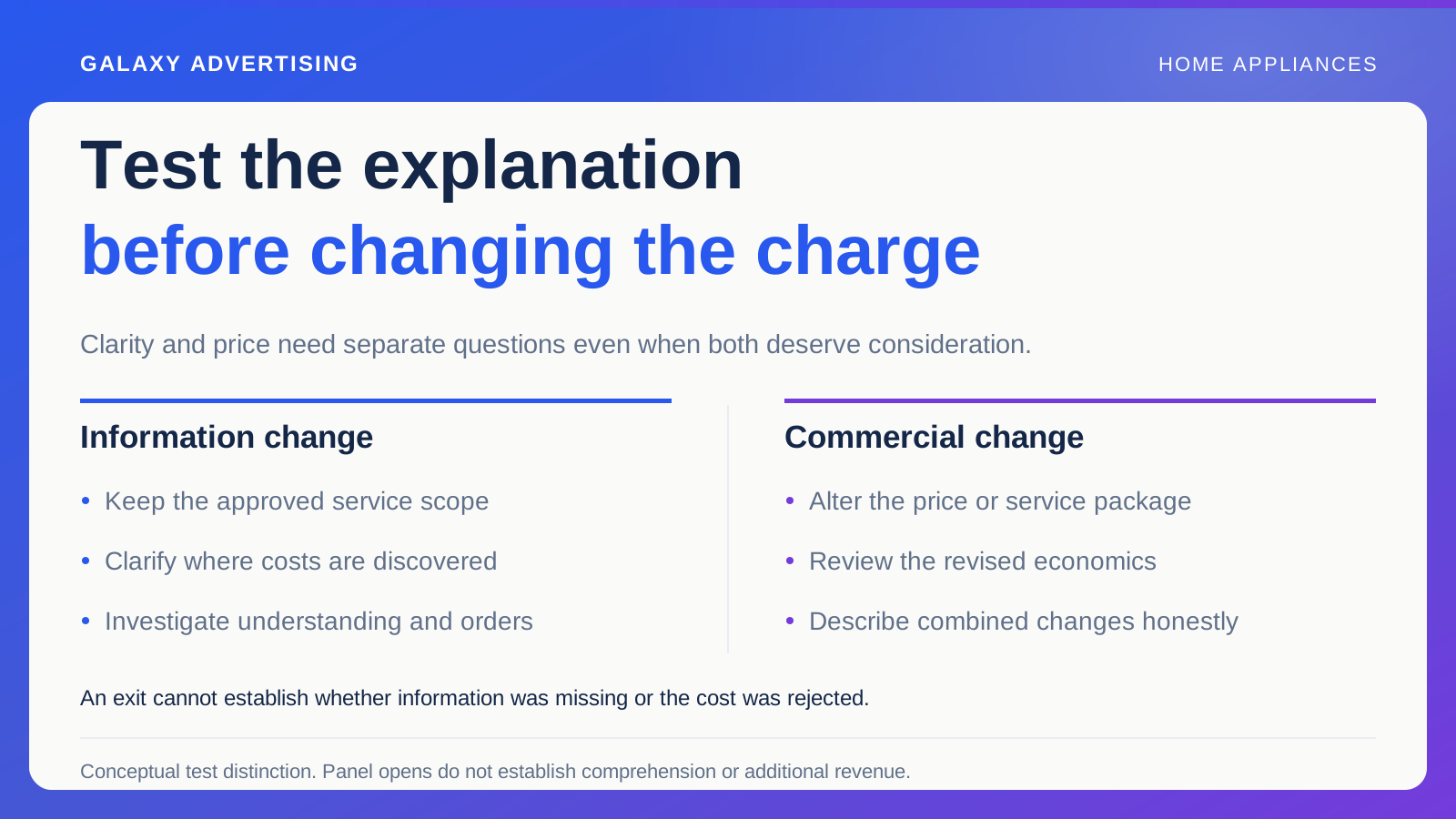
Review service descriptions near the product decision. A charge or limitation appearing only after a long sequence may call for earlier clarity, rather than a decorative change to the form itself.
Keep accurate conditions visible even if they discourage some orders. People can understand an offer and reasonably decline it. You may decide to change the commercial arrangement, but keep that decision separate from fixing an unclear presentation. An accurate answer that somebody dislikes is not automatically a broken customer experience.
Follow every answer to its next step
For a supported result, follow the model, amount and selected service into the basket. Does the state remain understandable? Check that later wording does not contradict what the checker just established.
For unsupported results, inspect both the explanation and the route to further information. A dead end can be appropriate when there is no offer. An ambiguous error should not pretend to be a definitive commercial answer.
Give unresolved technical suitability questions the appropriate source. Successful postcode or service checks do not establish compatibility with an individual property. The checkout should preserve that boundary. Operational eligibility and technical suitability answer different questions, even when they appear close together in the buying route.
Classify what you found before assigning work
Separate reproducible faults, factual inconsistencies, presentation ambiguities and commercial constraints. Give each an owner who can resolve it and evidence that will verify the outcome. That makes the next action practical.
A developer can fix an incorrect response or lost state. Operations can confirm service facts. The business owner may need to authorise another arrangement. Putting everything into a general conversion redesign obscures those responsibilities.
Distinguish ideas from established defects. A shorter label or earlier panel might deserve investigation. It is not a proven sales obstacle because a reviewer prefers it. Clear classification makes the resulting commitment easier to interpret.
Use two cases with deliberately different correct answers: an available model with the approved service, and an unavailable service that does not imply the product has disappeared. Ask an unfamiliar reviewer to explain the difference from the messages.
If both look like the same error, correct communication even if the underlying rules work. This gives development and operations a concrete acceptance standard. It also guards against a shorter, apparently successful redesign that preserves the very ambiguity the investigation was meant to resolve.
Verify through the route that exposed the issue
Repeat approved cases after implementation using the actual entry sequence. A campaign link or selected product state can change what happens. Opening the checker independently may miss the remaining mismatch.
Review later commercial evidence with stock, traffic and offer changes visible. An improved outcome is useful, while the strength of any causal claim depends on the available comparison. Do not turn a simple sequence into precise revenue attribution.
The right answer might be a small interface repair, earlier service information or another operational offer. Its value comes from resolving the evidenced ambiguity. You can only make that decision clearly when an unavailable service, an unclear answer and an accurately declined offer stop looking like the same problem.