Six videos of the same room reveal do not test six different reasons to buy. Change the opening, music and closing frame as much as you like. If the evidence and promise barely change, you are largely testing how to present the same argument.
One version might receive more attributed activity. That could identify a useful execution, but calling it validation of the wider creative strategy asks the result to establish something else.
Name the question before making more assets. Are you investigating the buying argument, the clarity of a demonstration or the presentation of an idea you already have? Each can justify production. Each should lead to a different kind of conclusion.
Be clear which part you are questioning
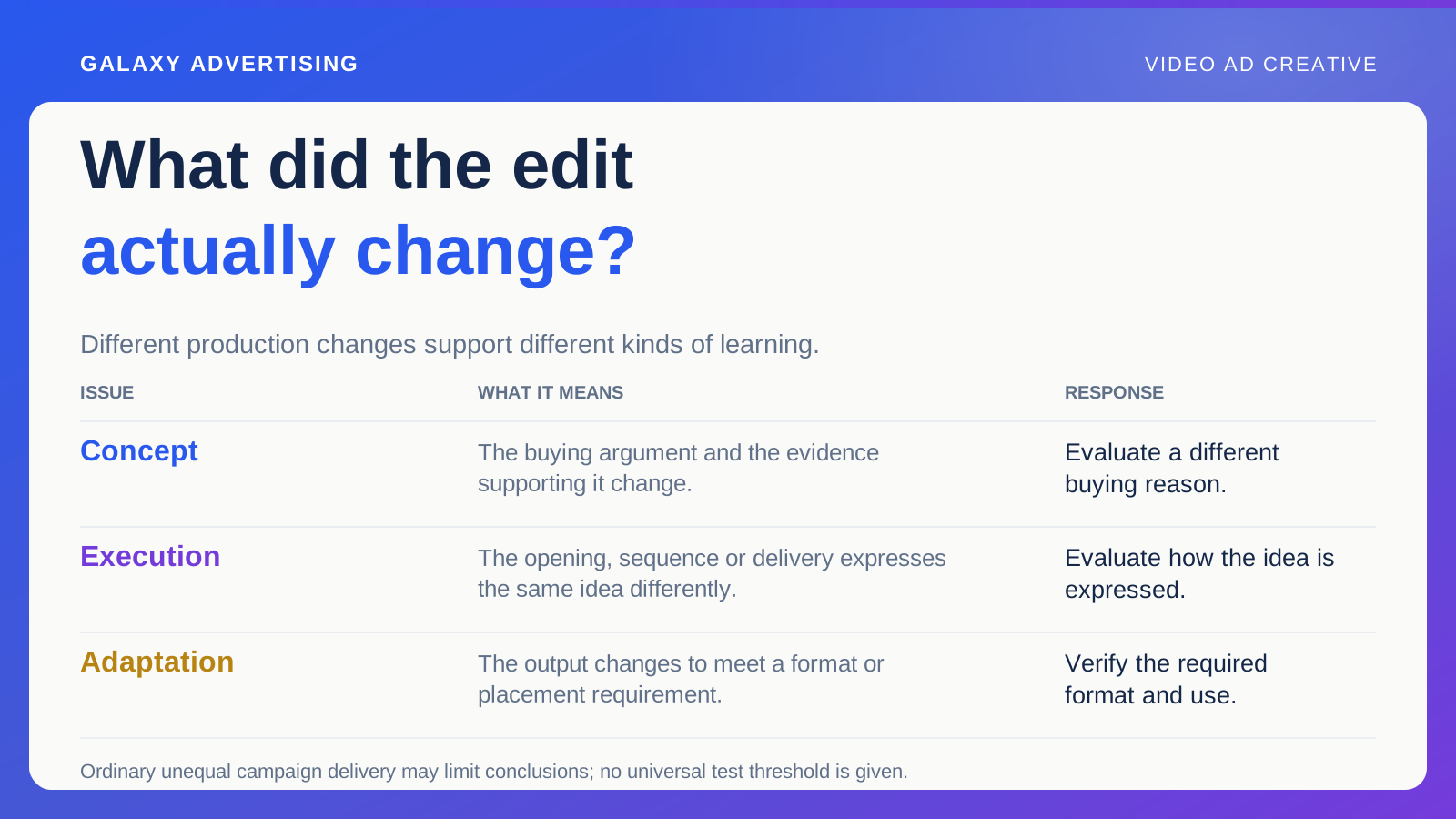
A concept is the buying argument and the evidence supporting it. An execution is how you express that idea, including the opening, sequence or delivery. An adaptation makes it usable for a format or placement requirement.
You need practical definitions your team can apply, rather than philosophical perfection. People should be able to explain why two assets are intended to teach you different things.
Take a hypothetical dining table campaign. A space focused demonstration and an explanation of a particular configuration could be different concepts. Two openings on the same configuration sequence are execution variations. Both comparisons can help, but they tell you different things and should not be reported as equivalent breadth.
Say what the viewer should understand
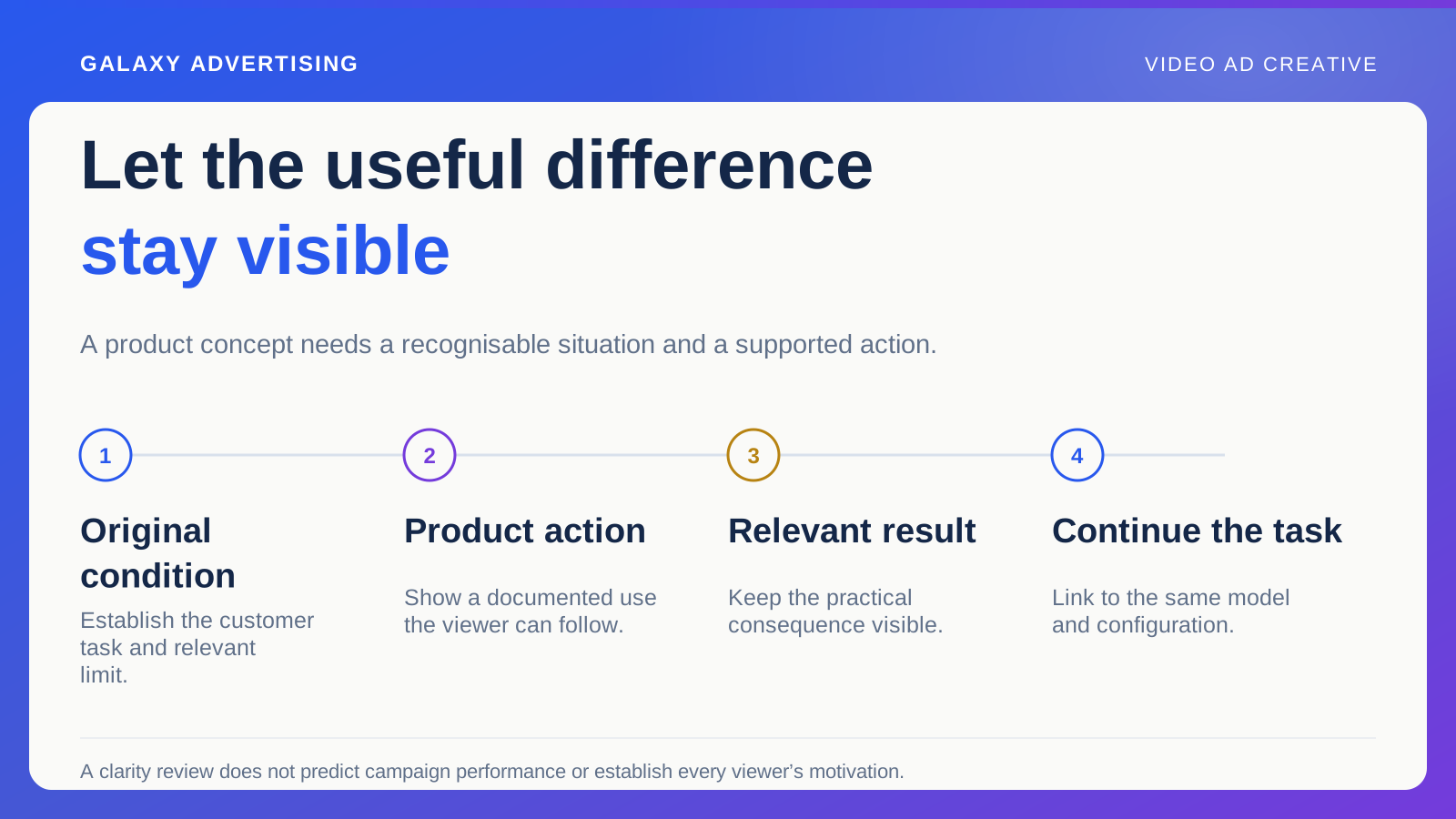
Write down the understanding each concept is supposed to create. Make the difference specific enough to affect footage and destination. A change in the tone of the copy alone may leave the evidence untouched.
Decide what observation would challenge the idea. If the space concept repeatedly prompts questions about another size, check the representation. If the configuration explanation is clear but the offer unavailable, that changes the commercial interpretation.
Avoid a hypothesis that can comfortably accommodate any result. “This will improve engagement” does little to explain how the viewer becomes more suitable or better informed. Tie the creative difference to a buying decision somebody can recognise.
Keep track of changes to the offer
Check product identity, configuration, price context and service promise. If one concept carries a materially different offer, you may be evaluating the proposition as well as the creative.
That can be a legitimate comparison when you make it deliberately. Record the changes and what stayed stable. Otherwise a later conversation could credit the entire movement to an opening line when much more changed.
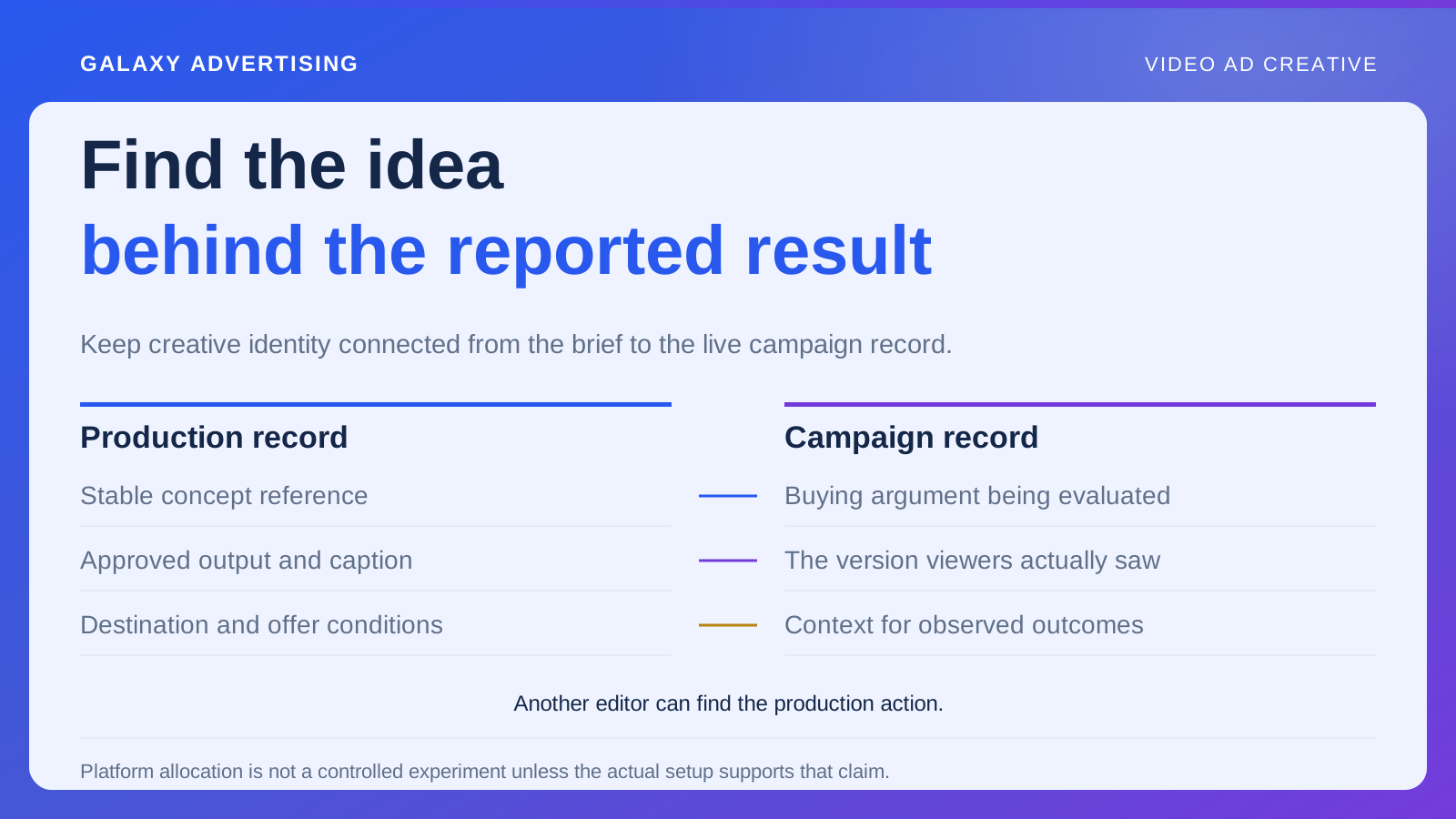
Check the destinations too. A confusing page can make a strong argument look weak, and a clearer destination can improve the result of an unchanged video. Your asset is part of a customer route, so testing needs enough awareness of that route to keep interpretations honest.
Choose a comparison your evidence can support
Ask the account team how distribution will work and whether the setup supports a controlled comparison. Ordinary campaign delivery may give the assets different opportunities, limiting what a simple performance ranking establishes.
There is no universal spend, duration or order threshold to invent here. Appropriate evidence depends on the question, available volume and consequences of choosing wrongly. Make those assumptions explicit before everyone becomes attached to an apparent winner.
If the commercial comparison will remain limited, add clearly described comprehension and factual reviews. They can establish whether an asset does its communication job. They cannot isolate a precise additional sales effect, and need not pretend to.
Find the problem before ordering the replacement
A weak result might reflect an unclear opening, missing evidence, an unsuitable argument or an offer problem. Those diagnoses call for different work.
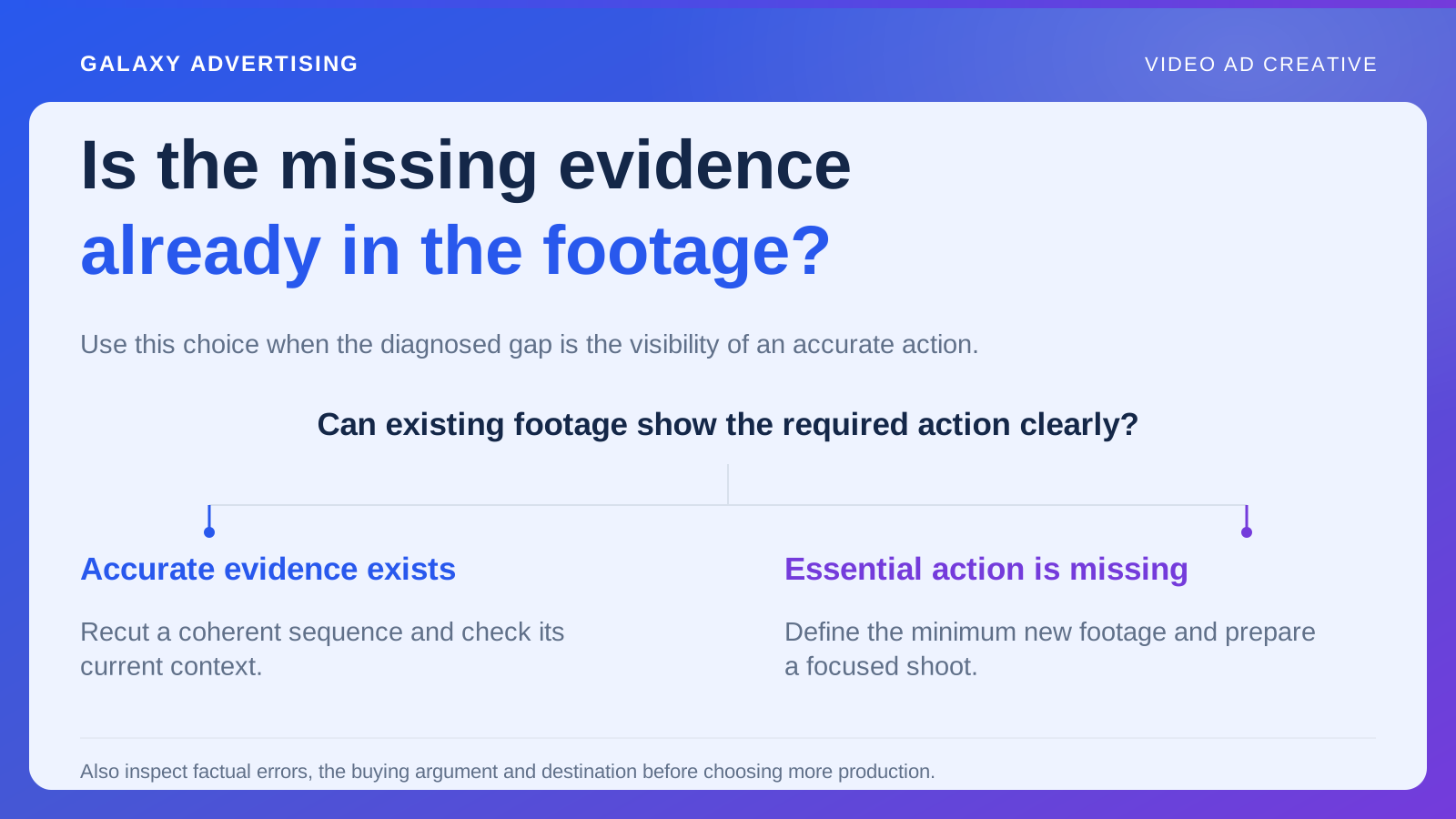
Review the asset and route against the brief. If the customer needs to see a mechanism and cuts hide the important action, a clearer execution may be sensible. If the evidence is already clear but attracts unsuitable interest, another concept may be more useful.
“More energy”, faster pacing or another creator can change the presentation without addressing why the previous video failed to help the decision. Work out what needs fixing before making those requests.
Keep a winning opening in context
An opening that works well for one product and audience condition gives you an observation. It does not create a universal rule for the catalogue. Preserve the product, argument and distribution conditions that made the finding meaningful.
Use it to form another specific question. Perhaps the same principle of clarity could help a related item, with evidence and offer adapted to that product.
A familiar format can make production efficient, but it should not crowd out different arguments for different uncertainties. Keep room in the test plan for those questions. Otherwise one useful result quietly becomes a permanent formula nobody is allowed to question.
Save the explanation you ruled out
Record a plausible explanation the evidence did not support, or could not distinguish. Perhaps you suspected the opening failed to identify the product. A comprehension review then showed identity was clear, while the practical benefit remained uncertain.
That distinction stops the next brief automatically asking for yet another product reveal. It gives the next team something more precise to investigate.
Do not manufacture certainty when the evidence is weak. The useful record shows your reasoning clearly enough that another production round starts with a better defined question, including what you still cannot tell.
Give the next round a specific purpose
State which concept or execution should continue, why, and what limitations remain. Identify additional footage or source information needed before work begins.
Record what you will stop making too. Retiring an unhelpful or unsupported argument can save more effort than adding another variation to a crowded library.
The next brief should become more specific because of this test. Twenty files all asking customers to believe the same thing leave you with plenty to export. A clearer distinction between a useful argument, a pleasing edit and an unverified assumption gives you something more valuable to decide.