Does this vintage cabinet really need a lower price, or do customers still need to know what fits inside it? If recent enquiries concern internal dimensions and the extent of restoration, a discount leaves those questions unanswered.
A lower price could make the object more attractive without making it easier to assess. Start by separating uncertainty about the piece from concern about the offer. Then bring in the costs already attached and the purpose of any further investment. You're looking for a worthwhile sale the customer understands accurately, rather than movement at any price.
Look at the evidence before choosing the incentive
Review the listing, relevant enquiries and the attention the item received. Can suitable customers establish identity, condition, dimensions and the purchase route? Check what's available to a new reader, rather than relying on what your own team knows about the object.
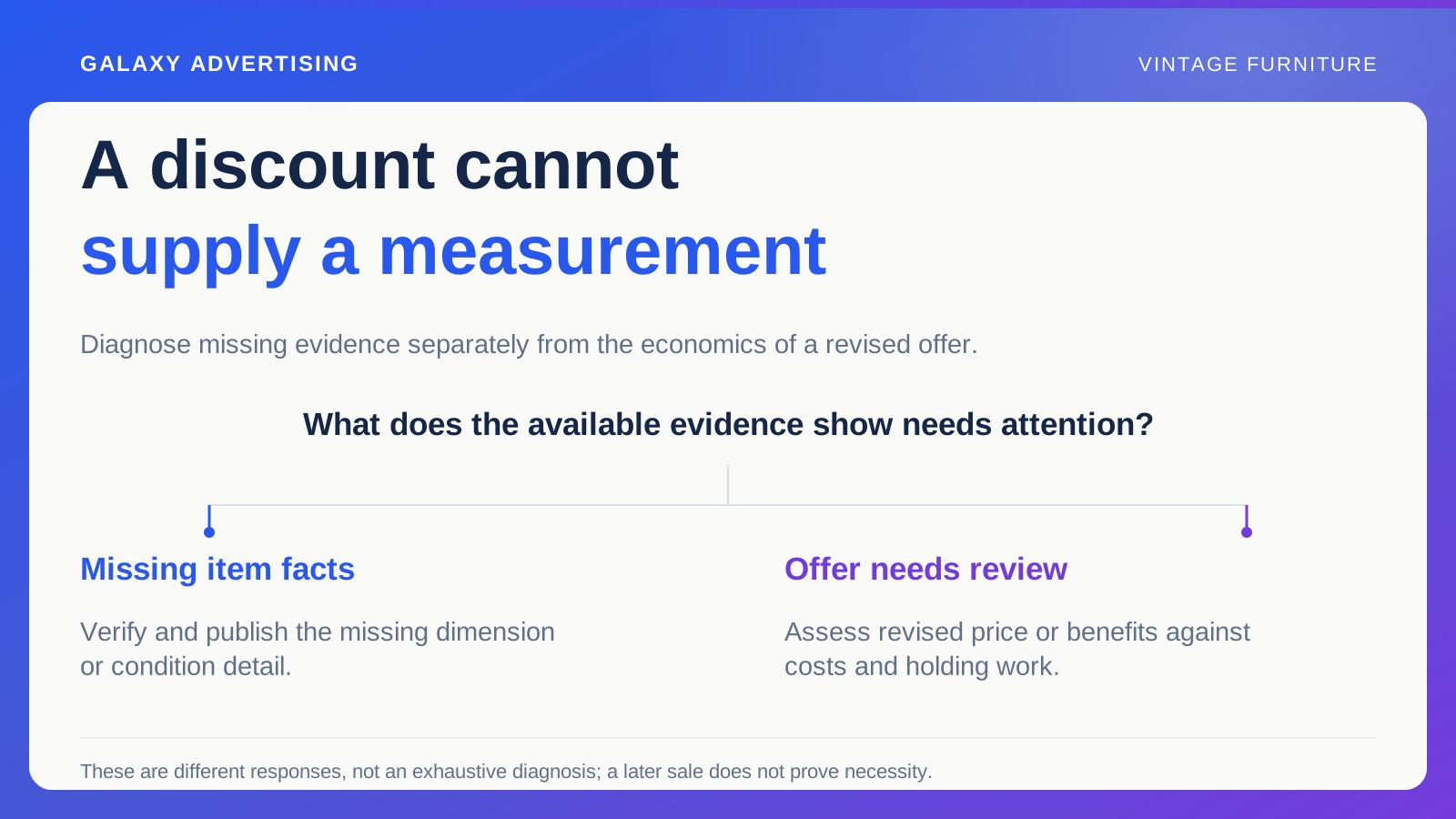
Time unsold doesn't prove the price is wrong. The piece might have received little relevant visibility or be difficult to assess from its information. Those explanations call for different responses. A discount shouldn't become the default answer simply because you need to make a decision.
Equally, heavy investment in the piece isn't a reason to defend the original price indefinitely. The decision concerns your options now. A useful diagnosis allows a commercial revision where justified, instead of turning every question into a demand for marketing to work harder. Keep both possibilities open to the evidence.
Fix missing facts as their own job
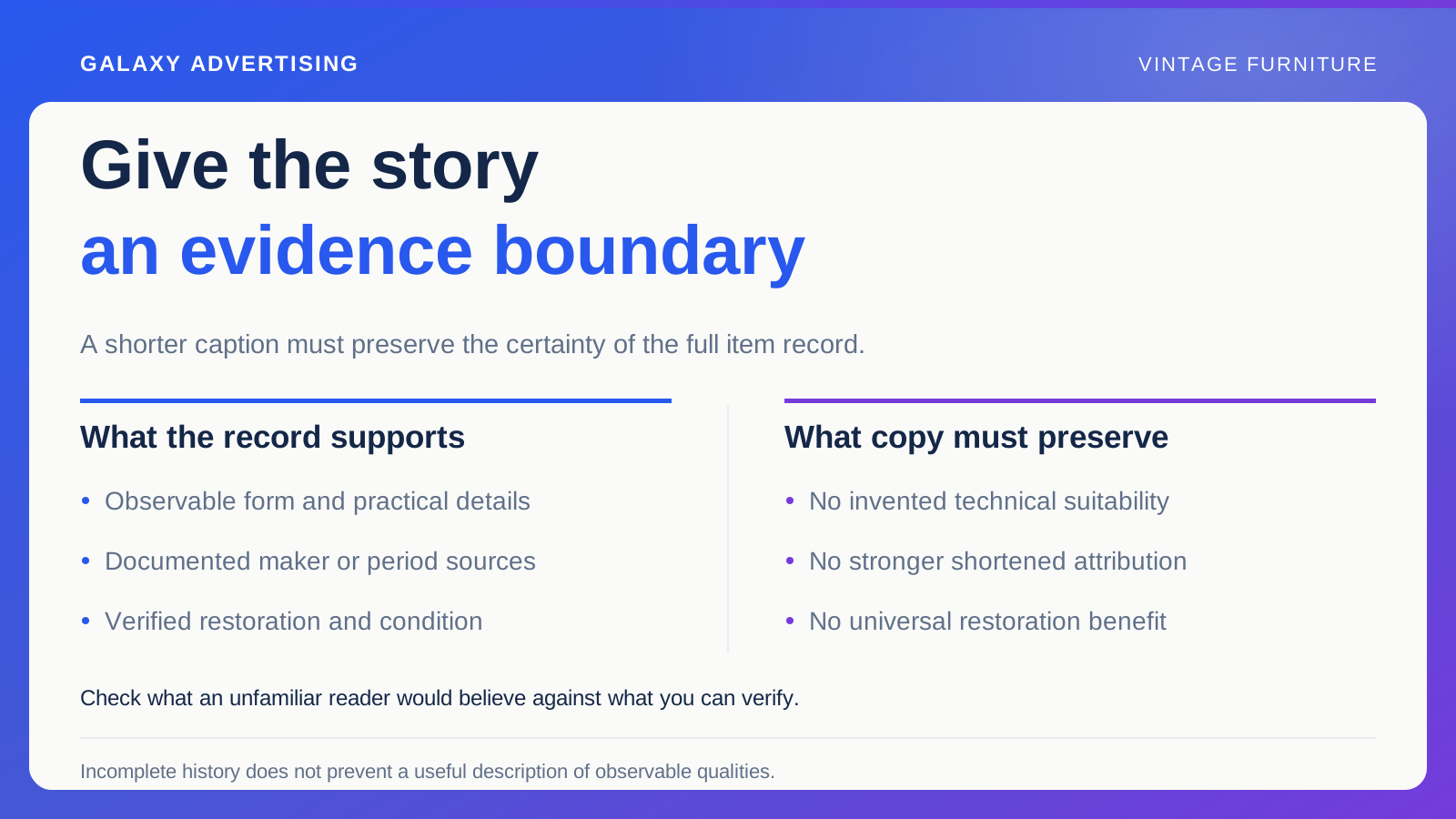
If an important dimension or condition detail is missing, obtain it and present it accurately. That improves the customer's ability to assess the offer. It doesn't need to be dressed up as a promotion to deserve attention. The gap itself is a reason to fix it.
Attach the verified answer to the stable item reference. Information hidden in one customer's messages won't help the next visitor or the colleague preparing a revised advert. Carry useful answers back into the record and presentation where they can do their job again.
Don't replace the missing fact with reassuring language. Calling the cabinet a versatile storage solution doesn't establish whether the customer's object will fit inside. That needs relevant evidence. A persuasive adjective beside a reduced price cannot answer a measurement question, however neatly the sentence reads.
Work out what the revised offer would leave
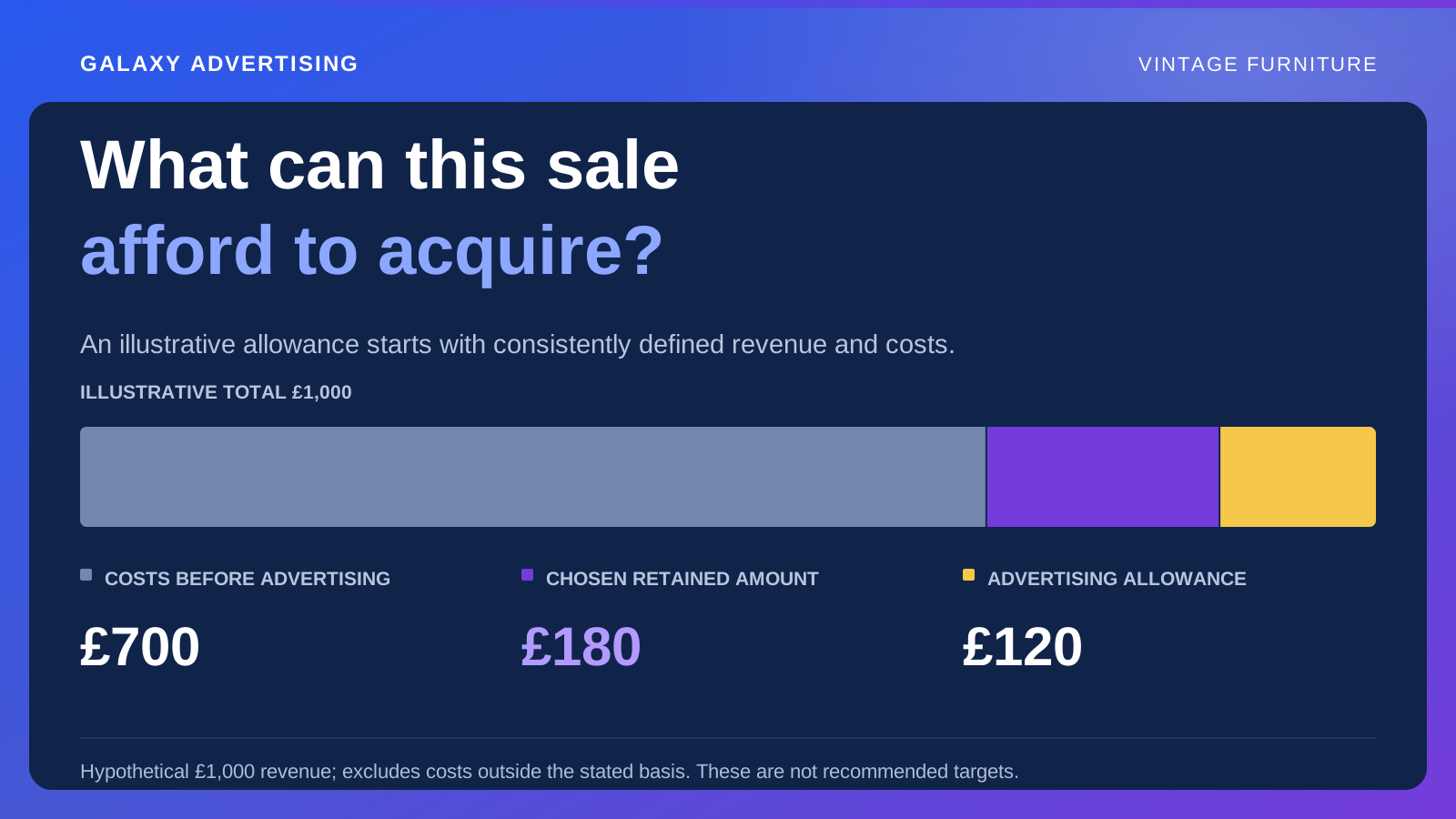
Review relevant purchase, preparation and fulfilment costs on your agreed business basis. Establish what a changed price or added benefit would leave before committing. You need to judge the complete commercial consequence rather than the appeal of the revised product figure alone.
A hypothetical calculation can help explain the decision, but shouldn't become a universal target. Pieces can have very different cost histories and service obligations. Use your own records rather than borrowing another business's standard percentage and treating it as suitable for your inventory.
Consider the practical cost of holding the piece longer as well as the immediate reduction. That doesn't dictate one answer. It makes the tradeoff visible, so you can explain the decision commercially before seeing the result. Otherwise almost any outcome can become a convenient justification after the event.
Give the promotion a defined purpose
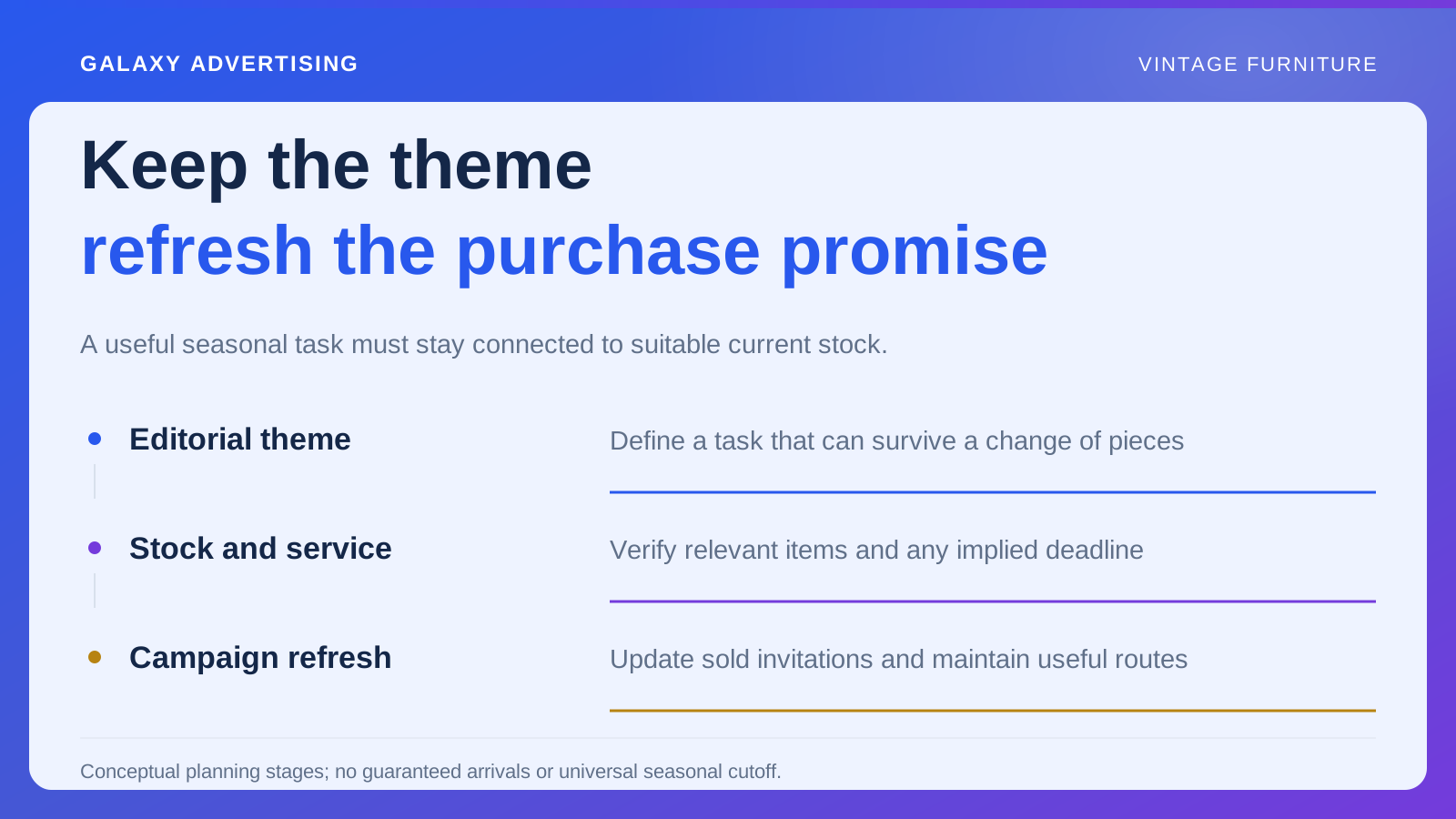
Perhaps you want a timely sale of one piece, to introduce a defined selection or to support a relevant service arrangement you can genuinely deliver. Name the purpose and the customer task it concerns. That gives the offer something concrete to be reviewed against.
Don't add unrelated benefits to avoid a price conversation. Unwanted components can make a unique piece harder to assess. A simpler revised offer may be more useful if its scope and economics are clear. Complexity needs to help the customer, rather than merely make the package look larger.
Keep the proposition tied to the individual object. A category promotion may need different explanations where condition and purchase service vary. One convenient headline shouldn't erase those distinctions. The customer is still buying a particular piece with particular conditions, not the uniform offer the headline may imply.
Let genuine scarcity do the explaining
There is a real availability limit: one particular object in its recorded condition. Explain that without inventing a queue of buyers or a deadline you don't intend to apply. Unique stock gives you a fact to communicate. It doesn't justify adding urgency you cannot support.
If there is an actual promotion end condition, state it and maintain it consistently. Someone shouldn't encounter a supposedly final offer that quietly restarts without an honest explanation. The wording and operating decision need to agree over time, rather than only at launch.
Review the message after reservation or sale. A statement accurate at the start can stop describing the current opportunity. Truthful promotion requires ongoing status management. Careful wording on the first day doesn't keep the offer accurate once the stock position moves.
Keep every part of the purchase route coherent
Check revised price, status and relevant service information across advert, listing and order route. Customers shouldn't need clarification because one part still carries the old offer. A clear change needs to reach the places where the purchase is introduced and completed.
Retain a promotion version reference and identify who can update it. Staff working across several channels need to establish which price or package a customer saw. Check that the people answering enquiries can identify the current version, rather than repeat an expired price or delivery arrangement.
If service changes with the promotion, explain it directly. A lower product price plus different delivery is a different complete offer. Assess both together in the commercial and customer review. Comparing only the product figures would leave an important part of the change outside the judgement.
Be careful about what the eventual sale proves
After sale or at a defined review, examine the actual commercial outcome and customer questions. Was the offer understood, and was the transaction worthwhile on your agreed cost basis? Those questions matter even if the object has finally moved.
A sale after a reduction doesn't prove the reduction was necessary. The buyer may already have been considering it, or a simultaneous information improvement may have helped. Record timing and known facts without giving them a causal meaning they cannot establish.
Use that learning for the next inventory decision, whether it supports clearer condition records, more selective preparation or a different promotional approach. The strongest offer makes it easier to judge the actual purchase while respecting the economics behind it. Price is part of that judgement. It isn't an answer to every other question.