Put two £1,500 furniture orders beside each other and the advertising report may treat them as equally valuable. One is a straightforward stocked arrangement; the other carries higher product and fulfilment costs. Your revenue line doesn't reveal that difference, but the money left over will.
Before debating the target, establish what each order leaves before advertising and what you need to retain afterwards. Then check whether the data reflects the actual product mix. This gives you a commercial reference, rather than a universal bidding instruction or a promise that customers can be acquired for that amount.
Make sure the revenue means the same thing
Agree how you handle tax, delivery income, discounts, cancellations and later adjustments. Use your established business definitions. Changing the basis until reports agree can make the numbers look reconciled while leaving the commercial question unanswered.
Record which stage the order value represents. A customer who changes configuration after ordering may create a different outcome from the original checkout value. Make the stage clear rather than treating the first number as the settled result.
Ask finance to confirm the definitions this decision needs. Marketing doesn't have to invent an accounting system, but it does need a dependable explanation of the figures behind the investment. The word “margin” won't help if everyone includes different costs beneath it.
Write down what each arrangement costs to fulfil
Identify the variable costs relevant to your agreed calculation. They can include product cost, payment processing, packing, relevant delivery costs and other obligations your business chooses to include consistently. Be explicit about the scope instead of allowing it to change between orders.
Where configuration affects the judgement, keep it visible. A collection average can hide an arrangement whose supply or fulfilment costs differ materially from the rest of the range. Blending that difference away won't make the investment decision clearer.
Distinguish confirmed amounts from estimates. An honest estimate can support a provisional decision. A precise looking figure without a source can hide uncertainty. Record who owns each assumption and which information would improve it if the decision warrants closer investigation.
Put the two hypothetical orders through the calculation
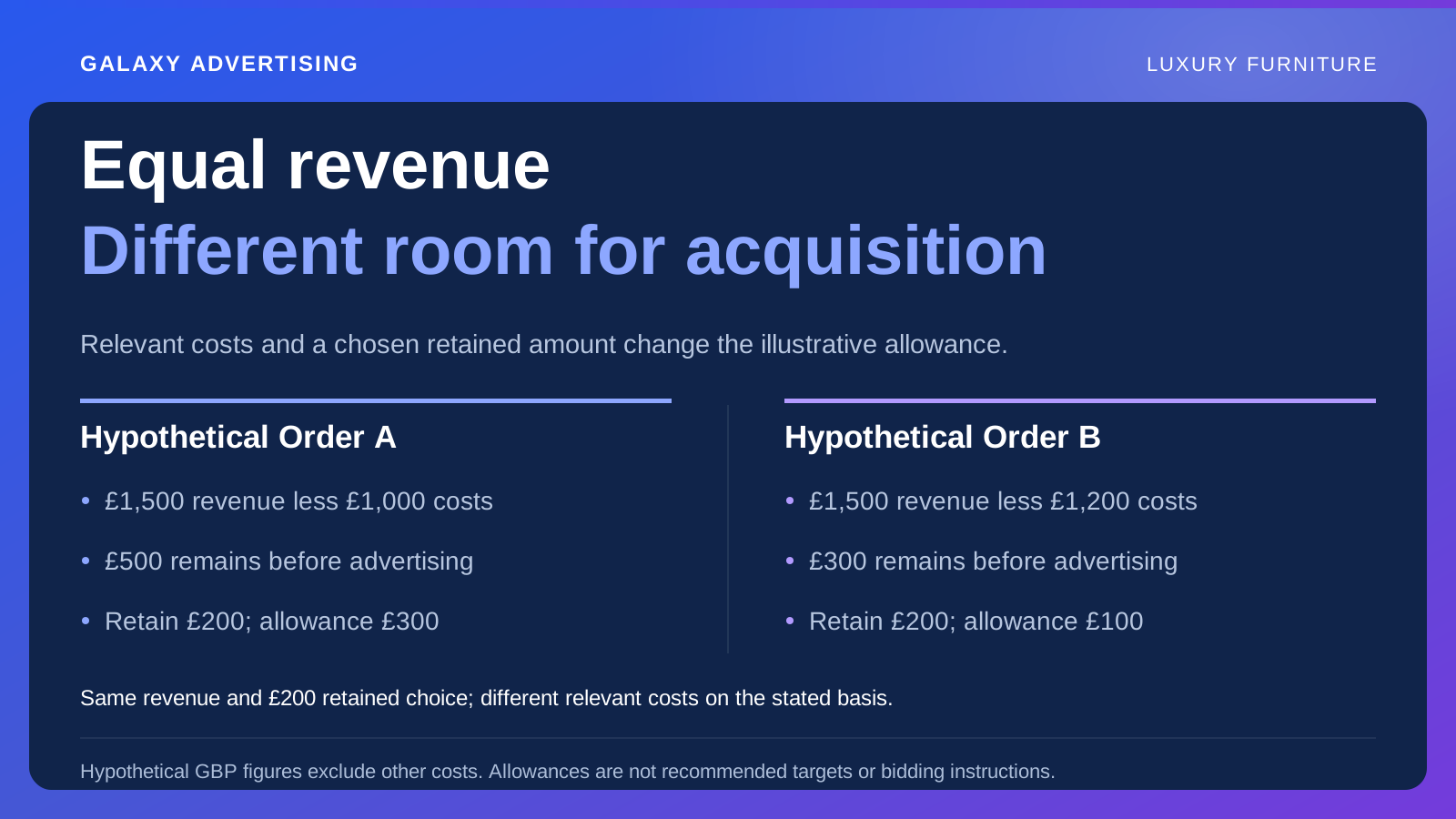
Suppose Order A generates £1,500 of revenue and carries £1,000 in relevant costs before advertising. That leaves £500 on the stated basis. Order B generates the same £1,500 but carries £1,200 in relevant costs, leaving £300.
Now suppose you choose to retain £200 from each order after advertising. The illustrative acquisition allowance is £300 for A and £100 for B. The revenue is identical; the obligations have changed how much room there is to win the order.
These are hypothetical figures, not recommended targets. They exclude costs outside the stated basis. Contribution means the money remaining after the costs included in this calculation, and the retained amount is your business's choice. Understand both before deciding what an acceptable advertising result means.
An allowance isn't a bidding instruction
Dividing revenue by the illustrative allowance produces a ratio for this calculation. It doesn't establish that your advertising account should immediately receive the same number as its bidding target. The calculation has answered one commercial question, rather than every implementation question.
Campaign goals, recorded values, product grouping and available evidence affect how the reference can be used. Ask the account owner to explain that relationship. An order calculation isn't a complete plan for configuring the account.
Nor is the allowance a commitment to spend. Even if a completed order would be acceptable at the estimated acquisition cost, you may be unwilling or unable to fund the uncertainty involved in pursuing more orders. The economics and the funding decision both need attention.
Look inside the average before trusting it
Review the configurations responsible for meaningful spend and revenue. If more orders resemble B, a stable headline return can conceal weaker contribution. The campaign average hasn't necessarily deteriorated, but the commercial result behind it has changed.
Use product groups that alter a decision and can be maintained. Numerous tiny categories can make a report harder to use without improving the investment choice. You're looking for a usable distinction, rather than detail for its own sake.
Check the operating context too. An unavailable finish or a changed package can alter what customers choose. Your mix partly reflects the offer available during that period. It isn't simply a verdict on how the account was managed.
Return to the order once the changes have settled
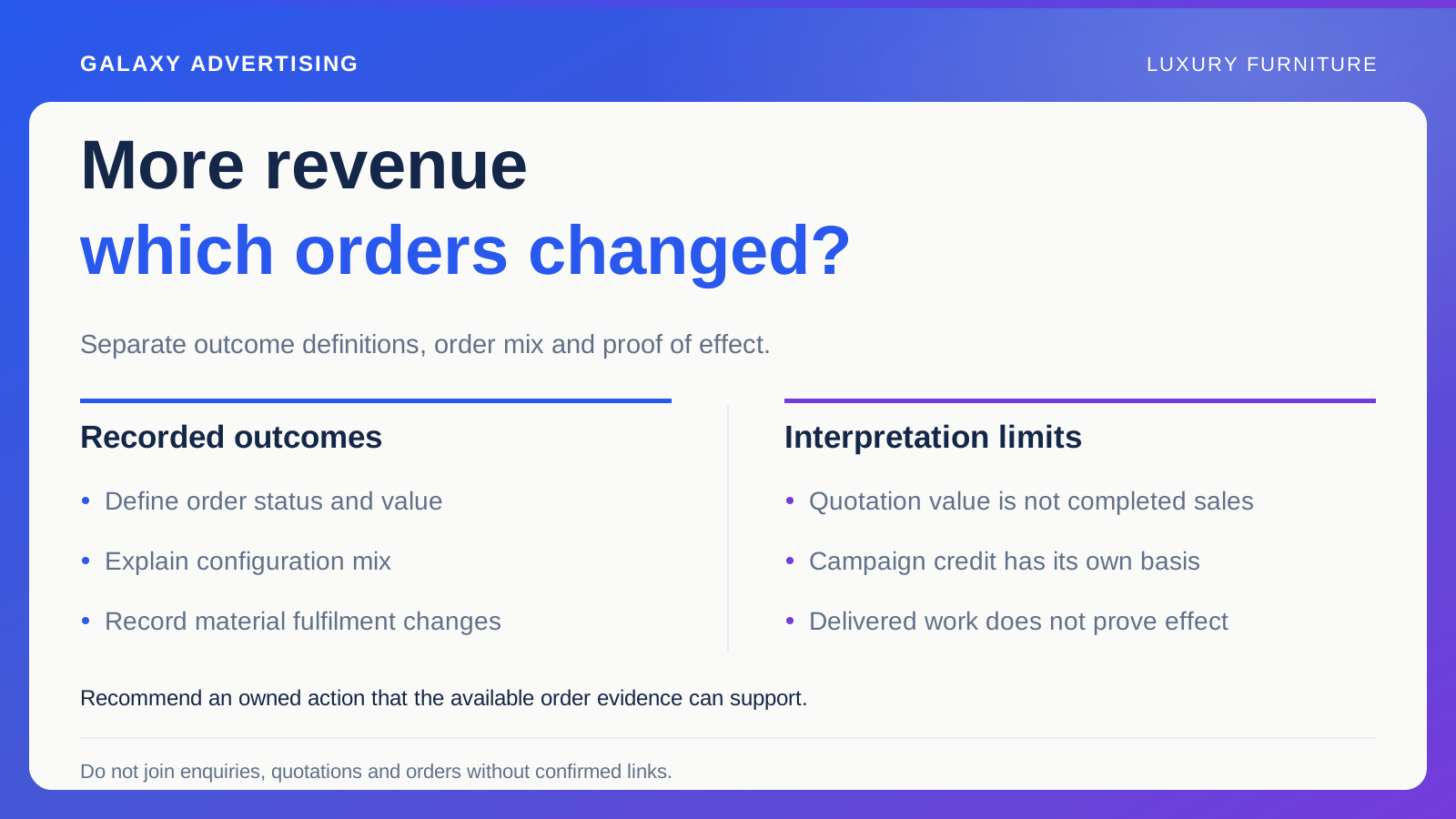
Compare the original record with the eventual configuration, order status and material fulfilment costs. A later adjustment might explain why expected contribution didn't appear. Keep the explanation attached to the order reference so the learning remains traceable.
One exception shouldn't become a rule for the whole collection. Several similar exceptions might justify reviewing the estimate more widely. Preserve enough context to distinguish a useful pattern from an isolated event.
Also separate errors in your commercial model from unexpected operating events. Omit a routine delivery obligation and the allowance needs correcting. Encounter an unusual event and you need to judge what it should mean for future planning. Both deserve attention, but they call for different decisions.
Choose the retained contribution deliberately. If you change it to justify a preferred campaign, explain why. Otherwise a calculation intended to test the spending proposal can quietly become a way of approving whatever was already proposed.
Let the numbers lead to a specific action
The review might support a different product emphasis, better cost information, a repaired value definition or a bounded expansion of a suitable campaign. Say why that action follows from the calculation and the mix you've observed. The figures should make the judgement understandable.
Keep the assumptions available for the next review. Supplier costs and service conditions can change, turning a previously acceptable acquisition result into an unsuitable one while the advertising dashboard stays calm.
A useful target lets you challenge the economics and judge which demand is worth pursuing, including how much uncertainty you can afford to fund. Two equally attractive revenue figures aren't a sufficient basis when the orders leave materially different money behind.