What if you increase promotion just as your best vintage pieces sell out and the next arrivals still need inspecting? The recent sales look promising, but extra attention could arrive before you have credible offers ready for it.
That risk grows when one person holds most of the knowledge about condition and attribution. Growth readiness includes the journey from acquisition to a dependable listing. You don't need identical stock to become systematic. You need clear responsibilities, stable records and enough capacity to keep each unique purchase accurate as the workload increases.
Find out what supported the recent sales
Review the actual objects, their preparation and the conditions in which they sold. A few unusually appealing pieces can produce encouraging results without establishing a repeatable supply or marketing pattern. Understand what the result rests on before asking it to support a bigger commitment.
Identify known costs and obligations. Purchase price alone may not explain contribution, the money remaining after the costs included in your calculation, when restoration and fulfilment differ. Use your actual commercial basis, distinguishing estimates from confirmed amounts. Growth needs that context as much as the revenue figure.
Keep the learning specific. Perhaps those listings had unusually complete condition photography, or the objects shared a useful practical role. Those observations can guide future preparation. They cannot promise that every arrival will perform similarly. Preserve the useful detail without turning it into an assurance about demand.
Map what happens before an object is marketable
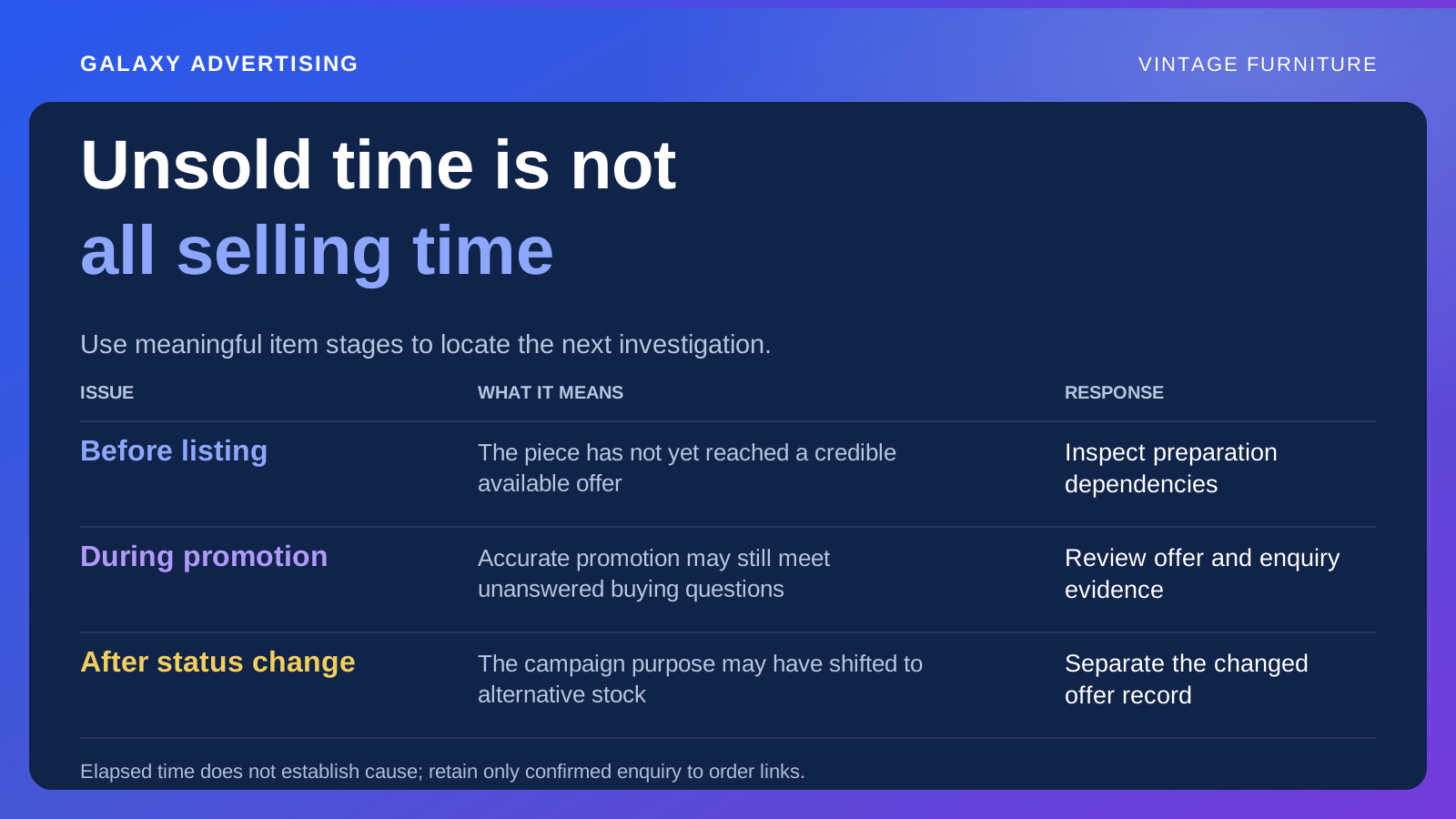
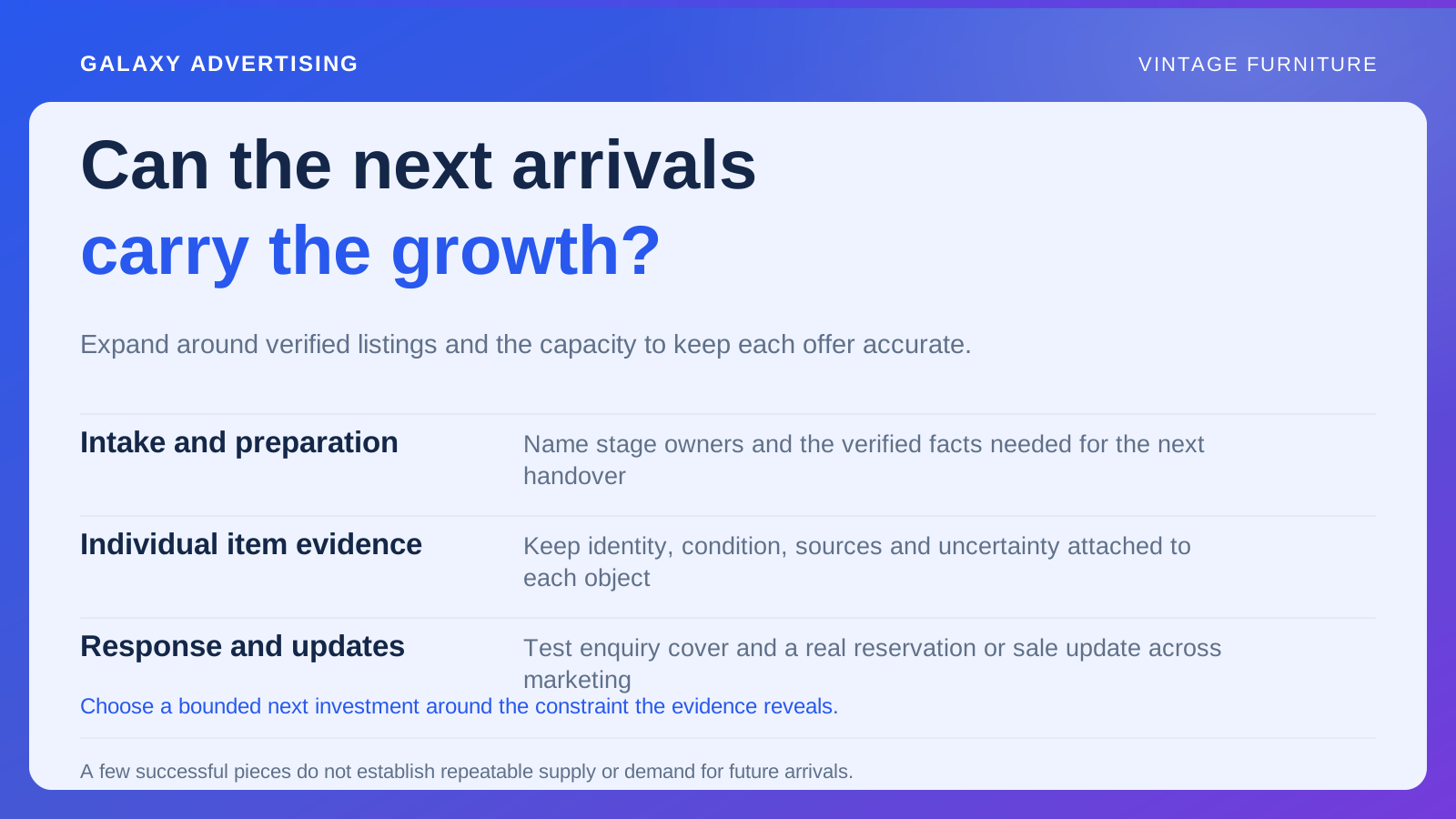
List meaningful stages from arrival through inspection, preparation, photography and publication. Name who owns each stage and the verified information needed by the next person. The handover should make the next job possible without relying on somebody reconstructing the item's story.
Look for dependencies resting on memory or informal messages. A photograph cannot replace an item reference. An appealing description cannot settle uncertain attribution. More objects and more people needing the same context can expose these gaps quickly. A busier business needs more dependable connections between the facts.
Use the map to identify the real constraint. You might need faster access to a qualified inspector, a clearer photography handover or consistent status handling. More advertising won't directly expand those stages' capacity. Choose the growth work that addresses the bottleneck you've actually found.
Build consistency around individual evidence
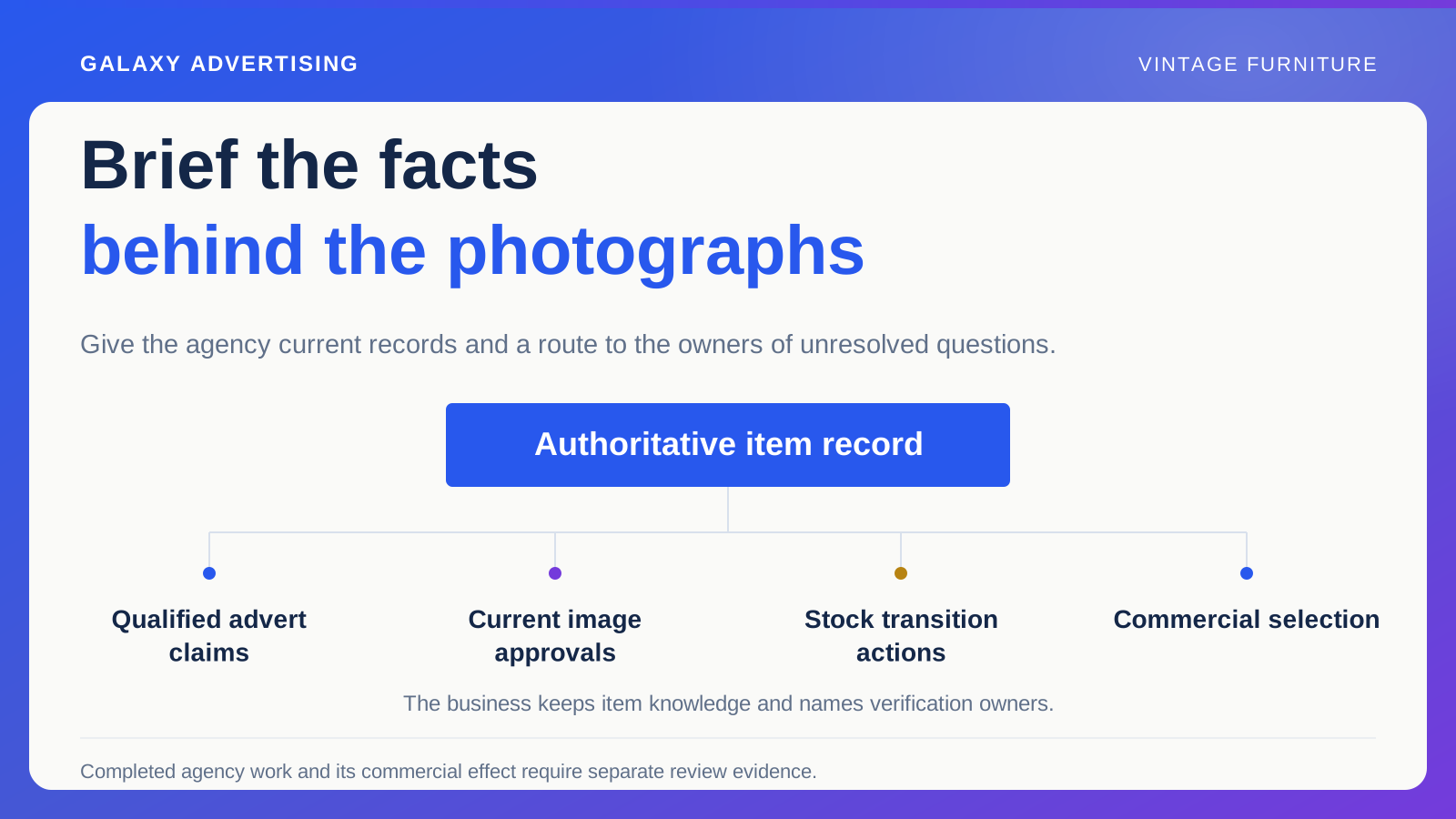
Give each object a stable reference, retaining dimensions, condition observations, relevant sources and current status. The process can stay consistent while the answers differ. That's the useful distinction when every piece needs its own purchase explanation rather than a standard product description.
Don't solve volume by copying generic wording across similar stock. Publication may become faster while the evidence customers need becomes weaker. Efficiency should come from an organised inspection and presentation routine, rather than removing the individual information that makes a piece assessable.
Keep uncertainty visible. A new staff member should be able to tell what's verified and what needs further review. Otherwise repeated use of confident wording can turn an incomplete assumption into apparent business knowledge. The record needs to retain the limit, not simply the most convenient sentence.
Check what you can reasonably acquire and prepare
Assess the supply opportunity while recognising that exact arrivals may be unpredictable. Don't base the campaign on uninterrupted access to one highly specific object unless you can genuinely support that assumption. Recent success doesn't establish that the next equivalent piece will be available when you need it.
Broader customer tasks can help where appropriate. Compact storage or individual dining pieces can sit above an accurate current selection. Give that selection meaningful criteria that survive changes in the objects. The theme needs to explain why today's stock belongs beneath it.
Don't use a theme as permission to promote whatever arrives. If stock no longer serves the task, revise the message or narrow the campaign. Keeping that relationship coherent is an operating responsibility too. A creative headline cannot do it on its own.
Count the work additional interest creates
Estimate staff needs for condition questions, individual measurements, reservations and delivery clarification. Unique stock may require more handling of individual enquiries than a familiar catalogue. Readiness includes the response customers receive after attention becomes a practical buying question.
Keep verified answers proportionately. Attaching a measurement from one enquiry to the item record can reduce repeated work without reducing the response to boilerplate. You can improve efficiency while preserving the particular answer that mattered to that object's purchase.
Review absence and handovers. If only one person understands reservations or preparation history, accuracy may become harder to maintain as demand grows. Make that dependency visible. Don't assume every question will keep reaching the same available expert when the workload increases or somebody is away.
Connect stock changes with the live marketing
Agree how reservation and sale events reach website and campaign owners. More active material makes it harder to rely on someone remembering every photograph and advert for a piece. Use the stable item reference to find affected messages and destinations.
Decide whether the purchase invitation should stop, become historical reference or introduce a clearly explained current selection. Test an ordinary stock transition before expanding. Verify the customer route changed, rather than merely confirming an internal status field was edited. A documented workflow needs to work in practice.
Make the next investment reversible where practical. A bounded increase in prepared listings or promotion can reveal a weak handover before you commit to a much larger workload the team cannot maintain accurately. Scope is part of the readiness decision, rather than something to discuss only after problems appear.
Expand within what the business can support
Choose the next step around the constraint you can address. That may mean more accurate listings, a focused campaign increase or a better current stock destination before broader reach. Agree review evidence and conditions needing prompt action, with owners for inaccurate availability promises or overloaded enquiries.
Those issues shouldn't wait for the next general reporting meeting. A systematic vintage business preserves the individuality of its stock by making facts and responsibilities more dependable. The next sales depend on acquiring, describing and fulfilling the next objects. Growth needs to carry that work with it.