A dispatched pair isn't a settled acquisition result. One customer changes size and keeps the replacement, another returns the same style and keeps nothing, and another switches styles during the exchange conversation. An initial sales report can make those routes look much more alike than they are.
Look at the retained purchase and the work needed to reach it. That doesn't mean assuming the worst about every unresolved order. It means tracing the history before initial revenue becomes a confident claim about a style's acquisition performance. What the customer ultimately keeps matters to the next investment decision.
Keep the history attached to the original order
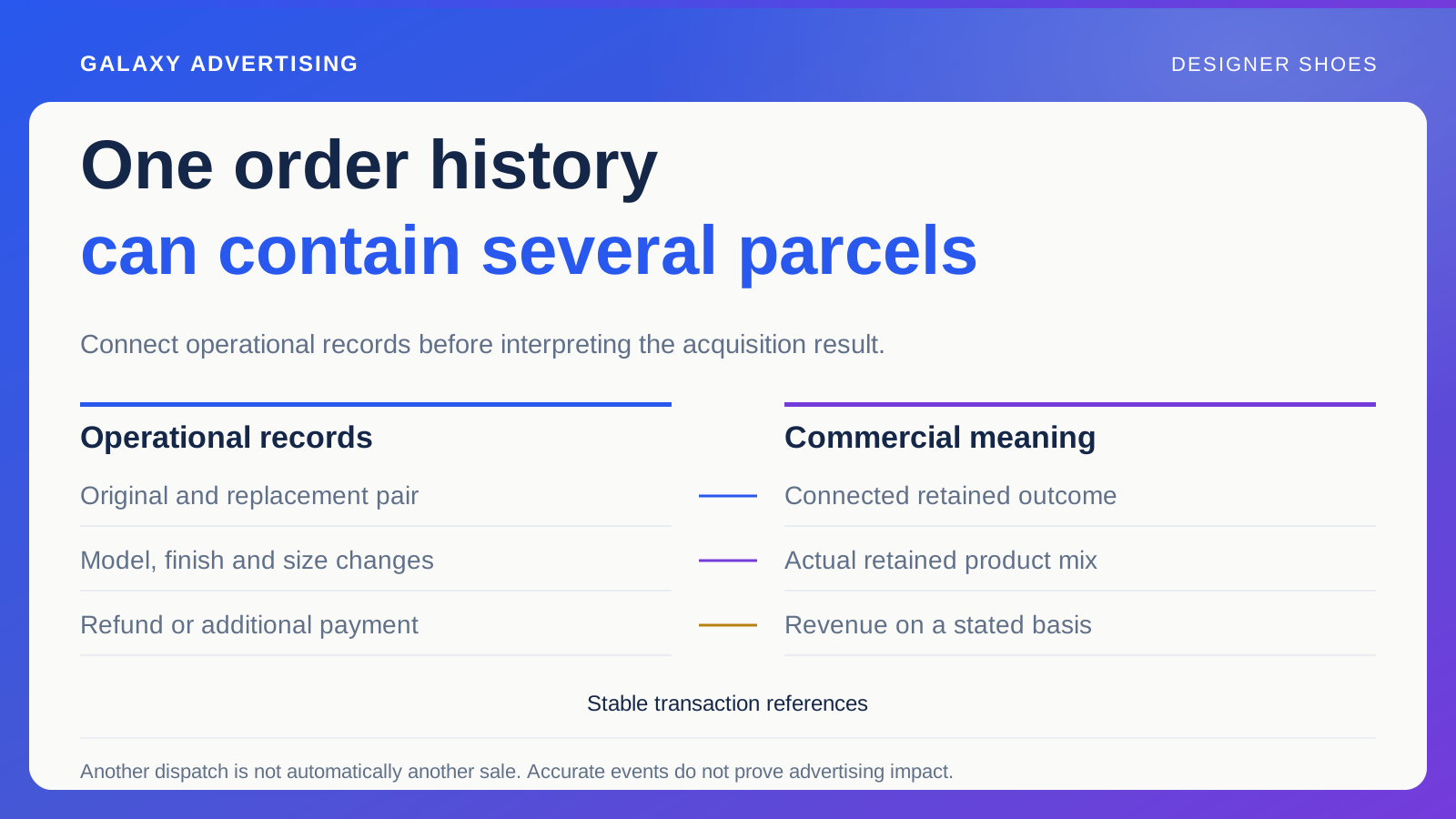
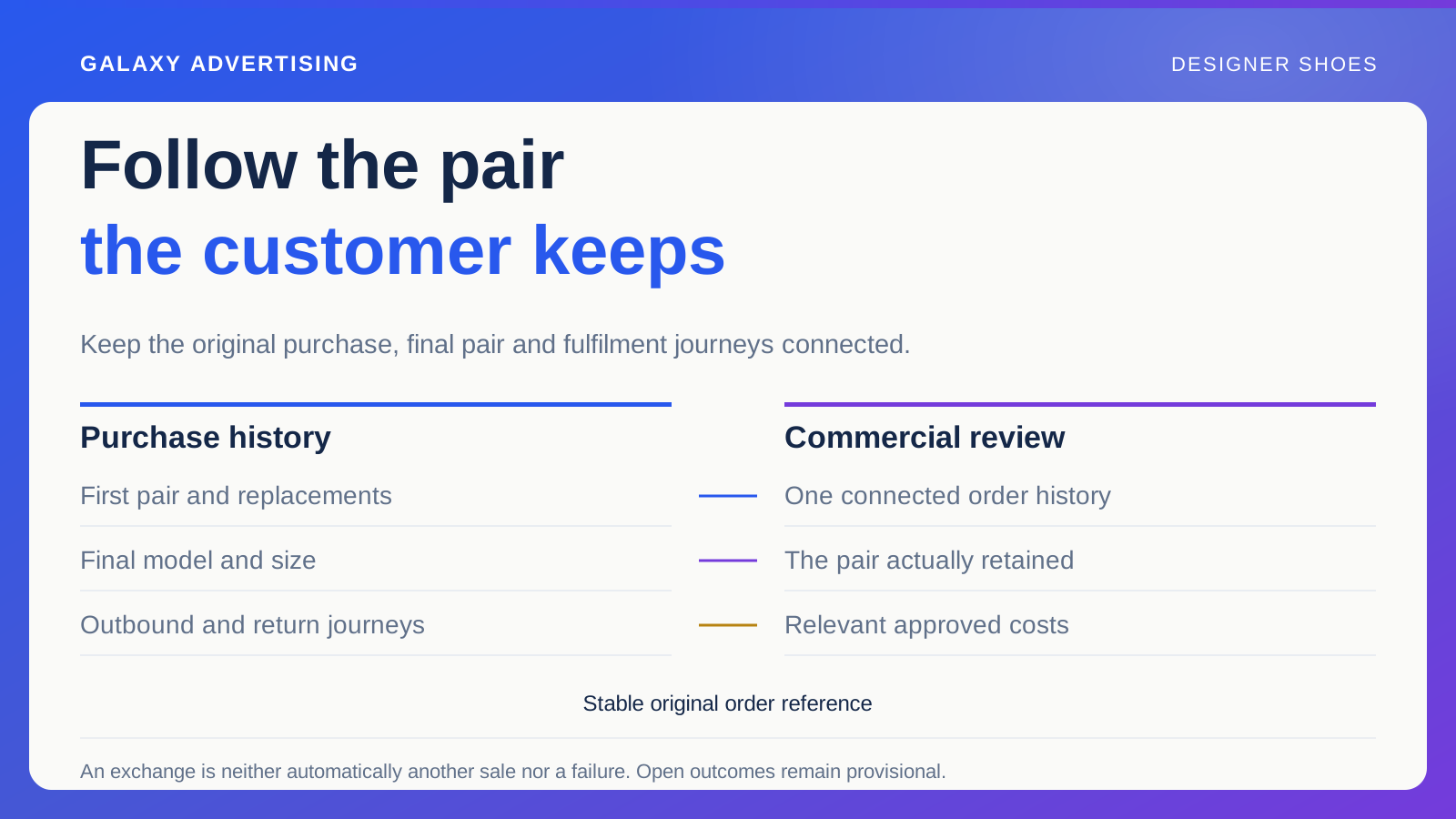
Use a stable order reference connecting the first pair, replacements and relevant payments or refunds. Ask how your actual store systems represent those relationships. The commercial review needs to follow the purchase across its records, rather than assume the connection is already obvious.
A replacement parcel shouldn't automatically count as another acquired customer or another full sale. Equally, an exchange ending in a retained pair isn't the same outcome as an entirely refunded order. Both distinctions matter if the review is to describe what your business actually served.
Ask the reporting owner to demonstrate ordinary cases and exceptions. You're not prescribing a new accounting system. You're checking that the commercial view can follow the resulting purchase, rather than adding disconnected operational records whose combined meaning nobody has examined. Plausible individual entries aren't enough on their own.
Identify the pair that was kept
Where the records establish it, retain the final style, size and relevant variant, meaning the selected size, colour or configuration. If the customer changes item, preserve that change. Don't leave the whole result attached only to the model first advertised simply because it began the route.
This matters when choosing products to promote. One style may introduce the customer while another receives the eventual purchase. Understand that path before deciding which item deserves the next introduction. Otherwise, the advertising shortlist can rest on an incomplete picture of what people retained.
Don't infer fit or suitability from the transaction alone. It identifies what was supplied and retained under your process. It doesn't explain all the customer's physical requirements, preferences or reasons for choosing the replacement. The record can be commercially useful without supplying that personal account.
Follow the journeys as well as the product
Identify relevant outbound, return and replacement movements using your approved cost basis. An additional journey can create a commercial commitment without bringing additional product revenue. The first sale value won't automatically reveal the cost of completing that transaction.
Separate recorded charges from estimates. If work isn't captured per order and needs an allowance, give its source, scope and owner. A visible estimate you can improve is more useful than an invented precise amount introduced to simplify the reporting. Keep its status honest.
Make packing and handling assumptions explicit where they matter. You don't need to allocate every overhead to every pair. Establish which meaningful additional work the initial revenue snapshot leaves out, and how that work affects the decision in front of you. The calculation should serve that decision.
Keep the stock outcome separate
A returned item has a different status from a completed retained sale. Let the responsible team establish condition and disposition through your normal process. Its arrival back in the operation doesn't, by itself, tell the marketing team what can happen next.
Don't assume every returned pair is immediately available for another promotion. Don't assume its value has vanished entirely either. Let the relevant records explain the outcome instead of applying one blanket treatment to routes that may have different consequences.
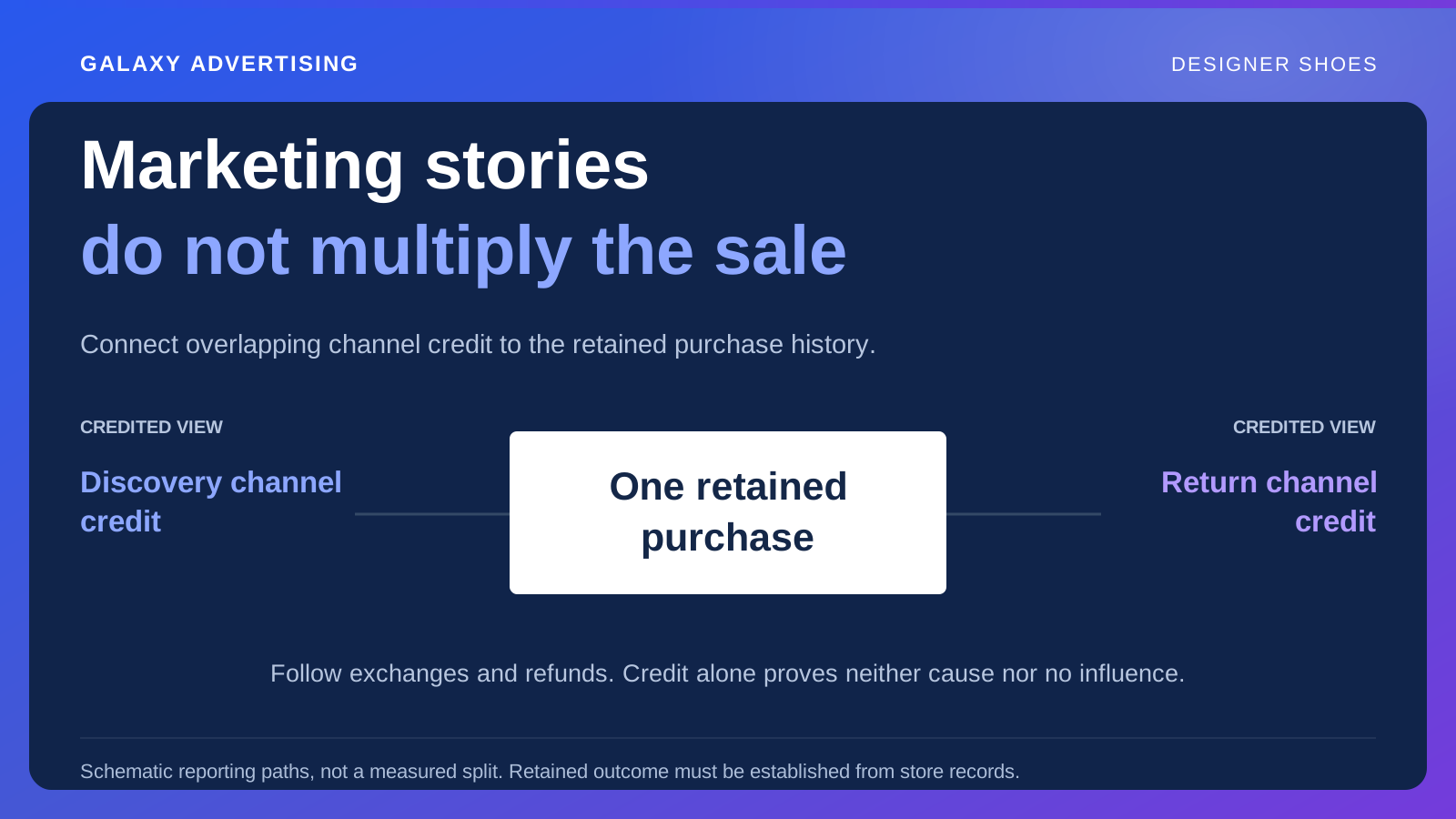
The stock question concerns what you can subsequently supply. The customer's commercial history concerns the resulting transaction. Both can affect future product emphasis, but combining them into one initial revenue figure hides their distinct consequences. Keep the views connected without making them interchangeable.
Show which orders are still unresolved
State the observation time for each order group, sometimes called a cohort, and which exchanges or adjustments remain open. Recent orders can look cleaner simply because more outcomes are still pending. That isn't necessarily evidence of a better acquisition result.
Use your own records to choose an appropriate observation approach. There's no universal waiting interval to impose here, and this isn't advice about standard return entitlements. The purpose is consistency in the analysis, rather than a new customer policy.
If a decision can't wait, present a provisional result with unresolved statuses labelled. The owner can authorise a bounded continuation while acknowledging uncertainty. That's different from treating every open order as though the original pair had already become a settled retained purchase. Timeliness doesn't require pretending the history is complete.
Compare styles at a level the evidence can support
Look at retained outcomes and relevant service burden in groups large and meaningful enough to inform action. Tiny size segments with only a few transactions won't necessarily support the conclusion being proposed. More segmentation isn't automatically more understanding.
Include availability. A depleted size selection can create a different buying route from the same style with its ordinary options. Look for explanations before permanently labelling a style unprofitable or a customer expensive. Unclear model information, inaccurate imagery or a changing available range may warrant correction instead.
Choose the action before changing a ratio
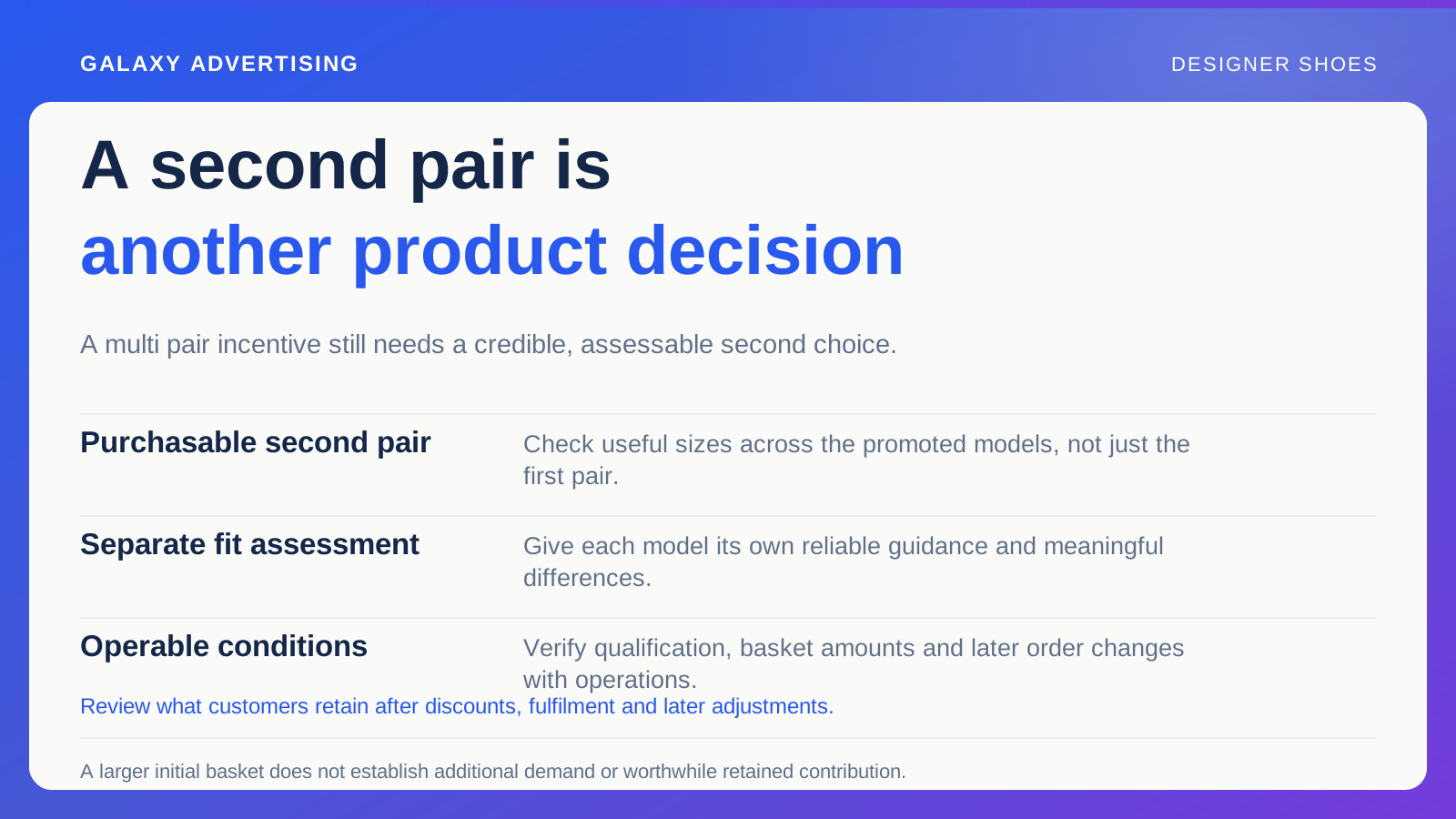
The finding could call for different product emphasis, clearer sizing information, a better exchange reference or more investigation. It doesn't automatically call for another advertising ratio. Match the action to the observed problem, rather than reach for the most familiar account setting.
Once you understand the retained purchase and relevant costs, use shared contribution definitions. Contribution is the money remaining after the costs included in that calculation. An exact advertising allowance isn't useful if the history still counts a replacement as another acquisition.
Assign an owner and define completion. Data reconciliation, product explanation and campaign changes require different skills. Distinct briefs help resolve the cause rather than merely make the dashboard look more reassuring at the next review.
Leave the reasoning for the next range review
Preserve the observation basis, material exceptions and conclusion. When the style returns to the advertising shortlist, colleagues should be able to see what earlier evidence actually established. Update assumptions when fulfilment arrangements or the range change, so an old initial order average doesn't become a permanent target.
An exchange is a real operating journey. It isn't automatically a failure or a second sale. Understanding the complete purchase gives you a more dependable basis for promotion than celebrating the first parcel and discovering the cost of finishing the transaction later.