Which buying journey did your SEO work improve, and what should you spend money on next? If you cannot answer after reading the report, a longer keyword table probably will not help.
You can have ranking movements, traffic charts and a list of published pages in front of you and still struggle to explain which customer problem anyone addressed. A comprehensive report can leave the programme surprisingly hard to manage.
Start with the decision. Show what reached the website, what you observed in relation to its purpose, and what those observations cannot establish. You should leave the review knowing your next move, rather than where to archive the attachment.
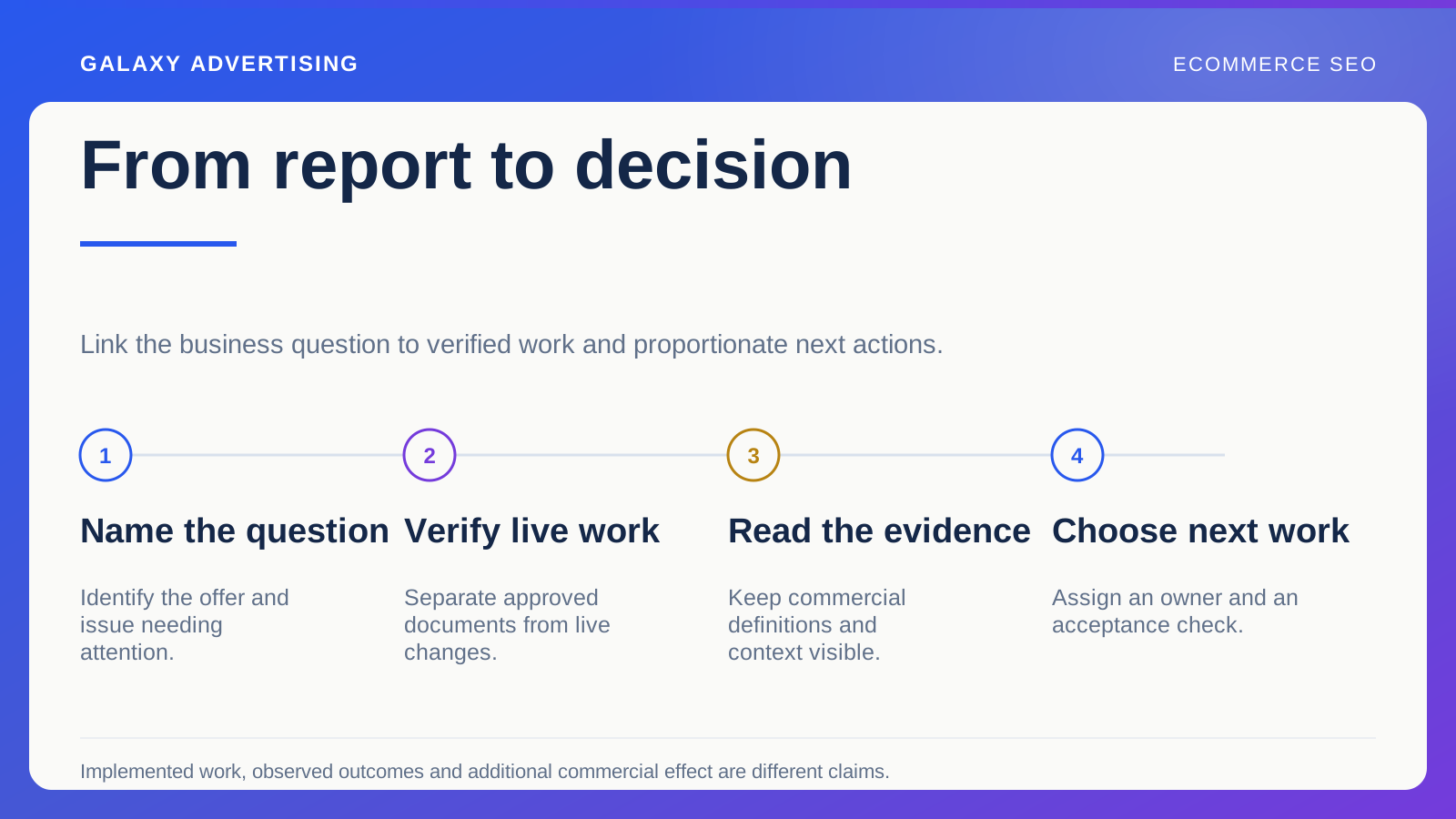
Put the business question before the charts
Name the issue that needs attention. Perhaps a range needs more reliable discovery. Perhaps a collection attracts people trying to do the wrong thing, or missing product information prevents planned work from becoming useful.
Say which offer is affected and why it matters now. That gives the report a reason to belong to your business. Changing the retailer's name should not be enough to send it to somebody else.
Resist squeezing the whole programme into one traffic percentage. That average can hide changes in the pages attracting visits, demand for your brand or available stock. Make the consequence visible first, then show where you can inspect the evidence.
Has the work actually reached customers?
For each substantive piece of completed work, record its purpose and how somebody verified it live. An approved content document, an implemented page and a commercial effect are separate stages. Call them separate stages.
A technical correction can be complete and checked while its wider effect remains uncertain. A proposed guide can still be blocked because nobody has supplied the product facts it needs. Neither deserves an ambiguous tick marked complete.
This protects accountability on both sides. The agency cannot claim impact simply because it delivered a task. You cannot assume an agreed correction was tested if it never reached the site. Record the real state of the work so the next conversation starts from something everyone recognises.
Explain what people were trying to find
Review relevant groups of pages alongside the query context your evidence provides. A collection designed to help shoppers choose needs a different explanation from a guide answering a question across several products.
Where it helps the decision, distinguish searches for your brand from wider product or category demand. More people searching your name could reflect other activity as well as a useful organic route.
Be clear about the limits. A reporting sample does not reveal every query or every visitor's motive. It can show a pattern worth investigating without proving one explanation applies to everybody. Keep the useful observation and the uncertainty together, where the reader can see both.
Agree what the commercial numbers mean
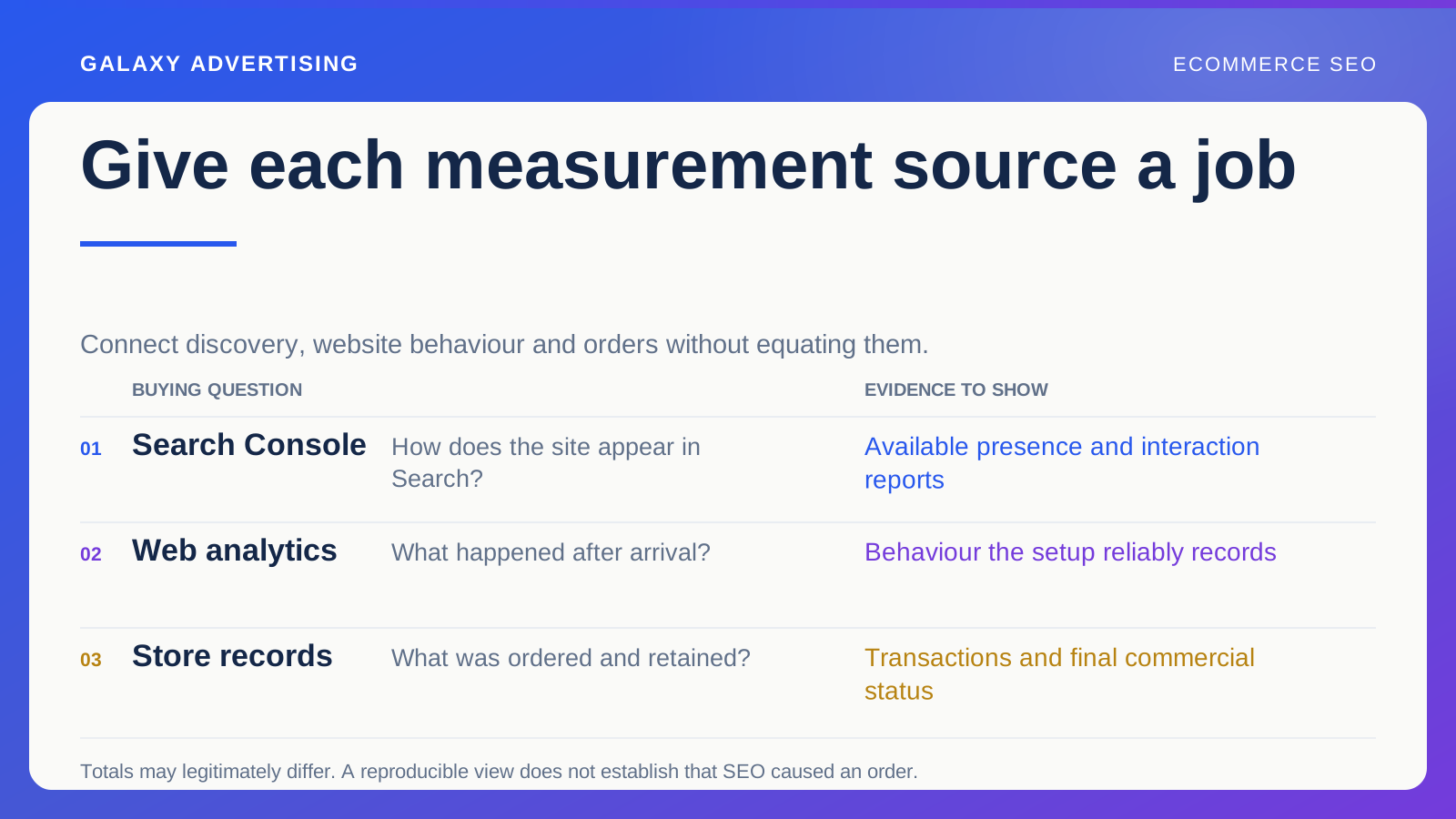
Use consistent definitions when presenting product exploration and order outcomes. Explain how tax, delivery income, discounts and later order changes have been treated wherever they affect the review. Otherwise two apparently comparable figures can tell different stories.
If the objective is contribution, meaning the money remaining after the costs included in your calculation, show that cost basis. Label estimates. Revenue alone may not answer the question when the product mix or fulfilment conditions have changed.
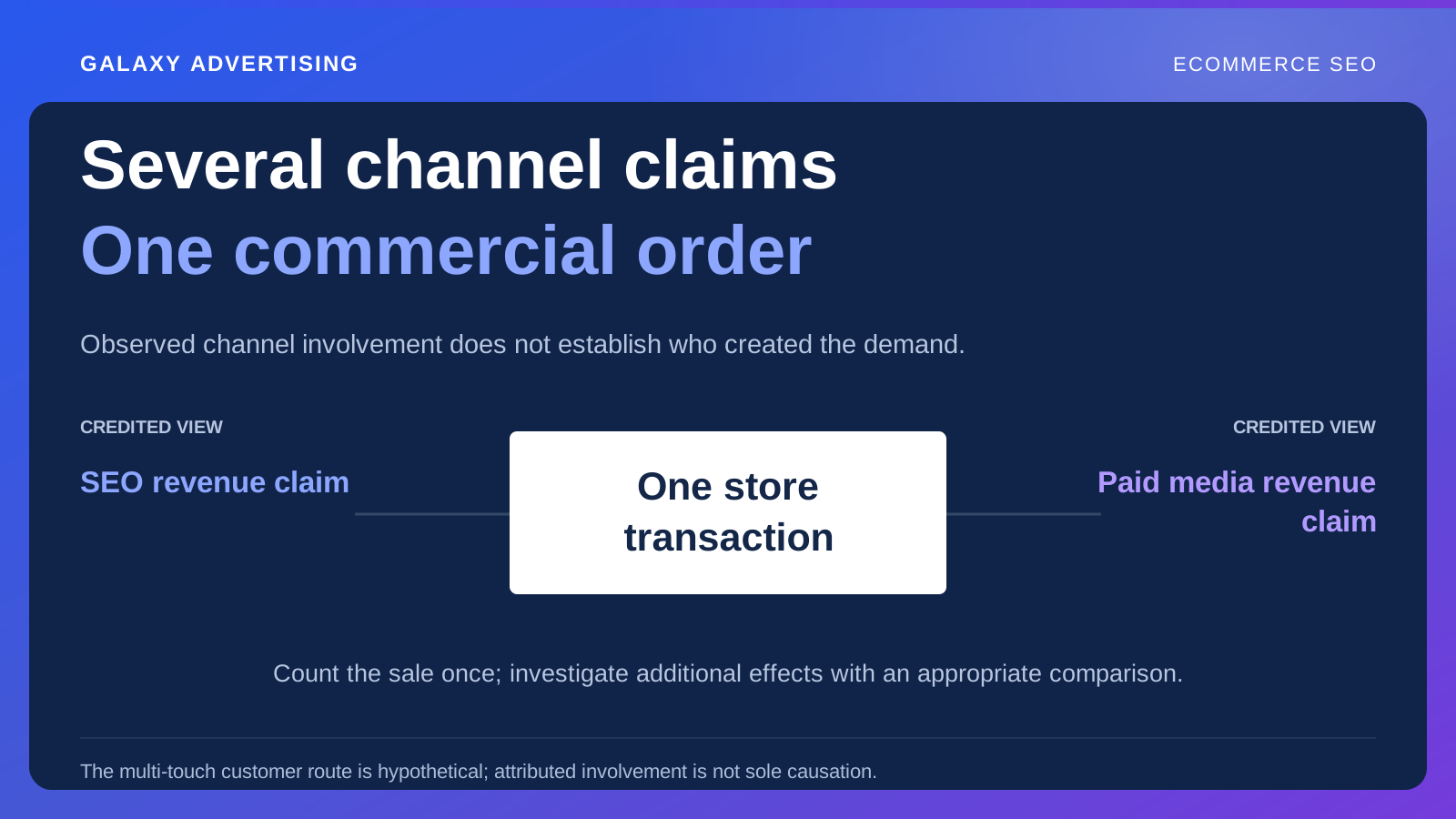
Count each commercial transaction once. Explain any attributed channel relationships separately. Adding overlapping channel totals, or claiming every order involving organic search arose solely from SEO work, creates confusion. Your business needs an understandable account of what happened, not a contest over who can claim the largest revenue number.
Put changing conditions beside the result
Record material changes in stock, prices, promotions, website behaviour and other marketing activity. They affect the offer available to shoppers and how those shoppers arrive.
Include measurement changes too. A revised event or a different channel definition can move a chart without the equivalent change in customer behaviour. That explanation belongs beside the headline, before somebody acts on it.
Apply the same discipline to good results and weak ones. External conditions should not appear only when you need an explanation for disappointment. Consistent context gives the next review a stable starting point and makes the team's judgement easier to trust.
Turn recommendations into decisions you can approve
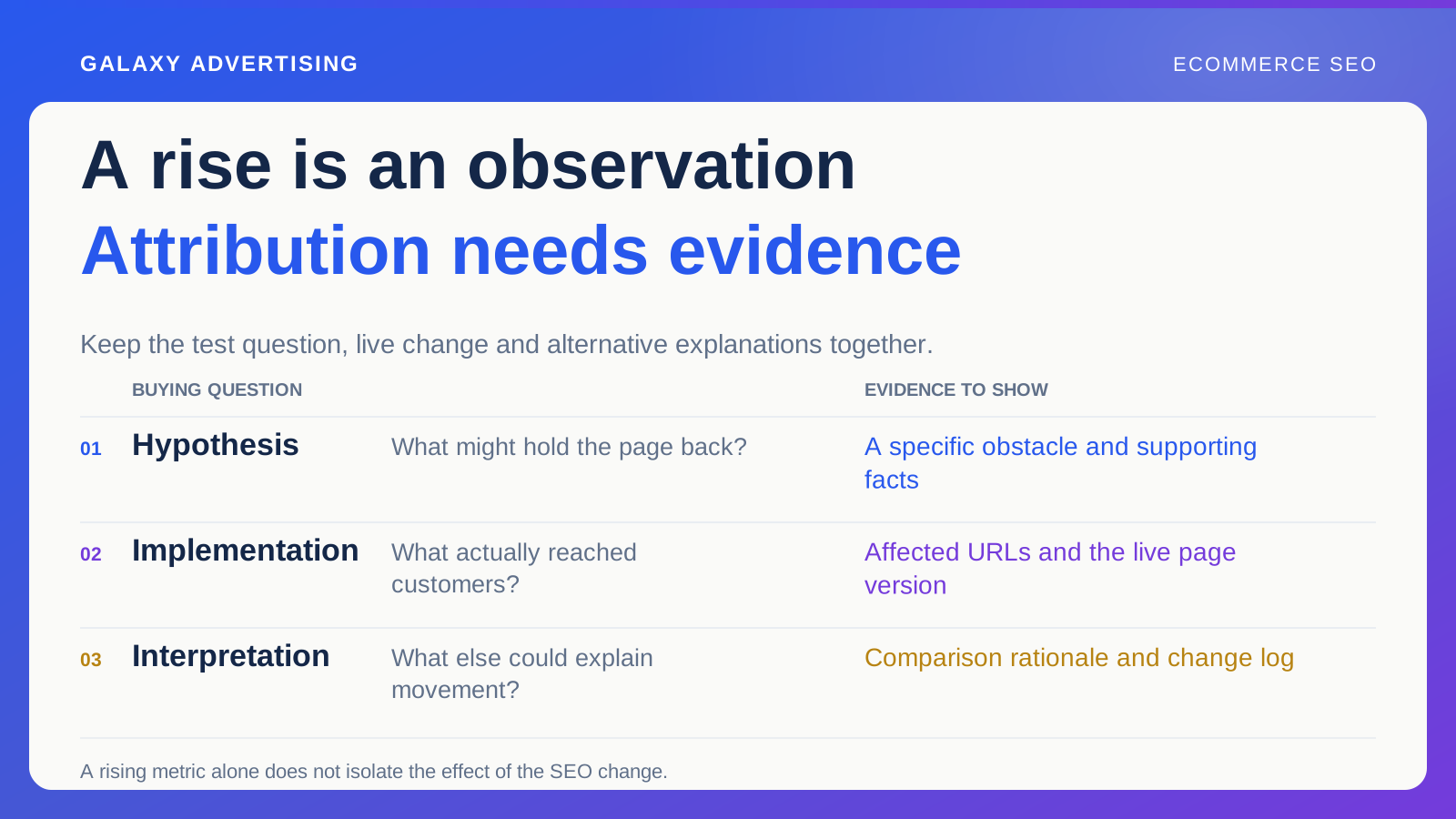
For each important action, state the observed problem or hypothesis, the work needed, who owns it and the check that will confirm acceptance. “Optimise pages” leaves almost everything unresolved.
If the evidence is inconclusive, explain what further observation would change the recommendation. A bounded investigation may be the sensible next commitment. You do not need an invented revenue gain to make a reasonable, unproven improvement sound worthwhile.
Name your decisions as the retailer, too. Product confirmation, development capacity and commercial approval can be genuine dependencies. Put them on the page so a blocked task does not return next month disguised as another vague delay.
Show where the evidence changed your mind
Where relevant, include a recommendation the team revised after its first assumption failed. Perhaps a page needed a factual correction rather than more copy. Perhaps the selected range was not commercially ready for the planned work.
The value lies in the reasoning and the owned action. A decorative lesson learned section adds little. Say which assumption changed, what observation challenged it and how the next commitment now differs.
That gives you evidence of judgement. It also makes the report a record of better decisions, instead of a defence of whatever happened to be in the original scope.
Start the next review with the last decision
At the following meeting, check what happened to the previous recommendations. Agreement is not implementation. Verify that the change went live.
Keep a concise record of what you learned and what remains unresolved. Another specialist should be able to understand the programme without piecing together several months of chart commentary.
An SEO report does not have to make every period look positive or every conclusion sound final. Its value is the connection between a real buying route, accountable work and proportionate judgement. You should be able to see what the business can responsibly do next, why the evidence supports it and which changing conditions would make you choose differently.