A review can praise a television for one use and still identify tradeoffs that matter for another. Lift only the enthusiastic sentence into your advert and the words may remain memorable while the impression loses its support. The surrounding conditions are part of the evidence too.
External material helps when you connect it to a real buying question. Preserve relevance, scope and permission rather than simply collecting praise. One assessment cannot act as a general guarantee of every customer's experience.
Check which product the reviewer actually assessed
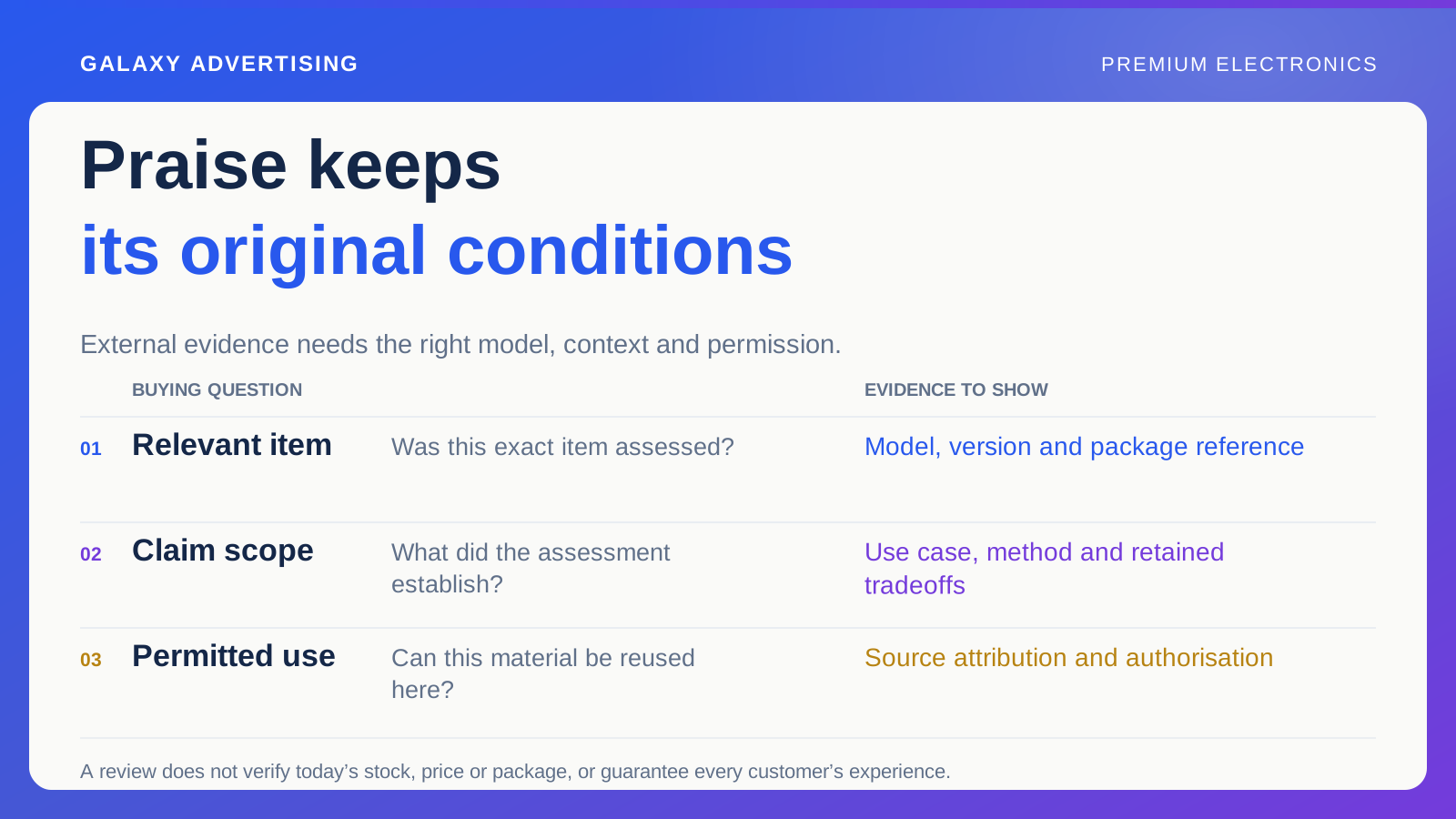
Identify the exact model, version and package. A familiar family name can cover meaningful differences. A review of one item does not establish the same conclusion about its successor or a different size, however similar the names appear.
Keep the source and relevant product reference together. Whoever approves the advert should be able to trace the connection without reconstructing it from a screenshot of a headline. Give the evidence a reference that remains useful after the original conversation.
If an earlier model is involved, decide whether the assessment still serves as background and label that context plainly. An old positive verdict should not fill an evidence gap for a new product in a way the source never intended to support.
Read beyond the flattering sentence
Inspect what the reviewer evaluated and the circumstances shaping their conclusion. Praise for one intended use can sit alongside tradeoffs for another. Those tradeoffs may be central to the decision your customer is trying to make.
A high overall verdict does not prove every individual claim in your copy. Reviews can contain opinions, measured observations and preferences. Keep their roles distinct instead of treating the final rating as permission to make a broader promise.
For a hypothetical monitor comparison, praise for a particular workflow should not become a universal suitability claim. Explain why the reviewed characteristic matters to the relevant customer, while acknowledging that someone with other requirements could reasonably choose differently. The qualification can make the comparison more useful.
Start with the customer's uncertainty
Choose the question before choosing the quotation. A shopper may be comparing physical controls, trying to understand a documented feature or looking for another assessment of a shortlisted model. Establish what the external material needs to help resolve.
Then select material that addresses that question. A memorable observation about appearance may add little when the unresolved issue is compatibility with existing equipment. Flattering and relevant are not interchangeable descriptions.
This order protects the purpose of the content. Start with the most enthusiastic quotation and you may invent a question afterwards to justify using it. A useful comparison should keep helping even when the external conclusion is balanced or qualified, rather than uncomplicated praise.
Make the source and permission clear
Identify the publisher or contributor accurately and make the original context accessible where the format allows. The reader should recognise which judgement belongs to the external source and which explanation you have added as the retailer.
Confirm permissions and usage requirements through the people responsible. A publicly accessible article does not establish that every image, badge or extract can be republished in advertising. Keep the relevant authorisation record with the asset so later versions do not lose that basis.
Do not invent an award treatment or certification badge because a source said something positive. Describe the relationship you can document. Accurate attribution can add credibility without suggesting that the reviewer endorsed your business when no such endorsement was provided.
Supply the offer details the review cannot provide
The external assessment may say a great deal about the product while saying nothing about your package, current stock or delivery arrangements. Add that commercial information separately. The review should not be asked to stand in for the whole offer.
Use verified model information to identify accessories the customer's intended setup requires. A reviewer may have used equipment the buyer does not own and that your advertised price does not include. Make those dependencies visible rather than allowing the demonstration to imply a complete package.
Keep stock and price current through your own process. Publication context can explain a review's comparison, but it cannot verify today's purchasable offer. The page must connect the independent observation with what someone can actually order from you now.
Keep excerpts visually distinct from your commentary. Readers should not need a careful punctuation inspection to find where the external assessment stops and your interpretation begins. That distinction matters particularly when a short quotation sits alongside a much longer retailer explanation.
Explain disagreement instead of tidying it away
Reviewers can value different characteristics and use different assessment methods. Conflicting verdicts do not establish that one source must be wrong. Understand what each was evaluating before turning the disagreement into a sales conclusion.
Relate the difference to the customer task. Physical convenience may matter most to one buyer; a particular documented connection arrangement may matter most to another. Your role is to help someone judge the tradeoff, rather than force every assessment into a single ranking.
Where the evidence remains unclear, name the unresolved question and offer a responsible route to investigate. Selectively chosen quotations can make a purchase look simpler while leaving the actual uncertainty untouched. Confidence in the copy is not the same as confidence in the evidence.
Recheck the context when something changes
Assign ownership of external references in live pages and adverts. Replacement models, altered bundles or changes in the source's own presentation can make a previously accurate use confusing. The maintenance job includes more than checking whether the link still opens.
Review the complete communication after edits. Put a quotation beside a different product image and it may imply that the source assessed the newly shown item. Layout and imagery contribute to context just as the quoted words do.
An independent review is most useful when it helps someone assess a particular aspect of a particular product, with room for the source's limits and the buyer's needs. That gives you a decision you can explain and stand behind. An incomplete offer surrounded by praise gives you much less.