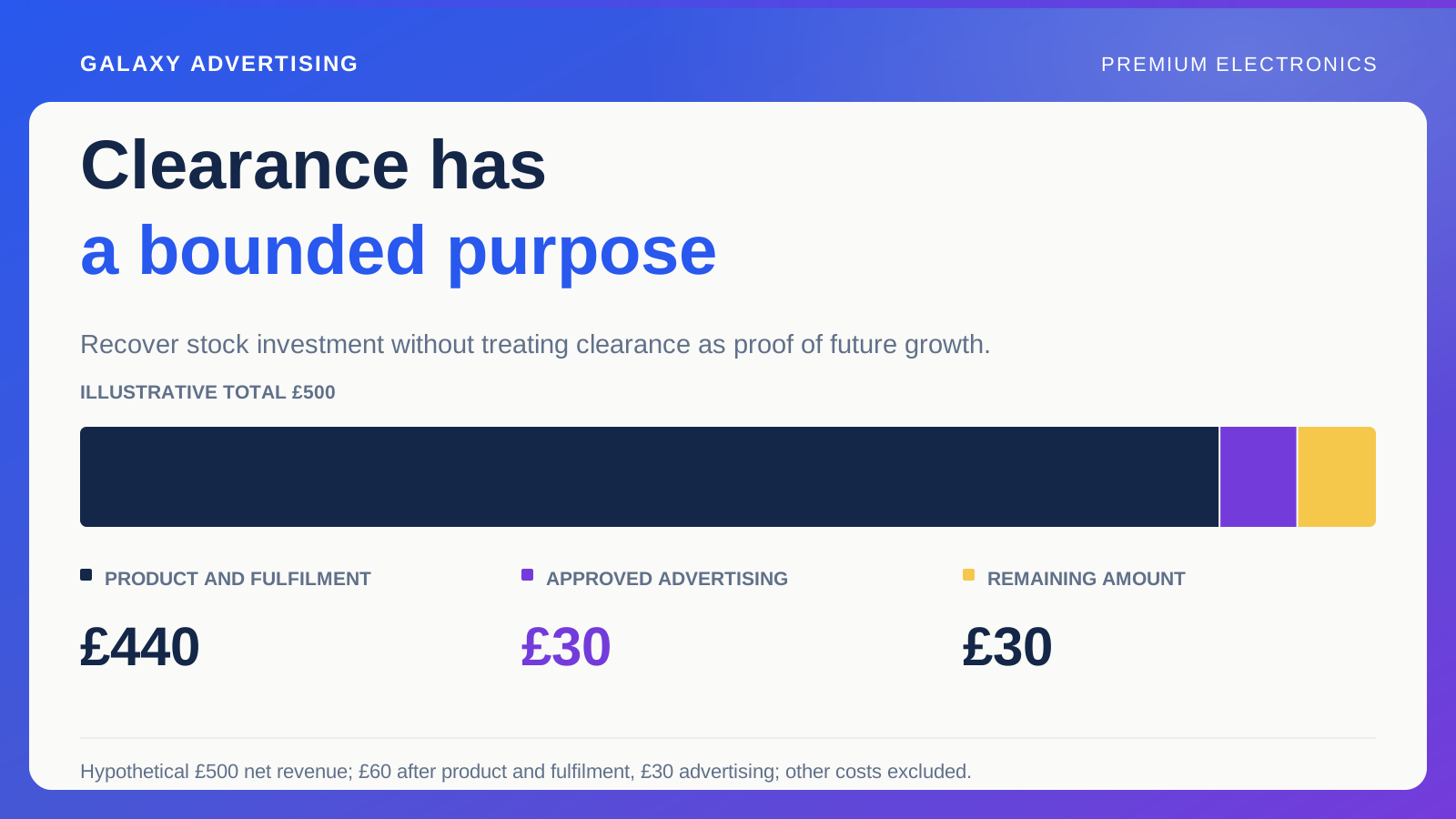
£30 can be all that remains from a hypothetical £500 clearance order after the relevant product, fulfilment and approved advertising costs. That can still be a useful result. It just needs to answer the right commercial question.
When an older model takes up warehouse space, a price reduction can bring orders and a sharply better advertising report. Clearance can release stock investment, serve suitable customers and make room for another range. Judge it against that purpose, rather than assume you have discovered a repeatable acquisition programme for after the units have gone.
Agree which stock problem you are solving
Identify the real constraint. It might be remaining stock, a discontinued package, an approaching supplier transition or another documented condition. Do not use clearance as a loose label for any promotion you want to make sound urgent.
Record the units and exact product references involved. A category can contain several versions with different availability and purchase costs. Treating them as one pile of old stock can leave you with a price decision nobody can properly explain.
Agree the review purpose with whoever owns the commercial decision. Recovering investment within an approved limit differs from proving a channel can acquire future customers at the same ratio. Both can matter. They should not silently share a success measure.
Check the product is still a suitable purchase
Confirm the precise item, its condition and package contents. Make it clear whether someone is buying a display unit, a returned product or a new boxed product. The reduced price does not explain that distinction for you.
Keep the documented information people need to assess the model. Intended use, included equipment and relevant compatibility conditions still matter when the price comes down.
Do not imply the outgoing model has every feature of its replacement. Customers may reasonably choose the earlier version, provided they understand the product actually offered. A discount is useful when it makes a suitable option more accessible. It should not hide a difference that could change the decision.
Calculate what you recover on an agreed basis
Use your business's treatment of stock cost, relevant fulfilment costs and advertising. Ask finance or the owner which measures matter for this decision. A convenient new margin definition will not make the comparison more useful.
Here is the full hypothetical calculation behind that opening figure. The offer generates £500 of net revenue and leaves £60 after the relevant product and fulfilment costs included. With an approved advertising commitment of £30 per resulting order on that basis, £30 remains before other excluded costs. This illustrates a method, not a recommended clearance target.
Discuss realistic alternatives as well. Holding the units, using another sales route or changing the package each brings different costs and uncertainties. Age alone does not establish that cutting the price is necessary. Assess the discount against the choices actually available to you.
Let the stock records support the urgency
For a finite offer, agree how availability gets updated and how advertising responds as it changes. A genuine stock limit is not permission to keep advertising an unavailable product indefinitely.
Be specific about the constraint. If only one variant, the selected configuration, is limited, do not suggest every configuration is nearly sold out. Your message needs to describe the offer, rather than a dramatic interpretation of the inventory.
Review destinations as the selection narrows. Someone following an advert for one package should not have to work out that only another arrangement remains. Offer an alternative if useful, but clearly identify it as an alternative. A silent substitution is a different promise.
Explain the lower price without undermining the product
A straightforward account of a range transition can explain the price without calling the product obsolete or implying an undocumented problem. You do not need to make it sound undesirable to explain why you are selling it.
Use verified information to show which requirements it still supports. Some shoppers will not need the replacement's extra features. Others will find those differences important enough to choose something else.
Leave room for both decisions. Calling the outgoing model universally equivalent to the replacement weakens the comparison. Your need to clear stock should not overrule the customer's requirements.
Keep replacement recommendations distinct from the clearance message. Someone whose needs rule out the older model may still be a suitable buyer for the newer version. Your process should support that choice, rather than force the discounted option because it carries today's stock objective.
Keep the result separate from the future claim
Report fulfilled units, recovery on your agreed cost basis and the stock still remaining. Put the promotional price and material offer changes beside the advertising result, where the person reviewing it can see them.
Do not carry that acquisition cost straight over to a replenished product sold at another price. The clearance condition may explain much of the demand. You have answered a bounded inventory question, without necessarily proving a sustainable route to new customers.
Track avoidable returns and enquiries when they reveal order quality. Strong initial sales can become less valuable if people misunderstood the package. Keep those consequences in the review instead of declaring victory at the first falling stock count.
Finish the offer properly
Name who will retire the creative, update product status and remove obsolete promotional references. Completing clearance is an operational handover, not just a decision to stop campaign spending.
Where your website strategy calls for useful product information or an alternative route, preserve it while making the sold status clear. A favourable price should not remain as an unexplained invitation to buy something unavailable.
A clearance programme can be valuable precisely because its purpose has limits. It serves suitable buyers and resolves a real inventory decision. Remembering that result accurately gives you something firmer for the next stock discussion than an expectation that every future electronics campaign should deliver the same return.