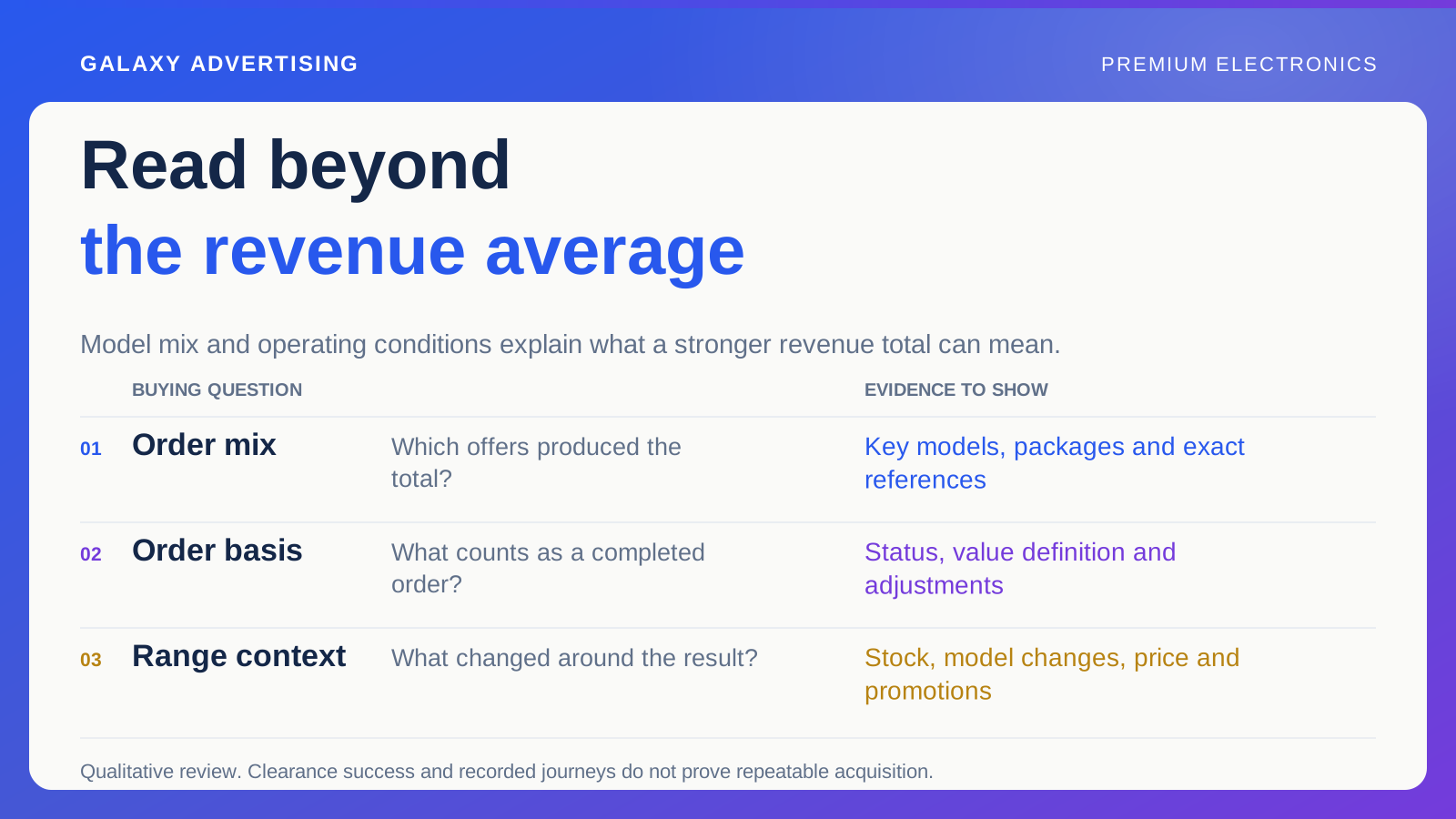
A confession for the planning table: a big electronics order is reassuring before anyone asks what it leaves behind. That is a common mistake when deciding what advertising can afford. Product costs, package contents and service arrangements differ across the range, so revenue tells only part of the story.
Start with definitions you agree, rather than borrowing another account's target. The calculation gives you a transparent reference for judgement. It neither predicts the cost of acquiring unlimited future customers nor replaces a full profit statement.
Agree which transaction you are measuring
Choose your revenue basis and explain how you treat tax, discounts, delivery income and relevant adjustments. Advertising reports and the contribution calculation need compatible definitions before their ratios can fairly be compared. Settle that before debating the target.
Identify the order status too. A placed order may change when an adviser clarifies the package. A cancellation or later refund can change the eventual result again. The first recorded value need not be the last commercial outcome.
Keep those changes connected through a stable transaction reference. You should be able to distinguish a genuine commercial adjustment from a measurement fault, rather than treating every system difference as the same problem. Ask finance or the commercial owner to approve the definitions.
Put the relevant costs in writing
Begin with product cost, then include the variable items your business chooses to consider. Payment processing, packaging and a delivery subsidy may belong here where they apply. Make the scope explicit so everyone knows what the remaining amount means.
Identify material support and fulfilment assumptions without pretending to precision you do not have. A package that routinely needs a different service arrangement could need a different allowance. Where the burden is uncertain, show the estimate and name whoever will review it.
State what is excluded. Premises, salaries and other overheads may still need funding from the retained amount. Contribution, the money remaining after the costs included in this calculation, can be narrower than total profitability. The mistake is presenting that remainder as comprehensive profit.
Follow the £1,200 example through
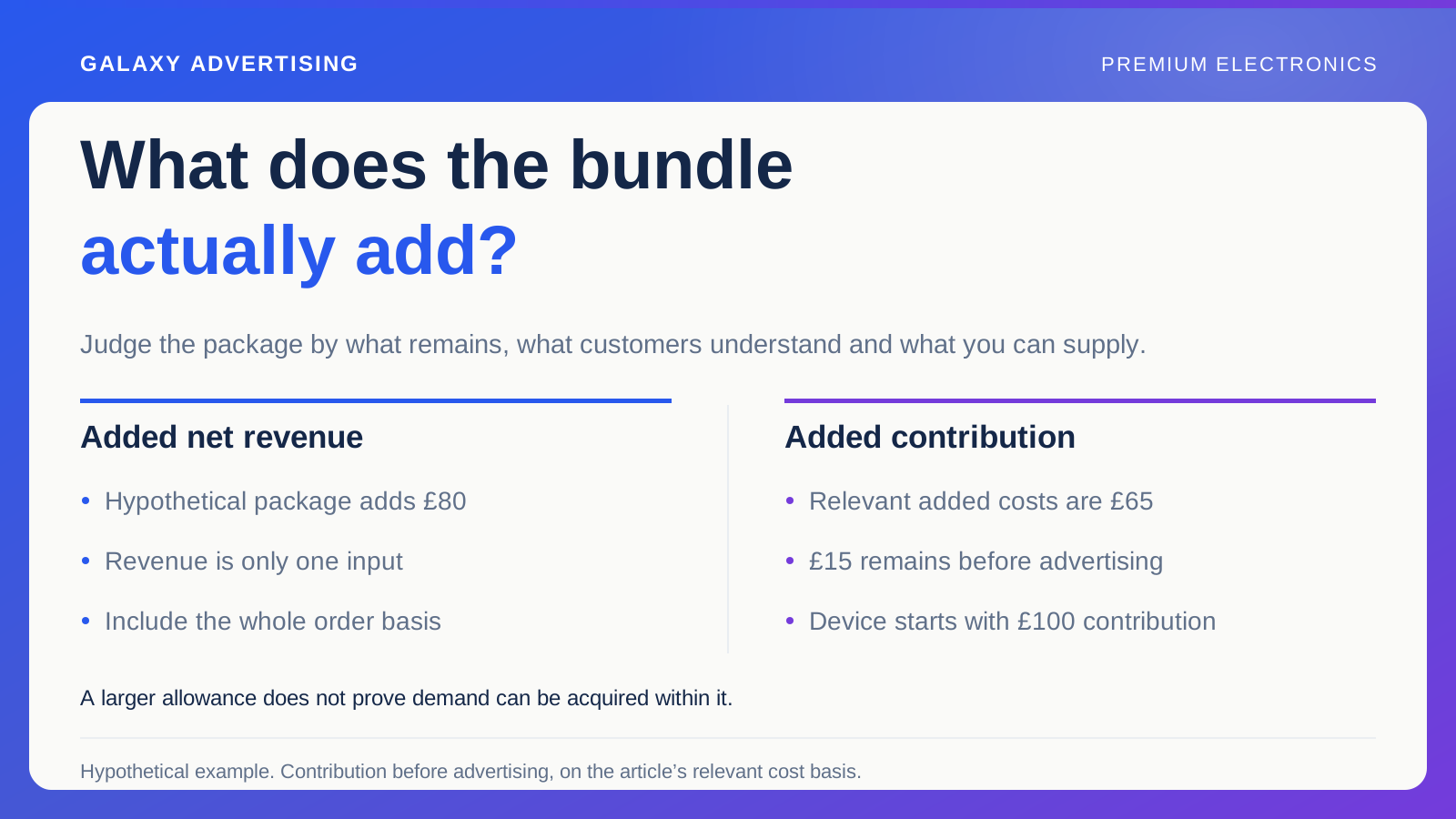
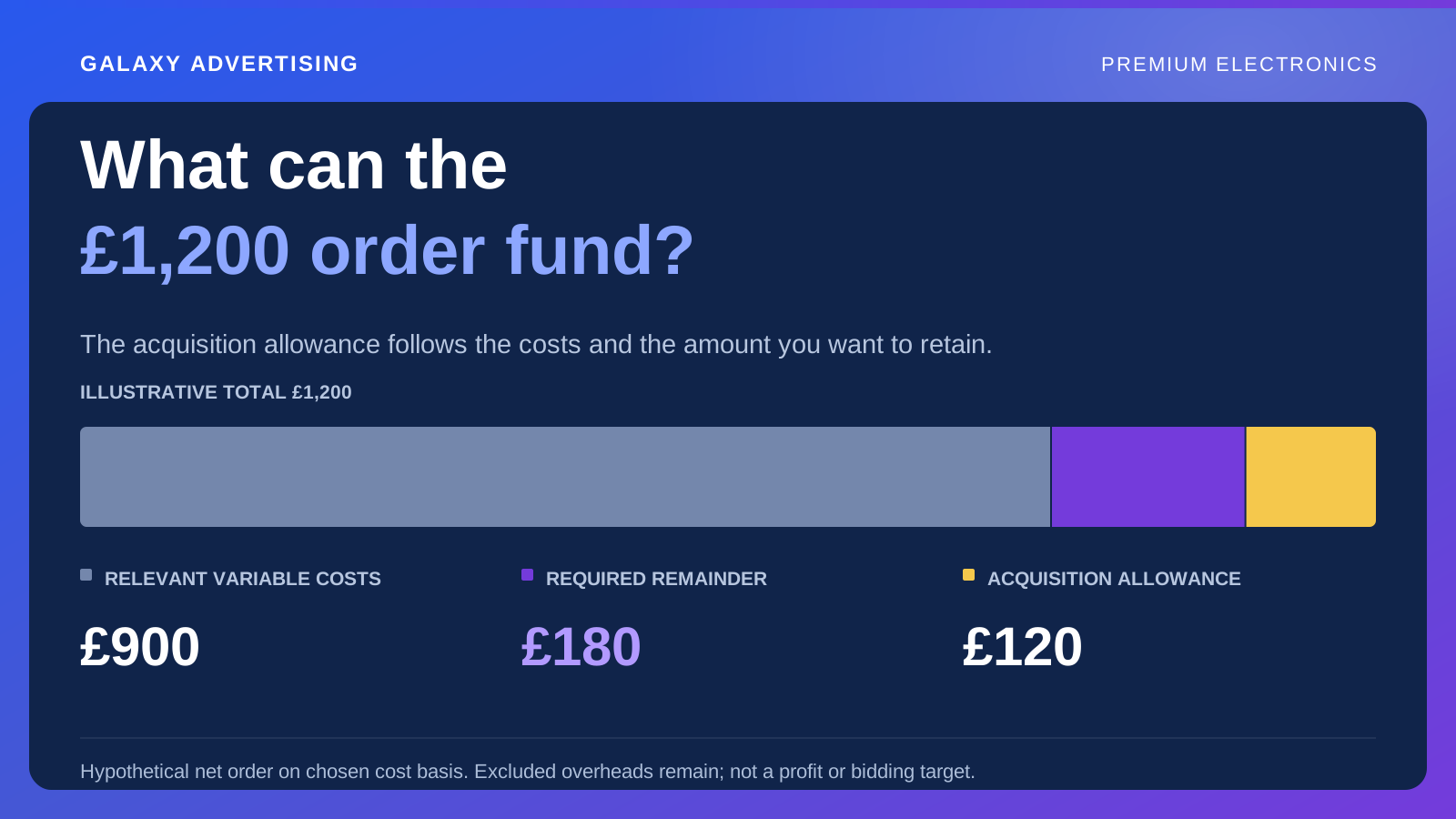
Take a hypothetical £1,200 net order with £900 of relevant variable costs on your agreed basis. That leaves £300 before advertising and anything excluded from the calculation. The order's headline value looks rather different once its costs are beside it.
Suppose you want £180 to remain. That makes the illustrative acquisition allowance £120. Divide £1,200 revenue by £120 advertising cost and the resulting ratio is ten, under these particular assumptions.
These figures explain a method. They are not a benchmark recommendation for electronics retailers. Another package can have different costs and a different retained contribution requirement. What matters is the visible relationship between the order, the money needed to serve it and what you are prepared to invest in acquiring it.
Do not turn the allowance straight into a platform instruction
A commercial reference, an average reported result and a bidding setting are different things. Review your account's available controls, actual configuration and evidence in their own right. A familiar ratio can mean something different in each conversation.
Asking a platform to pursue a ratio does not establish your full economics or guarantee demand at that level. The calculation can inform a campaign decision without translating mechanically into an exact instruction for every campaign.
Ask the account manager to explain the proposed connection. Which product group is involved? What values does the system receive? Which uncertainty remains? Those answers make approval more useful than accepting a number simply because it sounds recognisable.
Split products only when it changes a decision
Identify differences in contribution or service requirements large enough to affect investment. A complete package and a standalone unit may need different references even when their public names sound alike. The distinction should have a practical purpose.
Keep the grouping maintainable. Detailed classification loses its value if nobody updates it when supplier prices or package contents change. More labels can mean more places for old assumptions to hide.
Document why each group exists and where its source information lives. You want repeatable commercial distinctions, not labels preserved indefinitely because they appeared in one report. A few maintained differences can be more useful than an elaborate model going quietly out of date.
Check the allowance against real orders
Choose a manageable sample that materially affects the result. Connect the advertised item with the fulfilled configuration, recorded values and relevant adjustments. That tests whether the calculation is meeting the orders the business actually serves.
Investigate differences before choosing a correction. Someone may have added equipment, switched packages after advice or received a refund later. Each explanation points towards a different action. A mismatch alone does not identify which system or assumption needs changing.
Keep attribution limits visible. An order associated with advertising does not prove the whole sale was additional. The allowance explains affordability on your chosen basis. Judging wider investment still requires a view of demand and the evidence available.
Decide what you can afford to learn
A new model family might deserve a bounded test before response and service burden are well understood. State that learning purpose and agree an affordable commitment. Uncertainty can be funded deliberately without being hidden.
Name assumptions that could materially change the next decision. You should know what information is needed before committing again. An optimistic allowance is not permission to keep spending indefinitely while waiting for the answer to improve.
Include conditions requiring prompt action, such as an unavailable package or inaccurate destination. Those corrections should not wait for the broad performance review merely because some approved test budget remains unspent.
Change the reference when the offer changes
Update assumptions after material changes in costs, prices or service. A stable advertising ratio can become less attractive when the order underneath it leaves less contribution. The dashboard need not move for the commercial decision to change.
Give the review a concrete consequence: adjust product emphasis, investigate a recording gap, explain a package better or continue within existing limits.
A worthwhile target is one you can explain and maintain, with your required contribution visible. It remains useful when the excitement of a high value order has worn off and the costs of supplying it arrive.