A furniture collection can still be available while the finishes your adverts make people want are becoming difficult to supply. If you're about to put more money behind a successful sofa campaign, that distinction matters.
The orders so far may be worthwhile. They also arrived while popular finishes were available, delivery conditions were stable and your team could answer configuration questions promptly. More demand won't necessarily arrive into the same business conditions.
Readiness means asking what happens next. Identify which parts of that success support expansion and which need preparation. The budget decision follows that judgement. It can't do the thinking for you.
What made the recent orders work?
Start with the configurations, finishes and buying conditions customers actually saw during the period. Connect the commercial result with the offer they could buy, rather than the collection name sitting in the report. A collection name can cover quite different purchases.
Bring in meaningful changes to price, promotions and fulfilment. Orders won with a particular package don't establish what will happen once that package ends or becomes more expensive. You need a consistent commercial basis for the comparison.
Then check how widely the success is spread. Several valuable purchases in one arrangement give you a reason to investigate further. They don't establish that every configuration deserves equal investment. Understand where the result stops before you extend the claim.
Can you supply what the next adverts show?
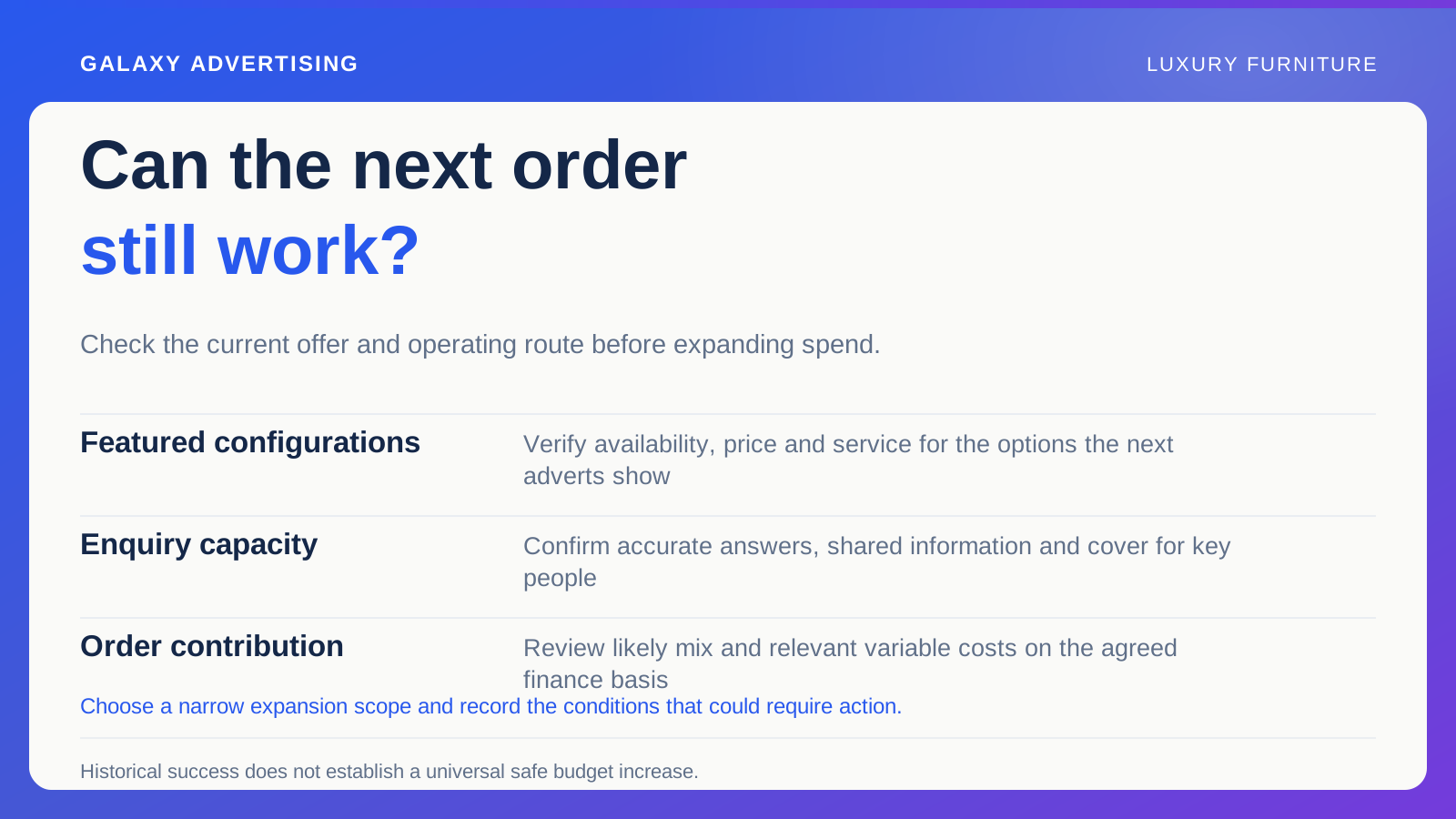
Check the configurations and finishes in the proposed creative. General collection availability isn't enough if the versions attracting customers are difficult to supply.
Put the creative plan beside a verified availability view. If you change the featured arrangement, review the price, imagery and service explanation too. Another version isn't automatically the same proposition with a different photograph.
Give the campaign manager a reliable route to important updates, with someone clearly responsible for providing them. An expansion plan is vulnerable if the person spending your budget first hears about a stock or lead time change from a customer's question. That communication belongs in the readiness check.
Who will answer the extra questions?
Ask your sales team what more suitable interest would require. Configuration questions, sample requests and service enquiries can take different kinds of staff time from a straightforward product order. Count the work your buying route actually creates.
Look for tasks that depend on one person, or information sitting outside the shared process. More demand can expose those weaknesses before it produces a matching increase in completed orders. A busy inbox isn't the same outcome as a healthy order book.
Don't respond by removing useful questions from the buying route. A considered purchase can reasonably need clarification. You're looking for an efficient, accurate response with clear ownership. A page that appears effortless but leaves people discovering important conditions after payment hasn't solved the problem.
Do the likely orders still justify the spend?
Review contribution, meaning the money remaining after the costs included in your calculation, for the products likely to receive extra attention. A different configuration mix can change the economics while headline revenue rises. More revenue alone doesn't settle this decision.
Use the basis agreed with finance and include relevant variable costs and material fulfilment obligations. If expansion depends on different supply or service arrangements, put those conditions into the calculation. Carrying the old average forward automatically would hide the change you're trying to assess.
Be clear about an optimistic future order mix if you're using one to justify current investment. You can choose to fund uncertainty, provided that choice is explicit and affordable. An allowance for acquiring an order isn't evidence that additional demand will actually arrive at that cost. Keep those judgements separate.
Is the next market comparable?
If you plan to expand into another audience, region or product family, identify what changes along the buying route. The same creative argument can meet different service conditions or information needs elsewhere.
Take a hypothetical retailer promoting into another delivery area. The question is whether the documented service and commercial basis remain suitable there. A successful campaign in the existing area cannot answer that operating question for you.
Choose a next step narrow enough to interpret. Expanding geography, product range and creative proposition together makes it harder to work out what caused the result. State which differences the next move will investigate. Several simultaneous changes shouldn't be presented as one simple decision to scale.
Agree what would make you act
Name the conditions needing prompt attention. An inaccurate availability promise and an enquiry process unable to give timely answers are operating problems. Keep those safeguards distinct from the broader evidence you'll need to judge commercial performance.
Give someone authority to change the campaign, and make responsibility for the underlying fix equally clear. The person able to pause an advert may be unable to correct the product source or change service capacity. You need both responsibilities visible.
Record material interventions during expansion, including what changed and why. Otherwise you risk crediting higher spend for an outcome achieved while important parts of the offer were moving too.
Check how quickly an inaccurate message can actually be corrected. A named owner helps, but you also need a workable response when that person is unavailable and promotion is still running. Readiness has to work in practice.
Make the next investment explainable
Choose the scope of the next investment, the information the review will use and who recommends whether to continue. There isn't a universal percentage increase that proves every furniture retailer is ready.
Review actual orders and contribution beside results attributed to the campaign. Put known stock and service changes around those figures. If the activity attracts unsuitable configurations or exposes a weak destination, deal with that evidence. Earlier success doesn't oblige the next phase to repeat it.
Expansion makes sense when the offer, economics and operating route support it. You should be able to explain what another order would ask of your business and why it's worth pursuing. A favourable historical average cannot give you unlimited permission to spend.