 Meta Ads
Your dining table advert fills the screen with a beautiful room and “uncompromising quality”. Then the viewer sees a substantially higher price than a superficially similar alternative, with little to explain the difference.
They might admire the room. They still don't know what the extra money buys. The creative has built a mood while leaving the commercial comparison unresolved.
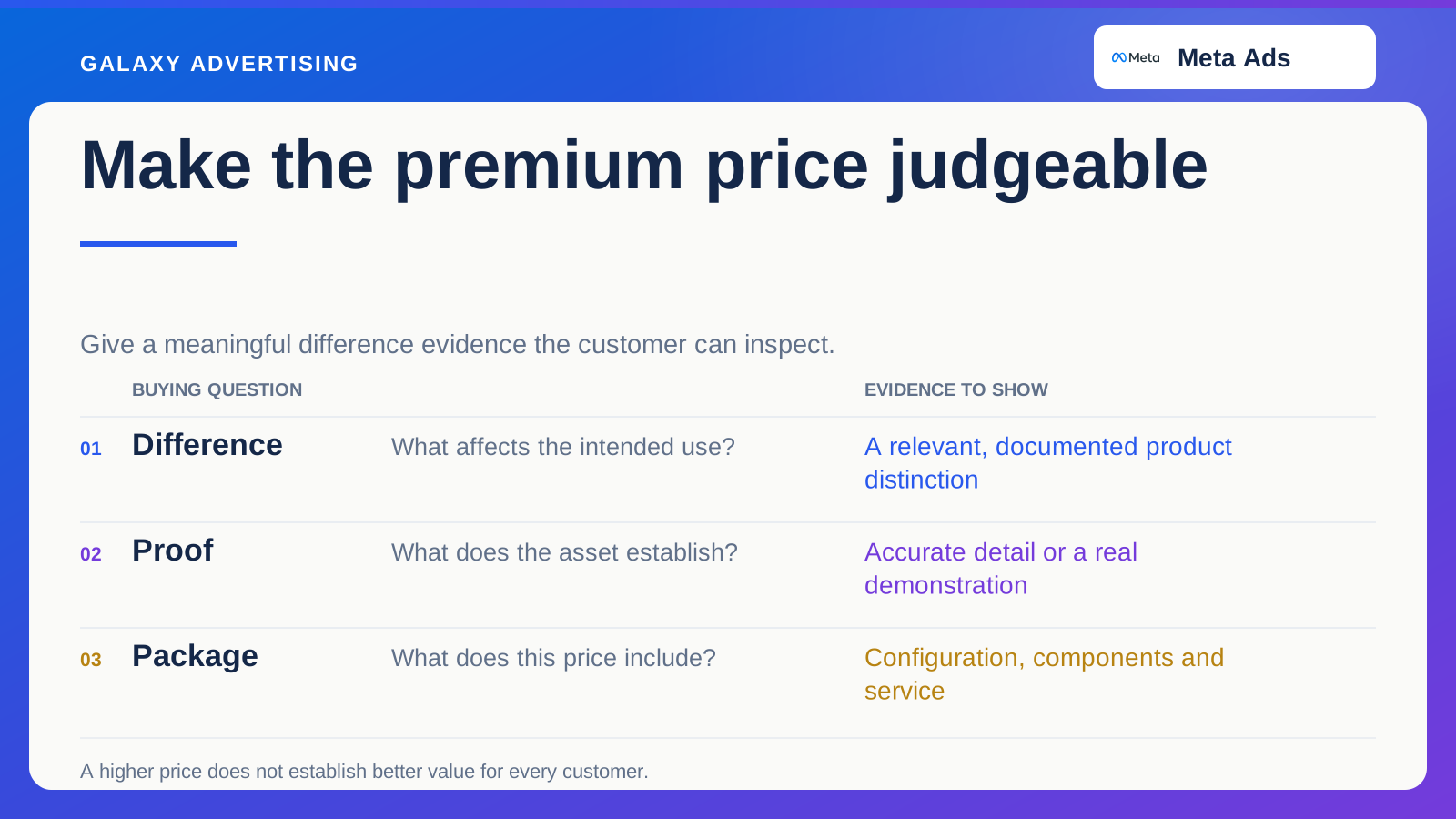
You don't necessarily need a longer specification list. You need a meaningful distinction, evidence that supports it and a destination where customers can inspect both. Explain the difference plainly before asking an editor to make it look expensive.
Find out what they're comparing you with
Ask sales and customer service which alternatives customers mention. Are they comparing the same product at another retailer? Or do similar little images hide different materials, dimensions or service packages? Those are different problems and deserve different arguments.
If the model is identical, don't invent a manufacturing advantage. Your useful distinction might be documented delivery arrangements, availability or support. Where products differ, choose the differences that affect intended use. You don't need every technical detail the supplier can send you.
Describe the comparison in ordinary language. One hypothetical table extends for occasional guests; the smaller alternative doesn't. That gives creative a practical decision to explain. “For discerning homes” leaves the customer doing rather more of the work.
Give one difference enough room
A short advert can't give equal attention to material selection, construction, finish, design history and delivery. Choose the strongest relevant argument and allow enough screen time for people to understand it.
If it's the extension mechanism, show the real operation and resulting arrangement. For a distinctive finish, use an accurate reference and close view that preserves its appearance. For delivery, explain the work included. Unrelated luxury scenery doesn't demonstrate the service.
Try describing the distinction without music or an impressive setting. Does it still make sense? If it doesn't, the atmosphere may be implying evidence you haven't supplied. Atmosphere can support your positioning. The buying argument still needs facts underneath it.
Know what your evidence actually establishes
Saying you care about craftsmanship offers reassurance. Showing an accurate, relevant construction detail gives someone evidence to assess. A testimonial can describe one customer's experience, but it doesn't establish every technical or service claim in the advert.
Make those roles clear in the brief. What can viewers assess from each shot? What does it merely suggest? Remove unsupported implications as well as unsupported words. Workshop footage, for instance, could imply you manufacture a product when you only distribute it.
Keep the source for important claims with the approved creative. If a supplier's documented specification supports your material description, retain that reference. The person making the next version shouldn't have to reverse engineer the fact from an earlier edit.
Explain what the price includes
A higher price may buy a different configuration, larger size or additional service. Establish what is included before comparing numbers. Otherwise, the customer is being asked to compare packages without knowing whether they're equivalent.
Take a hypothetical £900 table and £1,100 table. If one is a compact fixed model and the other includes an extension configuration, the prices alone don't give a meaningful comparison. This doesn't establish that the second is better value. It establishes what the customer needs to know to decide fairly.
Be wary of turning an assumed lifespan into a daily cost. Unless the assumptions are supportable, a tidy calculation can conceal an uncertain durability or usage claim. Start with the actual offer before reaching for impressive arithmetic built on guesses.
Put the advertised difference on the page
Send people to the relevant product or a focused range. Make the distinction easy to find without searching through unrelated promotional copy. If the advert demonstrates the extending version, identify that version and its price clearly.
Give customers the information they need to challenge the proposition: dimensions, included components and documented service conditions. They need to decide whether the premium difference matters in their circumstances. Hiding detail makes that harder; it doesn't strengthen the position.
Follow the route on a phone using the same reference as a new visitor. Your team might recognise the product instantly while the customer faces several similar options. A persuasive demonstration loses force if they can't identify what you've shown them.
Answer the reasonable objection
Write down a credible hesitation. Perhaps the customer likes the table but can't see why the extra cost is worthwhile for their room. Build an asset around explaining the relevant difference, without belittling the alternative or the person considering it.
Acknowledge when that feature may not matter. Someone who never needs extra seating may reasonably prefer the compact model. That keeps the argument specific. The most expensive option doesn't have to be universally superior for your proposition to be useful.
Ask somebody outside production to review the script. Have them describe the difference they understood and the evidence they remember. If they only repeat adjectives, revise the explanation before applying more visual polish. This checks clarity. It doesn't predict campaign performance, but it tells you whether the argument is getting through.
Listen to the questions your argument creates
Read campaign reporting alongside the product exploration, enquiries and order evidence available to you. Are customers asking about the distinction you advertised? Can they find the right configuration? Does the resulting product mix leave worthwhile contribution, meaning money remaining after the acquisition and fulfilment costs in this calculation?
Strong engagement doesn't prove the price argument has worked commercially. Equally, a price enquiry doesn't automatically mean it failed. A better informed comparison can produce a specific question your business is well placed to answer.
Let that evidence guide production. Clarify a distinction people misunderstand, supply a missing demonstration or reconsider the emphasis on a feature. Your premium price needs to be easier to judge. Making the language grander won't do that job for it.