What does this customer still need to know before they'll feel comfortable buying the cabinet? A question about marks visible from the front needs a different answer from a question about restoration or the maker attribution, even when everyone is looking at the same piece.
It's tempting to reach for a reassuring sales response. With unique stock, that can leave the real uncertainty untouched or add a claim you can't support. Keep the question tied to the actual object, preserve its context and answer within what you know. Then the enquiry becomes useful evidence about the buying decision.
Find the uncertainty inside the question
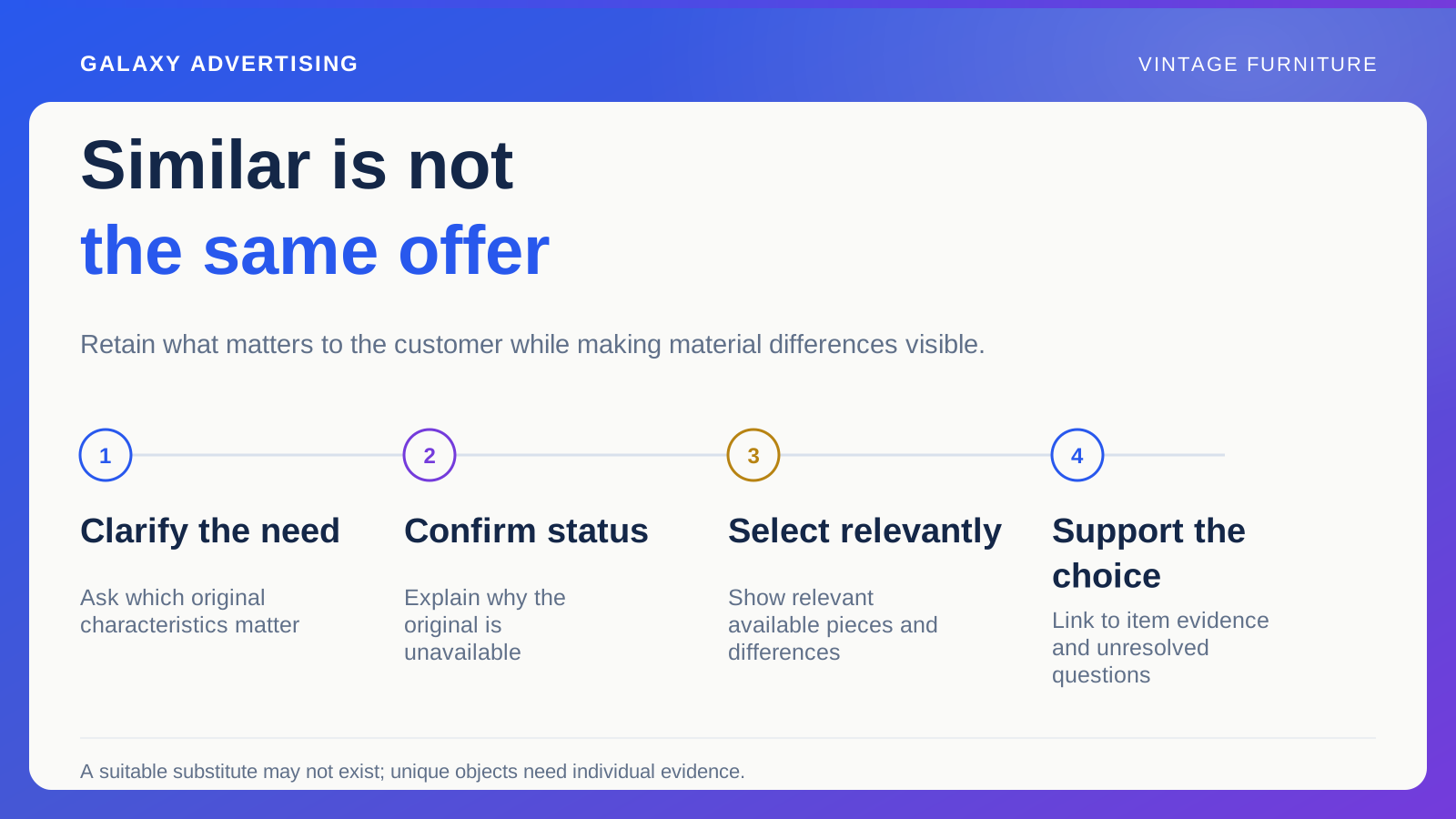
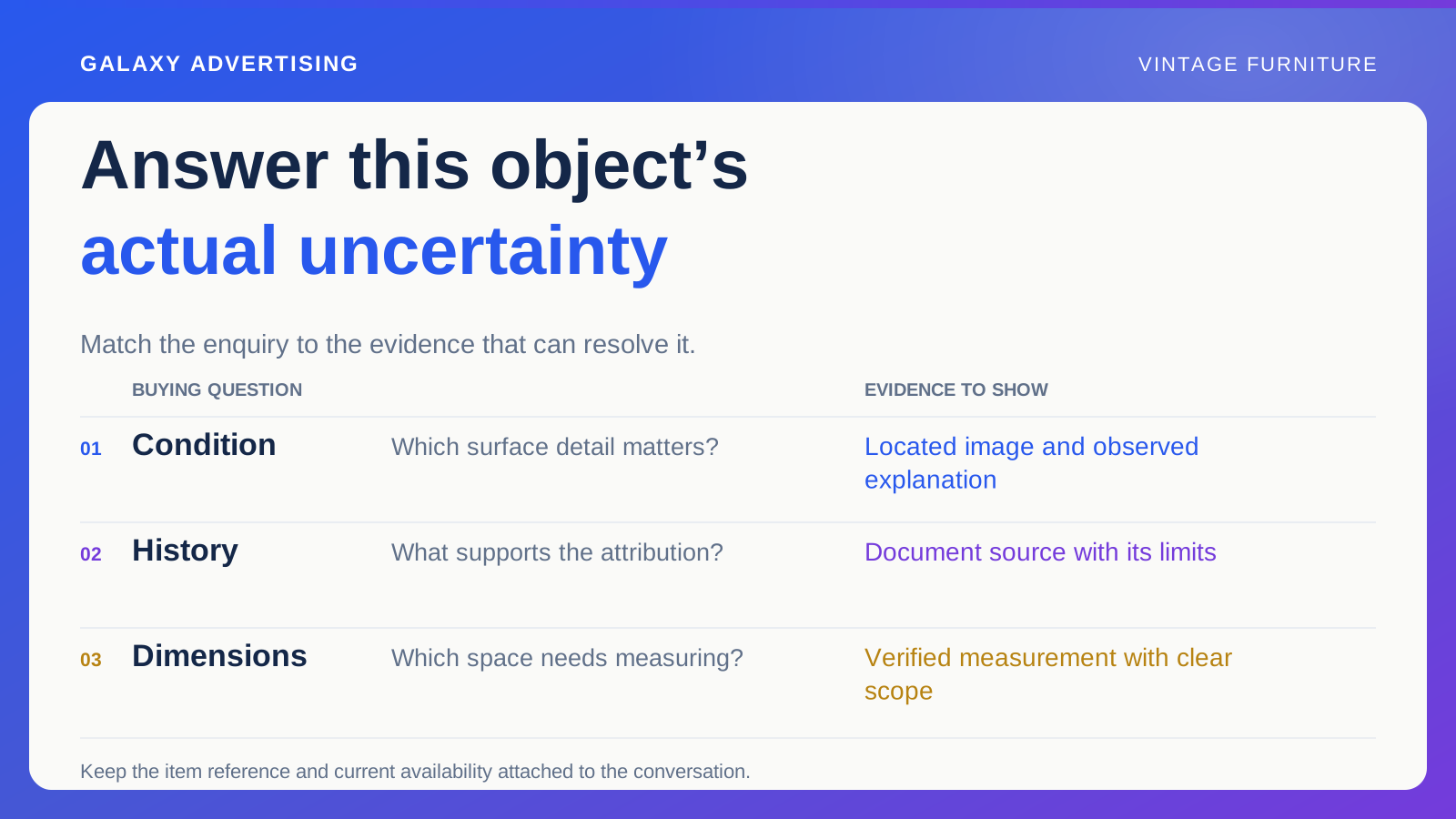
Ask what the customer needs to establish about this particular item. Another photograph might be needed to judge surface condition, scale or a detail hidden in the original image. Those aren't interchangeable requests, even if they arrive in similar words.
A cautious question isn't automatically an objection to overcome. It's reasonable for someone to want a clear understanding of an individual object's condition before committing. Your job is to help them judge it accurately, including the details that could affect that judgement.
When the wording is ambiguous, clarify the relevant detail. Sending a large bundle of unrelated images can create work without answering anything. A precise follow up question can save effort and stop you solving an uncertainty the customer didn't actually have.
Keep the right object attached to the conversation
Use a stable item reference and retain the listing or image context. Similar pieces may arrive over time, with materially different condition, dimensions and history. A previous answer about a similar cabinet isn't necessarily an answer about this one.
If contact began through an advert, establish which item it showed. “The walnut cabinet” can mean several things when you have more than one example, or when the advertised piece has already sold. Get the identity right before the conversation develops.
Make availability clear at that stage too. If the piece is reserved or unavailable, explain its actual status and the options you can responsibly offer. Don't continue discussing an individual purchase as though it remains available when it doesn't. Customers need that context before investing more time.
Show the evidence for condition
Provide a useful view of the relevant area and explain what you can actually observe. Locate the mark or alteration clearly enough that the customer can connect your words with the object. A photograph and explanation should help each other.
Don't use a flattering room image as a substitute for a condition record. It can help someone imagine the piece in use while concealing the precise detail deciding whether they're comfortable buying. Those images do different jobs. Both may be needed.
If existing records don't allow you to assess the detail, say what further inspection is required. Keep that specific uncertainty visible rather than replacing it with a broad reassurance about excellent condition. The purchase concerns this object, not the average quality of your stock.
Keep documented history distinct from interpretation
Check which parts of the description are documented and which are informed interpretation. A stylistic resemblance or approximate period description mustn't quietly become a verified maker attribution during a sales conversation. A warmer conversation doesn't strengthen the evidence.
Where you have reliable documentation, provide the source. If it supports only a limited statement, keep the limitation in your answer. Delivering an answer confidently cannot add certainty to the underlying record, however keen the customer seems.
This can change the buying decision. Some people mainly want the form and practical function. Others place weight on a particular attribution. You need to understand which question you can answer and which remains unresolved, rather than treating all interest as the same.
Measure what the customer needs to decide
Confirm the measurement required and what it describes. Overall width, depth and internal space answer different questions. A concise listing may reasonably omit some detail, but the follow up answer still needs to match the customer's intended use.
For a hypothetical cabinet enquiry, someone may need to know whether a particular object will fit inside. They aren't necessarily asking whether the cabinet fits against a wall. Sending the overall dimensions alone leaves their practical question unanswered.
After verifying an additional measurement, attach it to the item record. Distinguish a measured fact from an approximate estimate. Otherwise future staff and customers may repeat the same inspection because the useful answer stayed in one private conversation. That is avoidable work.
Explain the next step you actually offer
Once the item question is answered, make the purchase route understandable. Perhaps you offer an inspection, a defined reservation process or another appropriate next step. Your response should reflect the arrangements available, rather than a convenient promise made to keep interest alive.
Don't improvise a holding promise. If reservation has conditions, explain the current process and identify who confirms it. More than one customer may be considering the same unique piece. Unclear status becomes particularly costly when conversations run alongside each other.
Keep delivery advice tied to the object too. A substantial cabinet can need different service from a small table. Refer to the verified arrangement rather than assuming a general delivery promise covers every piece. The answer should remain accurate through the purchase.
Improve the process without making every answer the same
Review recurring question types across your stock. Repeated requests for internal measurements or restoration details may reveal a gap in listing preparation. You can learn from that pattern while keeping each answer specific to its item.
Use it to improve inspection and photography. Don't replace the individual record with boilerplate that claims to answer every condition question. Efficiency comes from asking the right questions consistently. It doesn't require pretending every piece has the same answer.
A good enquiry can help a suitable customer decide, and strengthen your record of the object. It can also establish that this piece isn't right for them. That's a useful judgement to preserve. A sale pushed beyond what the evidence can responsibly support is a poor substitute for helping someone understand what they're buying.