We can get carried away approving a gorgeous room scene before checking whether the sofa in it still exists as an offer. Warm lighting and convincing proportions are persuasive. Less welcome are the extra module, changed feet and side table that suddenly seems included in the package.
That's how a scene can look convincing while quietly redesigning the furniture. A better brief separates the actual product from the creative freedom around it. Your visual team can create atmosphere, and your approver has a dependable standard for identity, configuration and what the customer is buying.
Be precise about the product that stays fixed
Identify the exact arrangement, finish and included components. Supply approved references showing the relevant proportions and distinctive details clearly enough for production and review. Don't leave the team to infer the product from a general impression of the range.
Resolve conflicting references before work becomes polished. A prototype, another finish and a different arrangement can each look attractive while describing separate offers. Asking the creative team to assemble them leaves uncertainty inside the image's central promise.
Keep product and destination references together. The person making the scene needs to know which version the customer meets after clicking. Even a faithful representation creates an inaccurate campaign route if the configuration it shows is unavailable at the destination.
Tell the setting what job it has
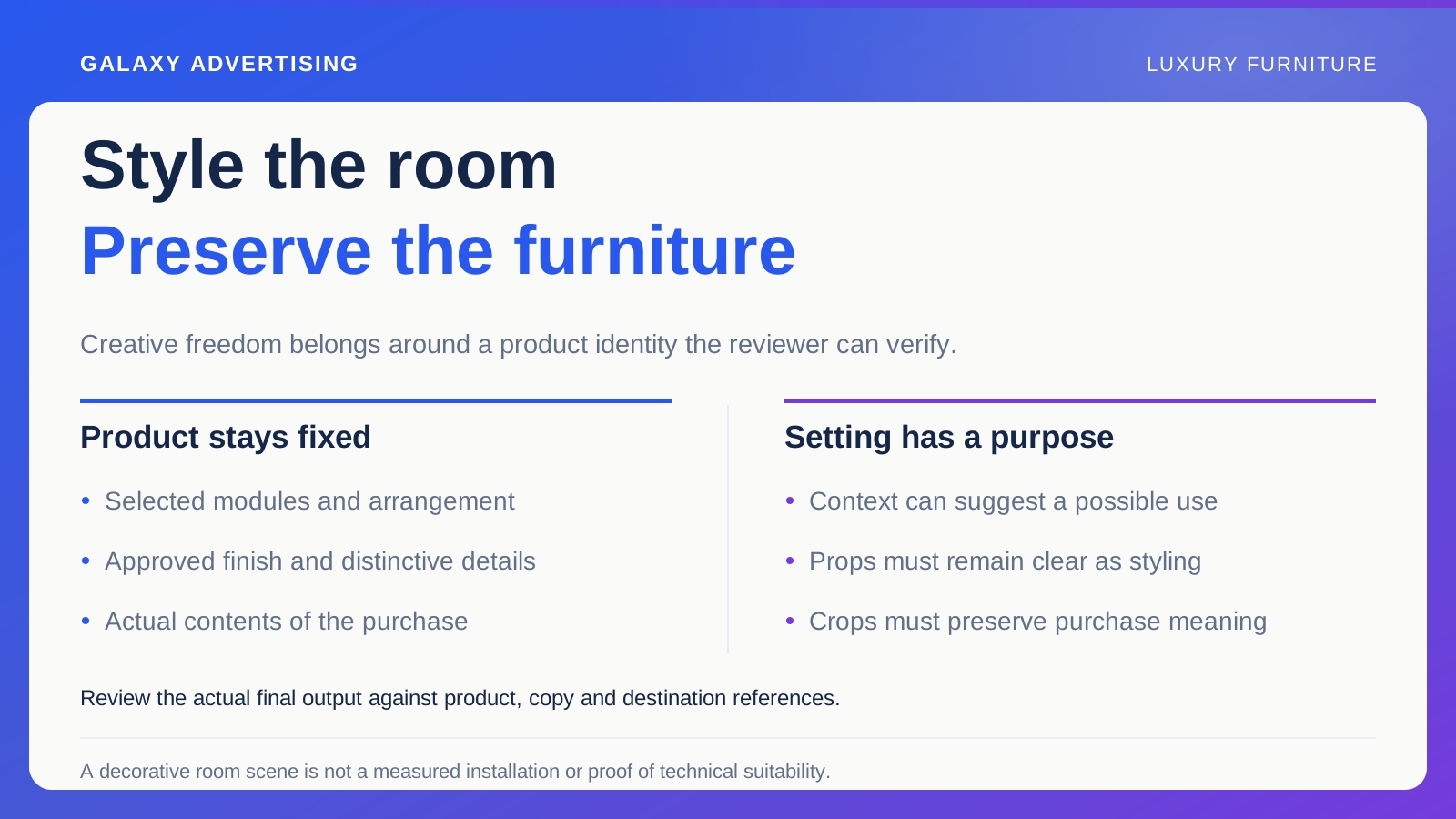
Decide whether the room provides context, illustrates an arrangement or supports a visual identity. It shouldn't become evidence that the furniture fits every similar room or performs a capability absent from the product record. A setting can suggest possibilities without establishing those facts.
Mark which surrounding objects are styling and which belong to the offer. If optional modules or accessories appear, decide how that relationship will remain understandable in the final use. The image needs to preserve what the package actually contains.
Leave room for decorative choices while drawing boundaries around changes that affect the purchase. A different wall colour isn't equivalent to a larger seating arrangement. Product accuracy shouldn't become an argument about every background detail matching a mood board.
Compare the arrangement with the real references
Check visible components against the selected configuration, meaning the chosen arrangement. Count modules where needed and inspect their relationships. A perfectly plausible sofa outline can still depict something you don't sell. General plausibility isn't the same check as product identity.
Use verified dimensions to identify questions needing closer review, without treating a decorative scene as a precise measured installation. If a diagram is intended to communicate measurements, give it separate status as an information asset and verify it accordingly.
Ask the product owner which distinctive details are easily missed. Feet, arms, seams and controls may separate one model from another. Specific references turn “it looks slightly wrong” into feedback the production team can act on.
Keep the surface true to the finish
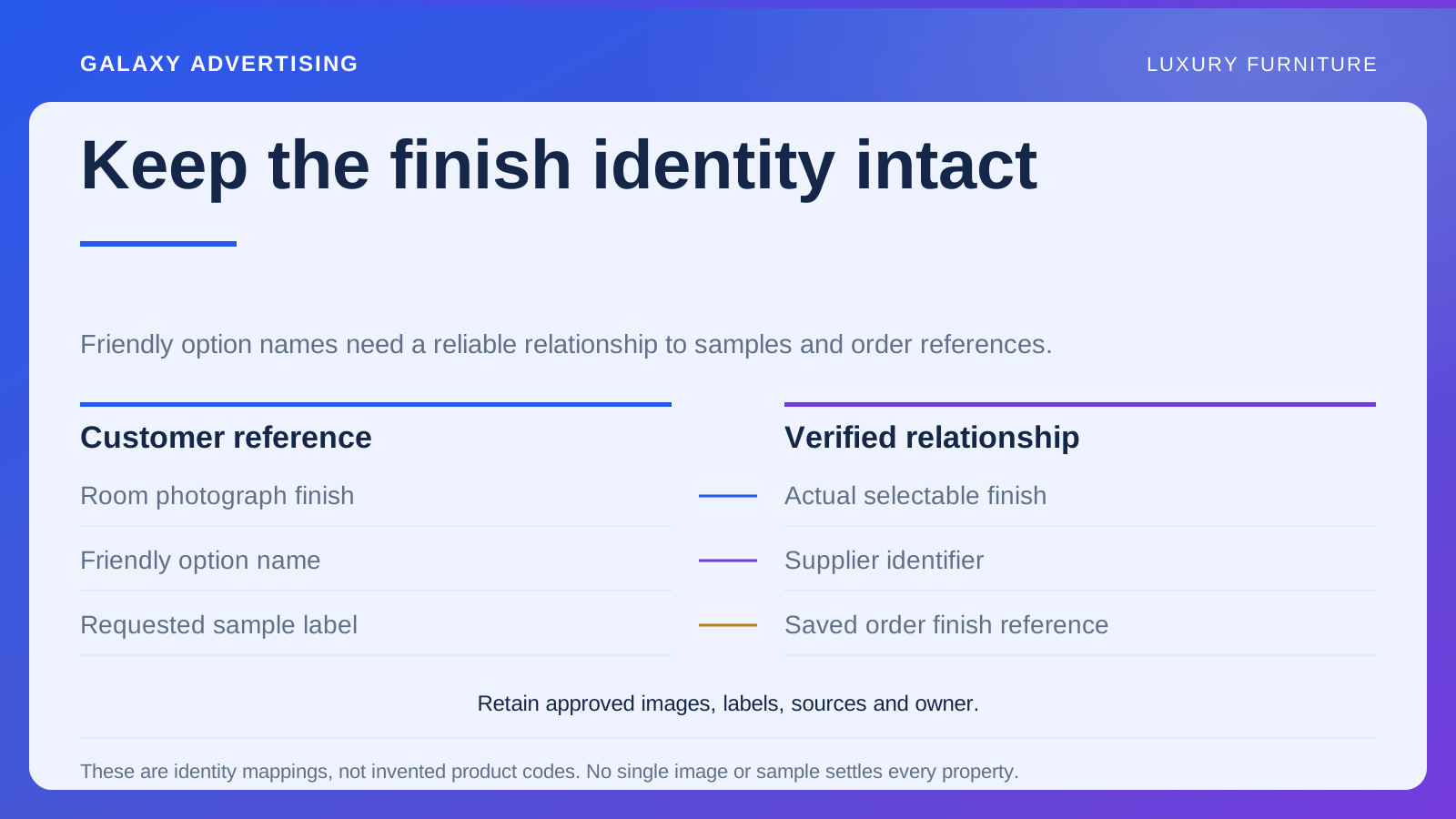
Base appearance checks on approved finish references. If photographs conflict, get a decision from the responsible product source. Choosing whichever version looks most luxurious substitutes an aesthetic preference for the factual reference the image needs.
Don't edit away a characteristic the customer would receive or add a finish effect the actual option doesn't have. Make the purchase attractive while preserving its identity. Styling should help the real finish, rather than quietly improve it into another material proposition.
Keep relevant screen presentation limitations understandable in the buying route. A room scene can introduce a finish; other references and documented information help someone investigate it. One dramatic photograph shouldn't silently carry responsibility for every material judgement the customer needs to make.
Look closely at generated and altered areas
When visual tools create supporting scenes, compare the result with the approved product references. Preserving the main outline doesn't prove every part of the image remains accurate. Inspect what has been created around and within that outline.
Check where product and setting connect. An object can gain a component, lose a detail or appear supported implausibly. The responsible reviewer needs to judge whether that changes the offer or undermines the representation's credibility, rather than treating it as harmless decoration by default.
If a correction concerns one area, inspect the whole revised image afterwards. A local repair can introduce another inconsistency or leave a second version of the detail unchanged. You're approving the final scene, not the fact that somebody completed the requested edit.
Check every crop still tells the same product story
Plan the intended placements and phone presentation. Cropping can remove the component that identifies an arrangement or make an optional accessory appear central to the package. Format changes can alter purchase meaning even when nobody sets out to change the product.
Keep essential labels and the relationship with the price understandable in each use. If the visible composition changes materially, the same source image may need different supporting copy. An approved master doesn't settle every later presentation decision.
Review actual outputs, rather than only the large original. A successful adaptation preserves the product argument and what the purchase means, alongside fitting the required dimensions. This prevents ordinary format work making the final campaign less accurate after its main review.
Ask one reviewer to inspect the final scene without seeing the mood board. Their job is to identify product, package and factual references. They're checking the offer, rather than rewarding how closely the production team followed an aesthetic preference.
Keep the approval attached to the offer
Retain the accepted version, selected product references, associated copy and destination together. A future editor should be able to establish what was approved and which offer made the scene accurate, without having to reconstruct the original production conversation.
When the product or package changes, identify the dependent scenes. An attractive older image can remain useful as a clearly labelled reference. It shouldn't keep describing a current offer that it no longer represents.
Desire and accuracy can reinforce each other. Your furniture can inhabit a compelling room without borrowing extra modules, altered details or implied services from the production process. The image then gives you a visual story you can use confidently because it still belongs to the real object and the actual purchase.