“Exceptional service” doesn't give a furniture buyer enough information to judge your higher price. If they can't establish what happens after ordering or how you'll help with an unresolved configuration question, the adjective has raised an expectation without explaining the difference.
Imagine two retailers offering a similar model at different prices. The useful comparison isn't who sounds more luxurious. It's the work each actually provides, under the conditions that apply to this purchase. Describe that clearly and the customer has something to assess, while your operations team has a promise it can verify.
Start with what your team actually does
List the specific tasks included in the offer. Depending on your business, they might cover product guidance, sample handling or a documented delivery arrangement. Use the service you genuinely provide, rather than the one a premium brand ought to sound as though it provides.
Separate included work from optional services and help requiring an individual agreement. Describing a complete solution can confuse customers if important parts are only available under separate conditions. The wording needs to reflect those distinctions before expectations become established.
Use your operating records as the reference. A writer shouldn't infer a stronger service from your positioning or a lovely showroom experience. Describe what applies to this customer and selected product, rather than the best service somebody remembers giving once.
Explain which buying question the work helps answer
Connect the service to a practical decision. A clear configuration conversation might help someone identify the relevant arrangement. A verified delivery explanation might help them understand what still needs checking about their property. Those are assessable benefits, rather than atmospheric reassurance.
Keep the consequence proportionate. Product guidance can make options clearer without guaranteeing suitability for every home. Delivery can have defined contents without becoming an unconditional promise for every location. The useful work doesn't need exaggeration to deserve an explanation.
For a hypothetical dining furniture purchase, a clear account of the package and available service might matter more than a broad reassurance about care. Make the work understandable. A premium tone cannot communicate the specific contents automatically.
Put the conditions where the decision happens
If a service applies only to particular products, areas or circumstances, explain that alongside the benefit. The condition shouldn't arrive only after the customer has formed a materially different expectation. Timing matters to whether the promise is understood accurately.
Qualification isn't the enemy of persuasion. A clear boundary helps a suitable buyer assess the offer and can stop an unsuitable purchase progressing on a misunderstanding. It gives both sides a more dependable basis for the conversation.
Where an individual answer is needed, explain how to obtain it. What information should the customer provide, who will confirm the position and what is still unresolved? A broad promise based on unchecked assumptions doesn't replace that route.
Show the work instead of borrowing a grand setting
Use accurate material that illustrates the service. A documented account of what the delivery team does can be more helpful than generic footage of an impressive home. The latter can imply a service level unrelated to the actual offer, however attractive it looks.
A customer account can illustrate that person's experience, within its proper scope. An unusually prompt order doesn't establish a universal service time. A favourable testimonial doesn't replace your verified conditions. Keep the evidence doing the job it can genuinely support.
Review the overall impression of imagery and words with the service owner. A scene showing additional tasks can broaden the apparent package even when its caption is cautious. Customers respond to what the whole presentation implies, rather than reading each element in isolation.
Compare the complete offers fairly
If you're explaining a price difference, establish whether product, configuration and service contents are actually comparable. A lower product price paired with a different fulfilment arrangement describes a different complete offer. Make the comparison intelligible before arguing for its value.
Don't turn every difference into superiority. Someone may prefer a simpler service at a lower total cost. Someone else may value the additional work. Your job is to help them understand the choice, rather than insist that the more elaborate package suits everyone.
Avoid unsupported claims about every competitor. Explain your verified service without pretending you've audited the entire market. A specific proposition is usually more credible than announcing that nobody else offers comparable care when you cannot substantiate that claim.
Give everyone the same usable promise
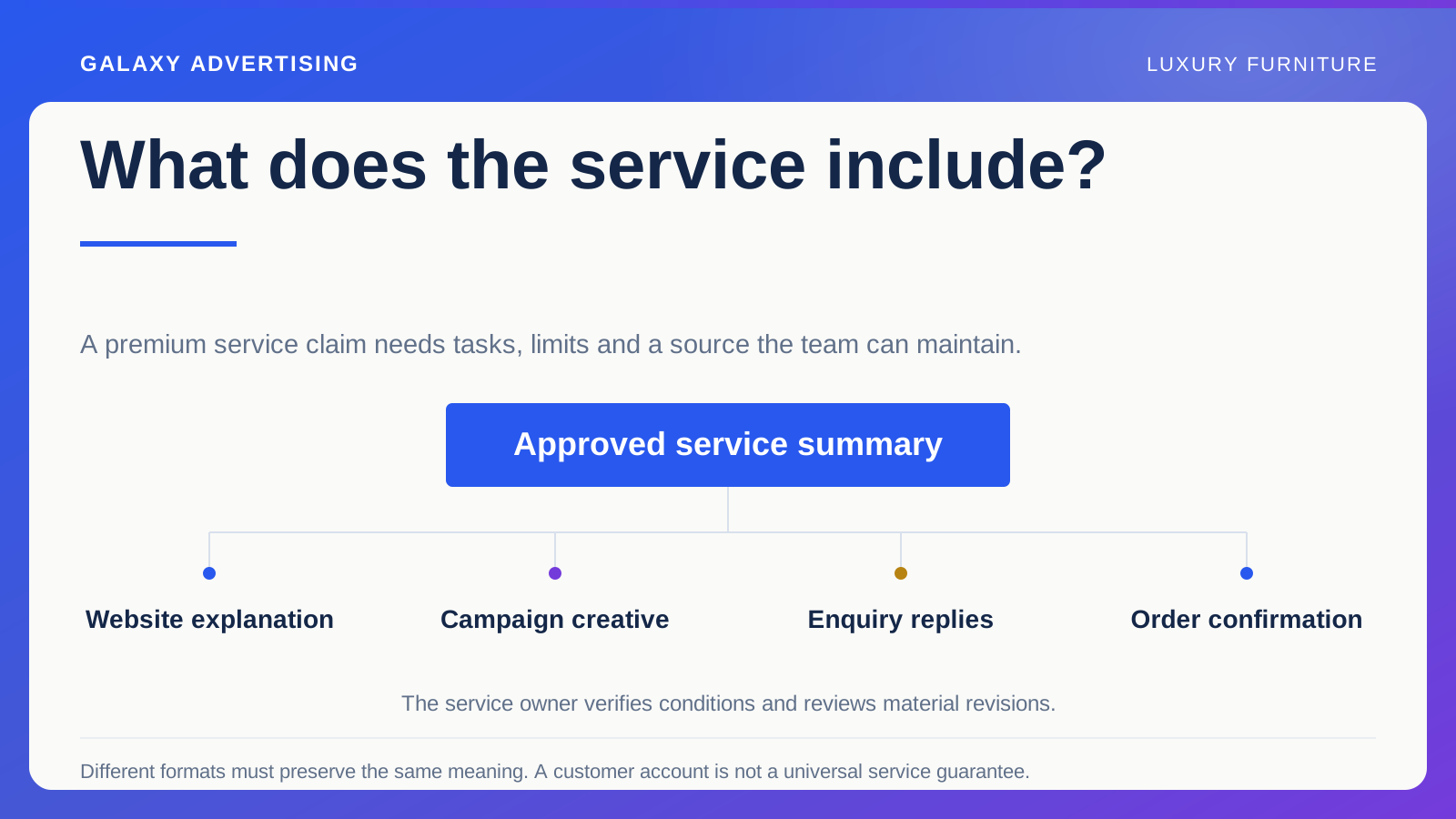
Create an approved service summary with its source and responsible owner. Its essential meaning should survive across the website, creative, enquiry replies and order confirmation. Different formats needn't become different promises about the same purchase.
Check shortened versions carefully. Concise wording is useful until it removes the condition that made the promise accurate. Keep a route back to the full operating information for the people maintaining the copy, so compression doesn't silently widen the offer.
When the service changes, identify and update the affected material. A current policy page won't automatically fix an old advert or saved response. Premium positioning depends partly on these ordinary handovers being reliable, alongside the quality of the main brand presentation.
Keep the service owner involved in revisions. Even an apparently small headline change can broaden what a customer reasonably expects, and the person delivering the promise needs to see that implication before it reaches the buying route.
Check whether the difference is understood
Ask someone unfamiliar with the offer to describe what is included, what remains conditional and why it might matter to the purchase. If all they can repeat is an adjective, the explanation still has work to do.
Use real enquiries to find recurring ambiguity. A repeated question about whether an optional task is included may reveal a gap in the explanation, rather than inattentive customers. Correct the relevant wording and check the route again.
Service earns commercial value when a buyer can see the work, assess its relevance and rely on the promise. You don't have to imply every customer needs the fullest package. You need a clear account of what you'll do for this purchase, backed by the process that makes it real.