 Meta Ads
Twenty ranked assets and three green labels can still leave production without a useful brief. The leading adverts have strong attributed returns. But which buying question did they answer, did they get comparable delivery, and what should the next work demonstrate?
Asking for more winners sounds decisive. It leaves the producer to supply the missing explanation.
A useful creative report makes the next investment clearer. Performance evidence belongs there, alongside the proposition, context and limits of the comparison. Filenames and ratios need interpretation before they can guide another round of work.
Put each file beside its buying argument
Identify the main reason to buy behind each concept. A product action demonstration, configuration explanation and customer account can offer different kinds of evidence, even when they promote the same range. Name what each is trying to help the customer understand.
Keep execution variants connected to their concept. A new crop or opening caption can matter operationally without creating another strategic idea. Grouping shows whether you've explored different arguments or mostly refined the presentation of one.
Use stable references linked to the actual files. The blue one stops being a reliable description when several versions exist. A reviewer should be able to inspect the represented product, caption and destination without reconstructing conversations from the production process. The report needs to make that connection easy to follow.
Show how much opportunity each asset had
Include relevant spend and delivery context beside the outcomes. Comparing total purchases alone won't explain a concept with substantial investment against one that barely appeared. The opportunity to produce the result belongs in the reading of it.
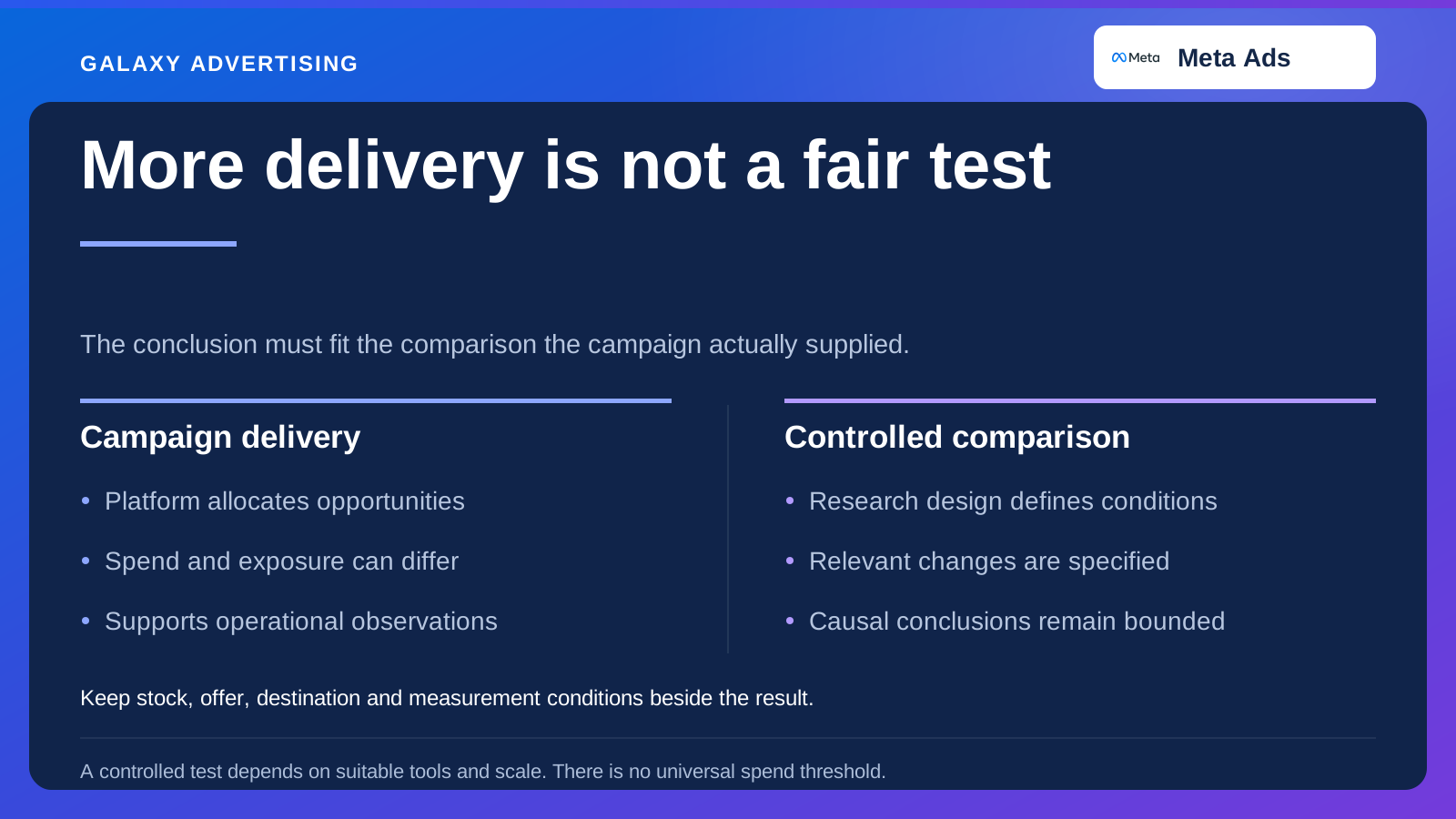
Say whether the evidence comes from ordinary campaign allocation or a suitable controlled comparison. Launching assets at the same time doesn't automatically create a fair experiment. The report should make that distinction visible before it declares a winner.
Don't hide uncertainty behind a colour. If the evidence doesn't support a useful conclusion, explain the limitation and whether further investigation is worth paying for. An honest unresolved category tells you more than a confident verdict assigned to every row just to make the table look finished.
Connect the result to what was actually offered
Record meaningful changes in price, stock, configuration and service. An unavailable product or materially changed destination affects how you interpret the creative result. Those facts aren't separate background detail when they change what somebody could buy.
Check whether the compared assets represented equivalent offers. If one included a promotion or different package, describe the combined proposition. You cannot attribute the entire difference to video style when the offer changed as well.
Include the relevant commercial basis. Higher revenue can still mean a less useful product mix after costs. Production decisions shouldn't reward an attractive headline while overlooking whether the resulting orders were worthwhile for your business. The report should connect the appeal of the asset with the value of the business it attracts.
Use attention to explain, rather than change, the task
Available attention observations can help investigate communication. They might suggest an unclear opening, a demonstration that earns interest or a situation viewers recognise. Those observations can sharpen a question about what the asset is doing.
Keep them distinct from purchase and contribution evidence. Contribution is the money remaining after the costs included in your calculation. An engaging video doesn't automatically establish a valuable acquisition route. Disappointing purchase evidence doesn't become a success because the report switches to views afterwards.
Where evidence is mixed, write down the question it creates. A clear demonstration with relevant product exploration but little order evidence might justify inspecting the destination or a bounded continuation. Explain why that next step is proportionate. Don't turn a useful diagnostic observation into a declaration of complete commercial success.
Keep customer observations specific and proportionate
Summarise useful enquiries, recurring misunderstandings and relevant comments. Use specific examples and remove unnecessary customer information from the general report. The observation needs to remain useful without sharing detail the discussion doesn't require.
A few comments can expose a question worth answering. They don't establish that everybody has the same hesitation. Selecting only praise to decorate an unsupported conclusion is no more useful. Give qualitative evidence its proper weight.
Connect each observation to a possible production or merchandising action. If viewers repeatedly misunderstand whether an accessory is included, the next brief might need clearer package evidence. Identify that communication task rather than simply requesting more reassuring content. Somebody should be able to tell what needs to become clearer.
Write the next brief into the recommendation
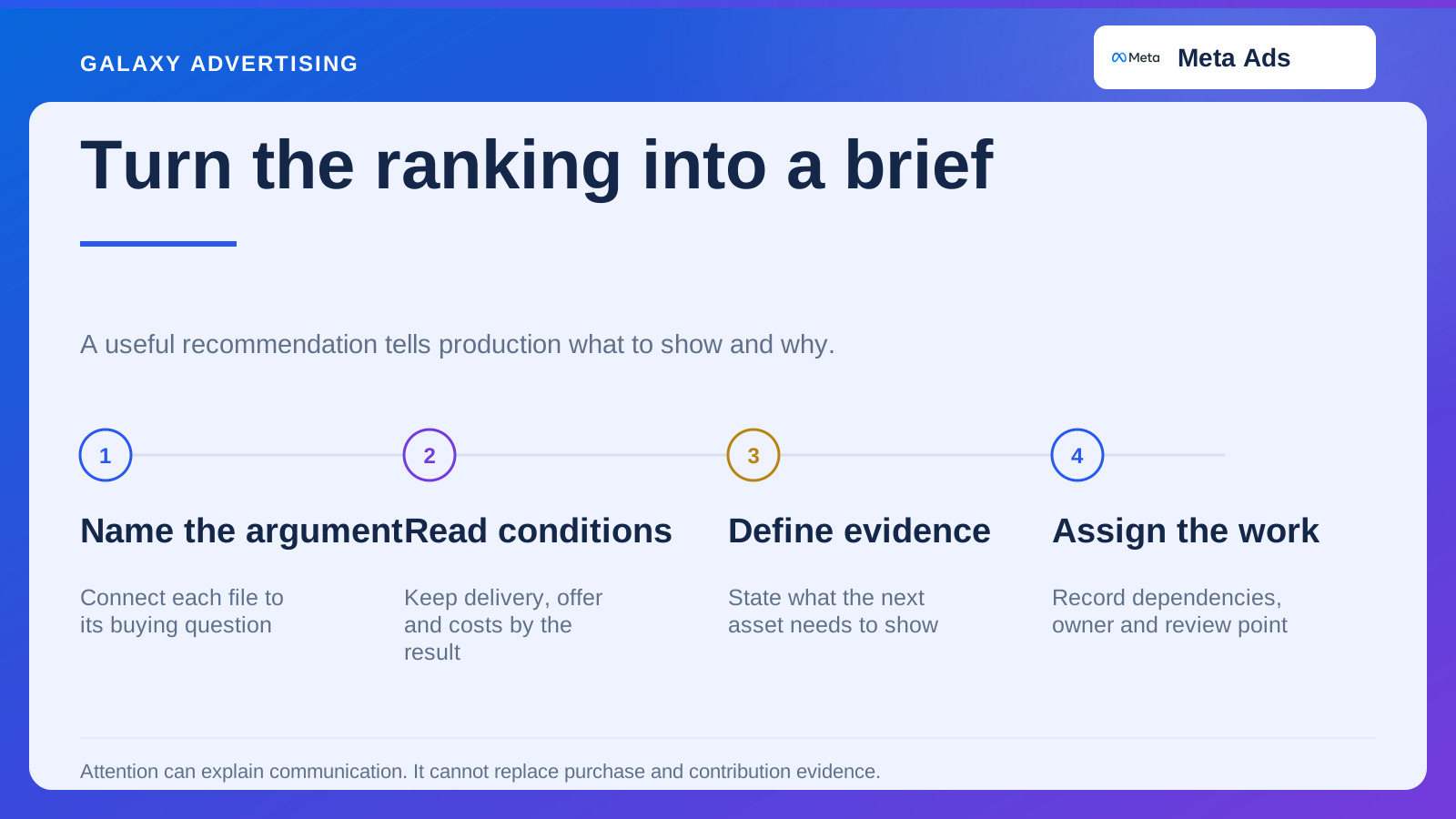
For each recommended concept, state the customer question, evidence to show and product or configuration involved. Identify references, permissions and operational facts that need obtaining before production. That turns analysis into a task somebody can prepare accurately.
Distinguish refinement from a new hypothesis. Making an existing mechanism easier to see differs from investigating another reason to consider the product. Both may be worthwhile, but another variation is too ambiguous an instruction to cover them.
Assign an owner and review point. The task should help somebody prepare the right evidence, approve the proposition and deliver a version identifiable in later analysis. Without that connection, the recommendation can sound useful while remaining difficult to execute.
Let the producer respond before approving the next round. They may need a sample, another location or a product specialist, rather than another edit of existing footage. Record that dependency in the brief and budget. A report can correctly identify the missing explanation while underestimating the work needed to show it accurately. The people delivering it must understand and be able to fulfil the evidential task.
Check that the learning reaches the next work
Keep a compact record of each material concept's question, observations, decision and limitations. That preserves continuity when people change or an older asset becomes relevant again. The reasoning should remain attached to the work.
Then check that the next production round uses it. If reporting repeatedly identifies a missing scale demonstration while new assets show only room atmosphere, the problem is implementation rather than insufficient analysis.
The report proves its usefulness in the next brief: less guessing about what to show, why it matters and how it will be judged. A polished leaderboard describes past results. A useful production recommendation gives your next investment a specific purpose.