A watched video is not proof of an additional sale. Strong viewing activity and several later orders in a campaign report can look persuasive, but they do not automatically make the asset a proven revenue generator.
Another video could have fewer recorded views while supporting detailed enquiries from suitable customers. A simple ranking makes the first look unambiguously better, even though the evidence describes different parts of the route.
Keep four questions distinct. Attention concerns encountering or continuing to watch. Referrals concern what happens after an identifiable transition. Attribution assigns outcomes under reporting rules. Additional sales concern what would otherwise have happened. They relate to one another, but they cannot stand in for one another.
Find out what a view actually measures
Ask your account team which viewing measure the platform provides and how it is defined. Similar names do not guarantee equivalent actions across services or formats. Establish what you are looking at before interpreting the comparison.
Use attention evidence to investigate the communication. A change around a particular moment could warrant inspecting the sequence. It will not reveal every person's reason for staying or leaving.
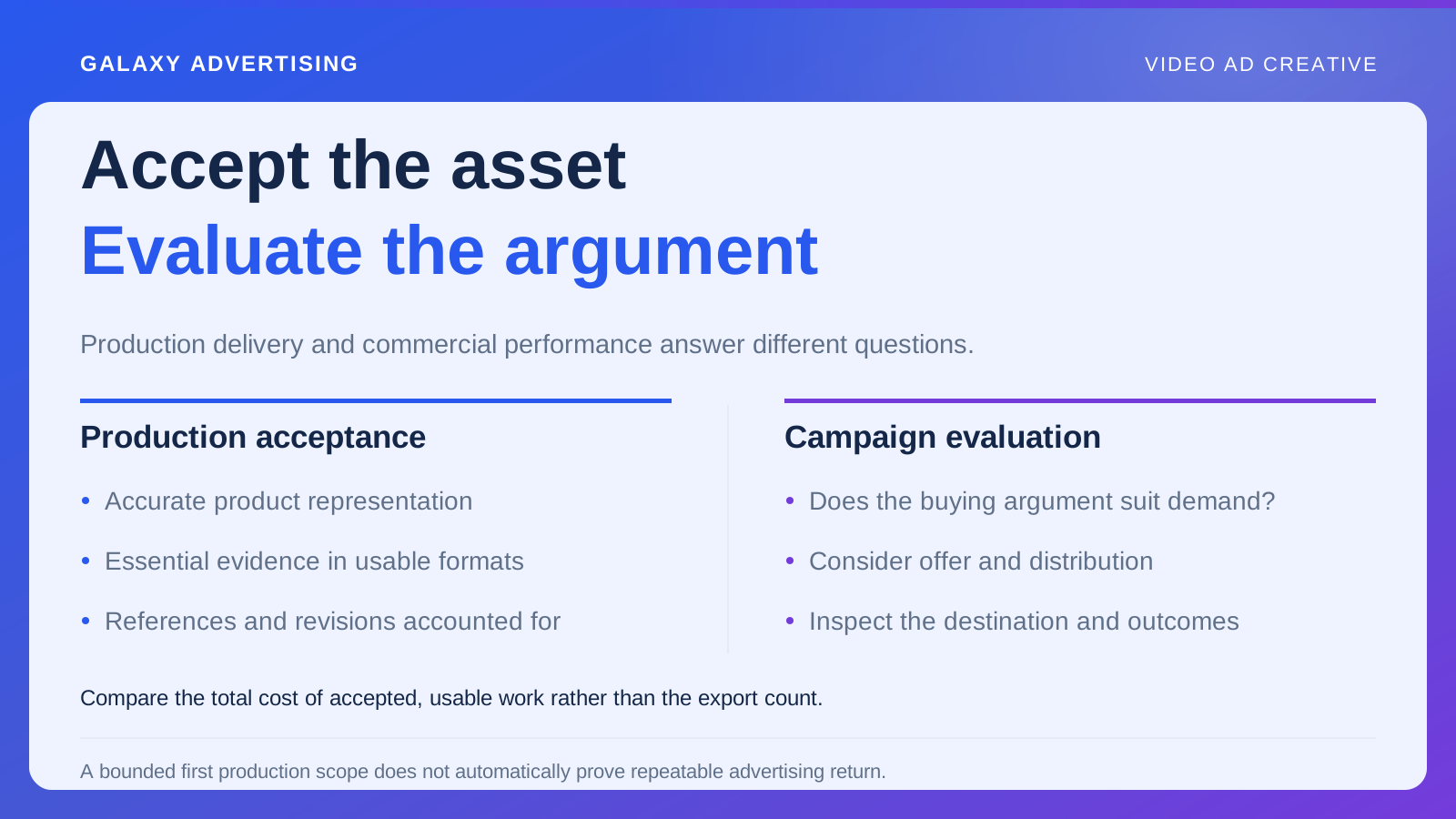
A completed view does not prove understanding or suitability. Someone can watch for reasons unrelated to buying. You still need factual and comprehension reviews, plus commercially relevant observations, before deciding which further production deserves funding.
Follow the transitions you can identify
Where your setup recognises referrals, inspect the destination and relevant product actions. Establish what is recorded reliably and where uncertainty remains before drawing conclusions about the route.
A click can express interest without settling the purchase decision. People may want dimensions, another configuration or clarification of the package. What the destination can answer affects what their subsequent behaviour tells you.
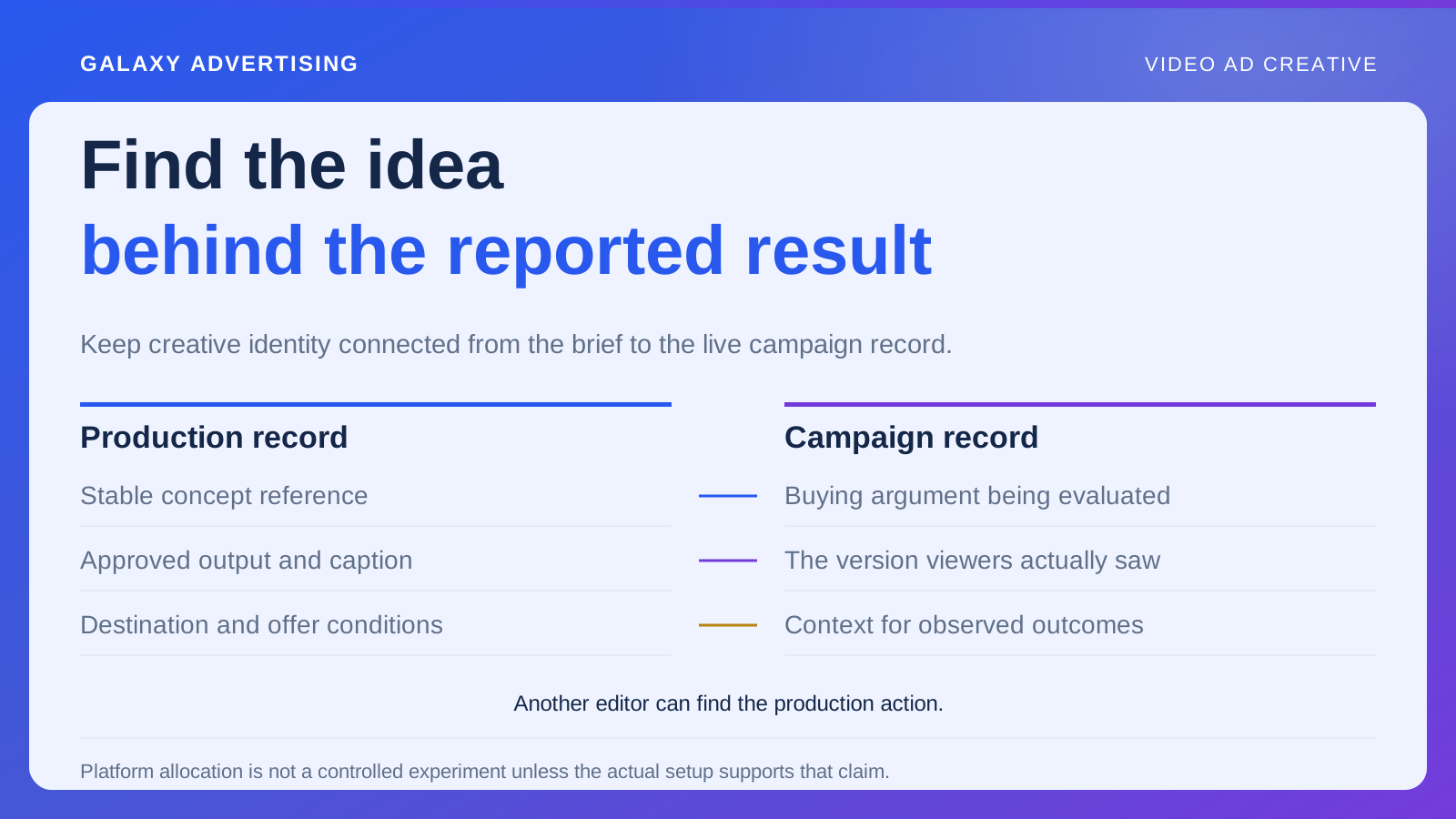
Keep the version and destination together in the record. If the page changes during a comparison, a different result could concern the route as well as the video. Preserve that context rather than presenting creative as the only possible influence. Your report should describe the experience that actually existed.
Know why the report gives the video revenue
Ask which interactions and reporting rules cause an order to be associated with the asset or campaign. Verify the current account configuration. Assumptions copied from an old presentation or another service may not describe this setup.
Attributed revenue can help manage activity. It is not automatically a count of orders caused solely by the video. Customers may encounter several sources, already know the retailer or return through another route before ordering.
Do not add attributed totals from different systems as though each represents separate sales. Connect the discussion to actual order records and agreed business definitions. Explain differences rather than forcing agreement in a way that conceals how each report allocates outcomes.
Check who had the opportunity to see it
Audience and distribution conditions shape observed results. Familiar customers seeing a product video may produce a different pattern from unfamiliar people encountering the offer for the first time.
Understand those conditions before saying the video alone created the difference. Unequal spend, product availability and campaign allocation can also change what the comparison permits you to conclude. The assets may not have had equivalent opportunities.
Ordinary campaign evidence still has a use. Match the recommendation to the observation's strength. A promising association could justify another bounded test without establishing that the same video will produce equivalent results in every setting.
Use stronger evidence for a bigger decision
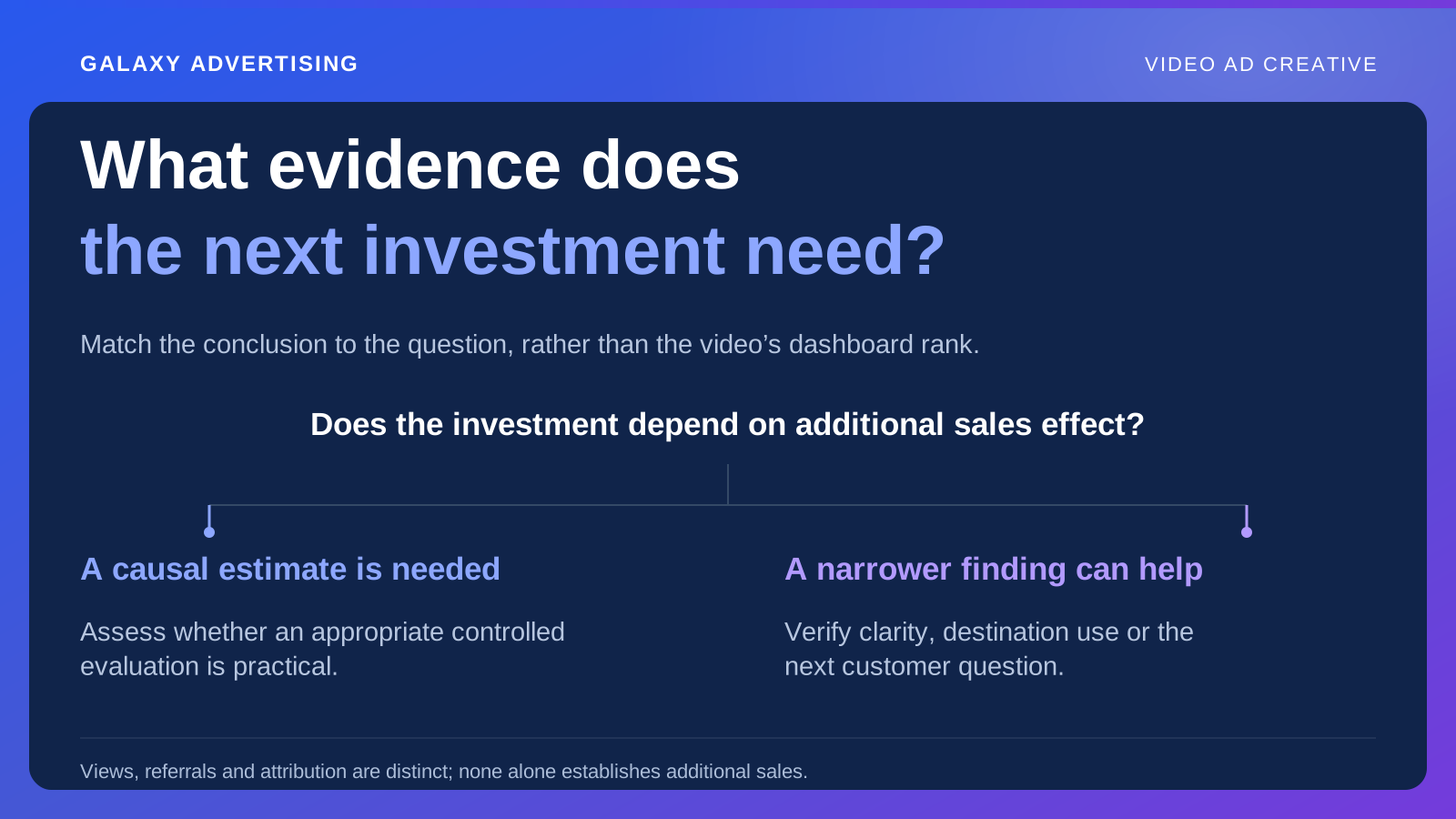
If an investment depends on estimating additional commercial effect, ask whether an appropriate controlled evaluation is practical. The responsible team should assess design, available volume, measurement and the consequences of uncertainty.
Do not invent one test duration or budget for every situation. A considered purchase, sparse order history and changing offer can alter the evidence needed. Put those conditions into the plan before becoming attached to an apparent result.
If an isolated estimate is impractical, narrow the conclusion. Perhaps you can establish that the video accurately explains a documented feature, that customers use the destination, or that enquiries reveal another question. Those findings can support action without settling causality.
Look at the money behind the orders
Review product mix and relevant contribution assumptions, meaning the money remaining after the costs included in the calculation. Orders for a heavily subsidised configuration can be worth something different from what headline revenue suggests.
Include production cost in the appropriate investment discussion. Its absence from a media report is not a reason to hide it. Distinguish reusable production investment from temporary campaign expense and explain your assumptions.
Keep future reuse uncertainty visible. A library may have practical value, but that is not a precise return guarantee. Retain evidence of actual use and the product conditions that make further use feasible, rather than treating every possible adaptation as a promised financial return.
Keep an individual account in its proper role
A customer might say the video helped them understand a feature. Preserve that as an individual account of usefulness, handling the underlying information appropriately. It could inform the next brief without proving the video caused every associated order.
Do not dismiss it merely because it is not a controlled estimate. Do not inflate it into one either. Different evidence can contribute to a decision when its role stays clear.
Explain what each observation adds. Trying to force them all into one revenue claim makes useful detail harder to interpret, rather than giving the business a stronger answer.
Choose a next step the evidence supports
The next step could be retaining a clear asset, investigating a destination mismatch, comparing another argument or stopping production that no longer has a coherent purpose.
Separate that decision from a sweeping verdict on video as a channel. One asset under one set of conditions cannot answer every future question about product storytelling or paid distribution.
You can value attention, understand recorded routes and assess commercial outcomes without asking any single measure to prove everything. The next production decision deserves that firmer basis, rather than a confident revenue claim attached to whichever video happens to top the dashboard.