Where does your customer go after your video has explained the compact dining arrangement? If the answer is a broad collection of sizes, configurations and styles, they may have to rebuild the explanation for themselves.
The product could be somewhere on that page. But the identity and practical point you just made are no longer easy to follow, and the customer is back to searching.
Plan the destination while writing the concept. It is part of the creative route, preserving useful context and supplying the next information needed for a suitable decision. A polished story needs somewhere coherent for its buying question to go.
What question comes after the video?
Describe what the viewer should understand from the asset and what they still need to establish. A scale demonstration could lead to precise dimensions. A configuration explanation could lead to comparing available options.
A click does not prove readiness to order. It may be a reason to investigate. Make that investigation useful instead of demanding commitment before essential facts are clear. That distinction helps you choose what the destination must provide.
Tie the next question to the actual offer. “Discover the brand” gives little guidance about the page or product state required. A specific brief says which information should be immediately recognisable when somebody moves from the video to the website.
Keep the same product recognisable
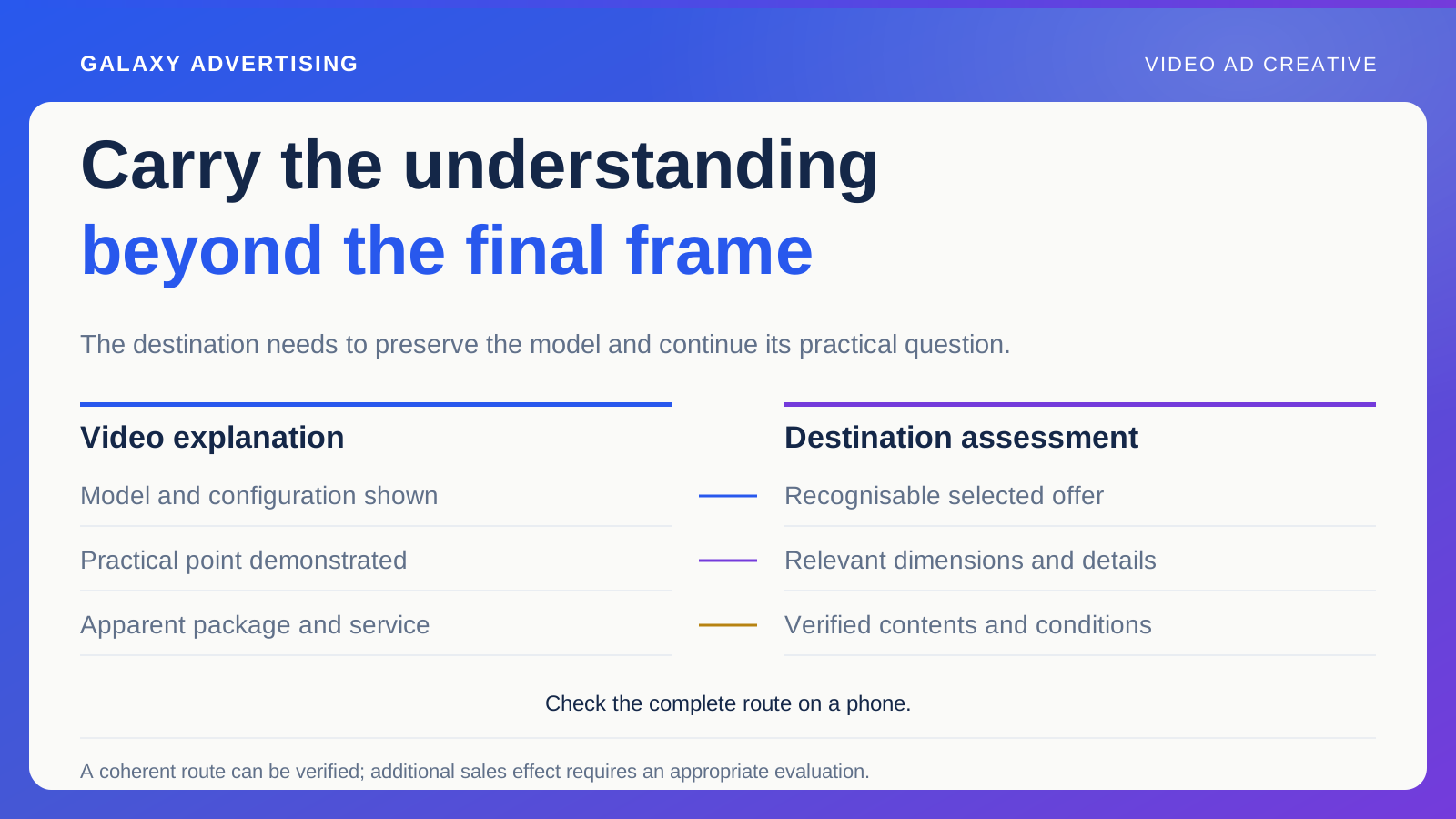
When the video introduces an exact model, check that its link makes the model and configuration easy to identify. A technically correct product URL can still open on a different finish or package.
Compare the dominant video image with the opening page state. People should not have to work out whether the new photograph shows another version or just another angle of the same item. Your familiarity with the catalogue does not settle that question for them.
Use stable references in both the asset record and product page. Production, account management and customer service can then discuss the same offer. Later destination changes also become easier to review without relying solely on visual resemblance.
Supply what the short video could not
Give people a clear route to the details needed to assess the video's point. For a compact arrangement, dimensions and relevant layout information could matter more than a lengthy general brand introduction.
The page need not replay every scene. It should supply facts the short asset could not reasonably contain, using consistent product names and accurate descriptions so the transition makes sense.
If the next question needs manufacturer instructions or specialist information, send people to the appropriate verified source. Do not improvise technical guidance on a marketing page merely to make the story appear seamless. You can preserve clarity while acknowledging where authoritative detail belongs.
Make the package and service clear
Identify what is included, optional or simply there for styling. A complete room in the video can create a powerful package impression even when the quoted price concerns one item.
Check delivery, assembly and other relevant service information for the product shown. A general website message may not apply in the same way to every configuration. Establish what applies rather than relying on the familiar wording.
Give customers practical facts with which to challenge the proposition. Limits are part of a useful buying route. Hiding them to protect the emotional effect of a video postpones the objection until later, when an enquiry or abandonment may be harder to interpret.
Walk the route on a phone
Open the destination on a phone and take the ordinary steps to inspect or select the offer. Check option controls, essential information and anything overlays or sticky elements affect.
Ask a reviewer unfamiliar with the brief to identify the product and explain their next step. Do not let the production team's knowledge fill gaps. A fresh description can reveal the difference between your intended story and the route the page actually provides.
Record the issue precisely. “The finish shown in the video is not identified among these options” gives somebody a clearer correction than a broad request to improve the landing page's conversion rate. You can check whether that specific problem has been resolved.
Connect the teams responsible for changes
Keep the destination and important dependencies with the approved asset. If a page moves, a configuration changes or the offer becomes unavailable, you can identify and review the relevant creative.
Agree ownership of each correction. An editor might change the closing message, merchandising might verify the package, and development might repair an option state. Make those responsibilities visible in the record.
Several owners should not leave a mismatch unresolved. Connect the finding, responsible person and verification condition. Customers encounter one route, regardless of how many internal teams maintain it, and the record needs to help those teams carry a correction through.
Decide what happens when stock changes
Rehearse the demonstrated configuration becoming unavailable. Silently sending people to a similar looking item can leave practical differences unexplained.
Decide whether to pause the video, choose another verified destination or replace it. Keep that decision connected to merchandising. Copy alone should not leave the editor responsible for solving an inventory problem.
This rehearsal recognises that the transition depends on current commercial facts as well as the original page design. A good route needs a response when those facts change, rather than only an approval from the day production finished.
Assess the explanation across the whole route
Review campaign observations beside product exploration, enquiries and orders. If interested viewers ask basic identity questions, inspect the transition before concluding the argument is commercially weak.
Keep interpretation proportionate. You can verify that a route is coherent. Its additional sales effect needs an appropriate evaluation. If both video and page change, record the combined work honestly.
The video establishes a useful point; the destination lets somebody assess it. When that connection holds, the customer carries understanding beyond the final frame instead of starting again. That is where the production investment continues to support the buying decision.